Mobile County Reports Second COVID-19 Death, a 74-Year-Old Man With Underlying Conditions
The Mobile County Health Department confirmed the county's second COVID-19 fatality on April 1, 2020 — a 74-year-old man with underlying health conditions who had been hospitalized with virus symptoms.
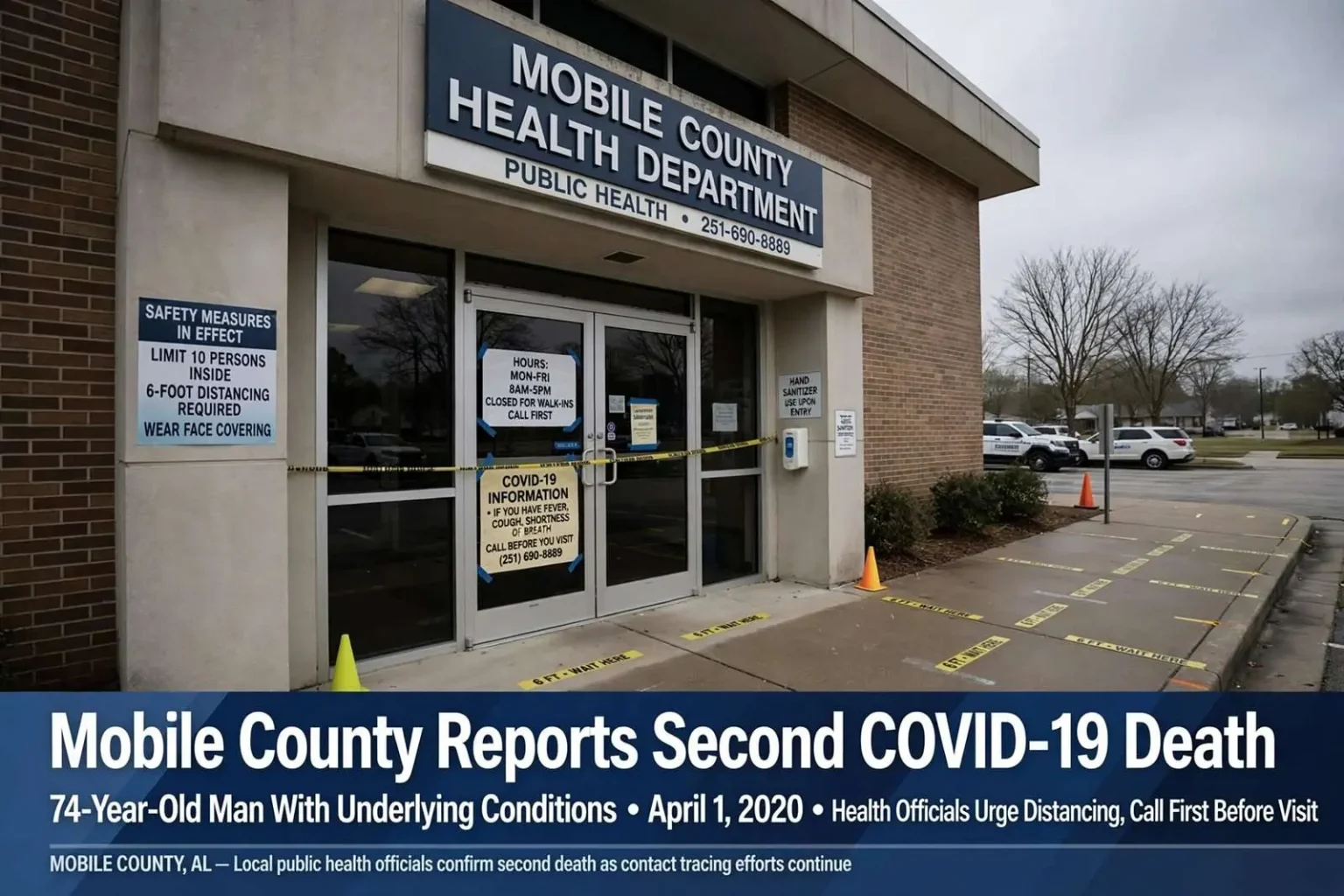
The Mobile County Health Department confirmed on April 1, 2020, that a second Mobile County resident had died after testing positive for COVID-19. The announcement came in the earliest, most uncertain weeks of the pandemic, when each new death was reported individually and public health officials were still working to explain to residents how the virus was spreading through their communities.
The individual was a 74-year-old man with a history of underlying medical conditions who had been hospitalized after presenting with known COVID-19 symptoms. His death followed the county’s first by less than a week, and it fit the pattern health officials were already seeing nationally: older adults with pre-existing conditions faced by far the greatest risk of severe outcomes from the new coronavirus.
Dr. Bernard H. Eichold II, the county’s health officer, addressed the death directly in announcing it. “We are sad to report our second death in Mobile County,” Eichold said. “The patient was a 74-year-old male with known COVID-19 symptoms and had other underlying medical conditions. The Mobile County Health Department team is conducting case contact disease surveillance of individuals who have tested positive for COVID-19.”
The surveillance work Eichold described was the core of the department’s early response. Contact investigation meant identifying people who had been near confirmed cases, checking on their symptoms and asking them to isolate before they could pass the virus onward. In the spring of 2020, before widespread testing was available, that labor-intensive work was one of the few tools local health departments had to slow transmission.
Eichold also used the announcement to reinforce public health guidance for local businesses and residents as the outbreak continued to spread through the community. His message to merchants was concrete and practical. “Merchants should limit the number of customers in their stores and have markings in check-out lanes for 6-foot spacing,” he said. “Everyone should take this (illness) very seriously and keep persons infected in their thoughts and prayers.”
The recommendations to retailers anticipated the changes shoppers would soon see everywhere: taped lines on floors six feet apart, limits on how many customers could enter at once and staff stationed at doors to count arrivals. In April 2020 those measures were still being introduced, and local health officers like Eichold were among the voices pressing businesses to adopt them before state requirements fully took shape.
What Health Officials Knew Then
Health officials noted that most people infected with COVID-19 experience mild respiratory illness, including fever, cough and shortness of breath, though some cases become severe enough to require hospitalization. That framing, repeated in nearly every briefing of the period, was meant to inform without panicking: the majority of infections would pass like a bad flu, but a meaningful minority, concentrated among the elderly and those with chronic conditions, would not.
By the start of April 2020, the national picture had darkened quickly. The United States had recorded its first confirmed case only in late January, and by April 1 the country was reporting thousands of new infections daily and a mounting death toll in New York, Louisiana, Michigan and Washington state. Alabama’s counts were smaller but doubling on a pace that health officers found alarming, and the first weeks of April brought the state’s early deaths, concentrated like Mobile’s among older residents with underlying conditions.
The Mobile County Health Department is one of the oldest local health agencies in the United States, tracing its origins to the 19th century when yellow fever epidemics forced port cities to build organized public health systems. That history meant the department already had the infrastructure, the epidemiologists and the community relationships that the pandemic response would demand, even as its staff faced a pathogen no one had confronted before.
MCHD and the Alabama Department of Public Health urged residents experiencing symptoms to contact their healthcare provider first, so appropriate precautions could be taken before an in-person visit. The guidance was designed to protect both patients and medical staff: an unannounced arrival at a clinic or emergency room risked exposing others, while a phone call allowed providers to arrange testing, masks and isolation before the patient walked in.
Testing capacity remained the binding constraint through those weeks. Shortages of swabs, reagents and laboratory slots meant that in early April most people with symptoms were told to assume they were positive and isolate, with tests reserved for the sickest patients, healthcare workers and those at highest risk. The limited numbers understated the true spread of the virus in the community, a gap officials acknowledged openly at the time.
The health department also renewed calls for residents to follow statewide orders limiting gatherings to fewer than 10 people and maintaining at least six feet of distance from others in public, along with basic precautions such as frequent handwashing. Alabama’s statewide health orders of late March had closed or restricted restaurants, bars, gyms and entertainment venues and discouraged non-essential travel, and local officials kept pressing residents to take the restrictions seriously even as compliance varied.
The Early Days in Mobile County
Mobile County’s outbreak began in mid-March 2020, when the first cases were confirmed in residents who had traveled or been exposed to travelers. Within two weeks the count had grown from single digits to dozens, and the first death was announced in late March. The second death on April 1 confirmed what epidemiologists were warning: community transmission had taken hold, and the numbers would continue to climb as testing expanded.
The county’s demographics shaped its risk. Mobile County is home to more than 400,000 residents, with a population older than the national average in several communities and high rates of the chronic conditions, diabetes, heart disease, lung disease, that make COVID-19 more dangerous. Public health officials in the county and across the Gulf Coast understood that the region’s health profile made the kind of death announced April 1 likely to be repeated unless transmission slowed.
As case counts and, increasingly, deaths mounted across Mobile County in the early days of the pandemic, the department’s daily updates became a fixture of local life. Residents checked the numbers each afternoon, watched for announcements of deaths and tried to gauge from the trends whether the restrictions were working. Each briefing carried the same core advice: stay home when possible, keep distance in public, wash hands frequently and call a doctor before seeking care.
The local medical community mobilized alongside the health department. Hospitals postponed elective procedures to preserve capacity and protective equipment, physician offices shifted to telephone and video visits, and nursing homes, the most vulnerable settings of all, closed to visitors. Those measures, multiplied across the county, aimed to flatten the curve so that serious cases would not overwhelm intensive care units at once.
Eichold, who had served as Mobile County’s health officer for decades, became a steady presence in the local response through the pandemic’s early months. His announcements paired hard data with direct appeals, and the April 1 message was characteristic: grief over the second death, a clear description of the department’s surveillance work and plain instructions to merchants and residents about spacing and seriousness.
The weeks that followed would test the county’s response in ways the April 1 briefing could only foreshadow. Case counts climbed through the spring, the death toll passed the early double digits and the restrictions tightened in some areas even as debate grew about their economic cost. But the announcement of the second death stands as a marker of the moment when the pandemic in Mobile County stopped being an abstraction measured in distant cities and became a local reality, counted one life at a time.
Guidance That Shaped a Year
Much of what officials urged in those early April days, limiting store capacity, marking six-foot spacing, calling before visiting a doctor, staying out of gatherings of more than 10 people, became the standard vocabulary of the pandemic year. The second Mobile County death was reported at the moment those practices were shifting from suggestions to expectations, and the health department’s appeal that day captured the seriousness with which local leaders were beginning to treat the disease that would define the months ahead.
Contact Tracing Under Pressure
The “case contact disease surveillance” Eichold described involved some of the most demanding work of the pandemic’s first spring. Nurses and investigators with the health department called every confirmed patient, mapped their movements and reached out to anyone who had spent close contact time with them, asking those people to quarantine and monitor for symptoms. With testing scarce, the department’s case numbers represented only a fraction of actual infections, which meant the tracers were always working behind the curve of the outbreak.
Local health departments nationwide were performing that work with staff stretched thin. The Mobile County Health Department supplemented its epidemiology team with nurses redeployed from clinic duties and, as the outbreak grew, with volunteers and staff from other agencies. The effort in those early weeks was credited with slowing chains of transmission even as the department acknowledged it could not interview every case once counts began their steep climb.
The 74-year-old man’s death also illustrated the profile that would recur across the county’s pandemic statistics. Older adults, especially those with chronic illnesses, accounted for the overwhelming majority of severe cases and deaths throughout the pandemic, a pattern established in the earliest outbreaks in China and Italy and confirmed repeatedly in Alabama as the state’s numbers grew. Health officers used those figures to press the point that protecting the elderly meant community-wide vigilance, since the virus reached nursing homes and households through younger people who often felt fine.
Mobile’s port city identity added another layer of concern in the early weeks. Communities along the Gulf Coast watched the spread of cases tied to travel, cruise ships and business trips, and local officials urged residents to defer non-essential travel weeks before any formal order barred it. By April 1, the question had shifted from whether the virus would reach Mobile County to how fast it would move through it, and each daily report answered that question with higher numbers.
For the family of the 74-year-old man, the public accounting of his death was one entry in a period of private grief made harsher by pandemic restrictions on hospital visits and funerals. Families across Mobile County were beginning to confront those rules in the spring of 2020, saying goodbye through phones and windows and holding services with far fewer mourners than gatherings of the kind the health orders now discouraged.