
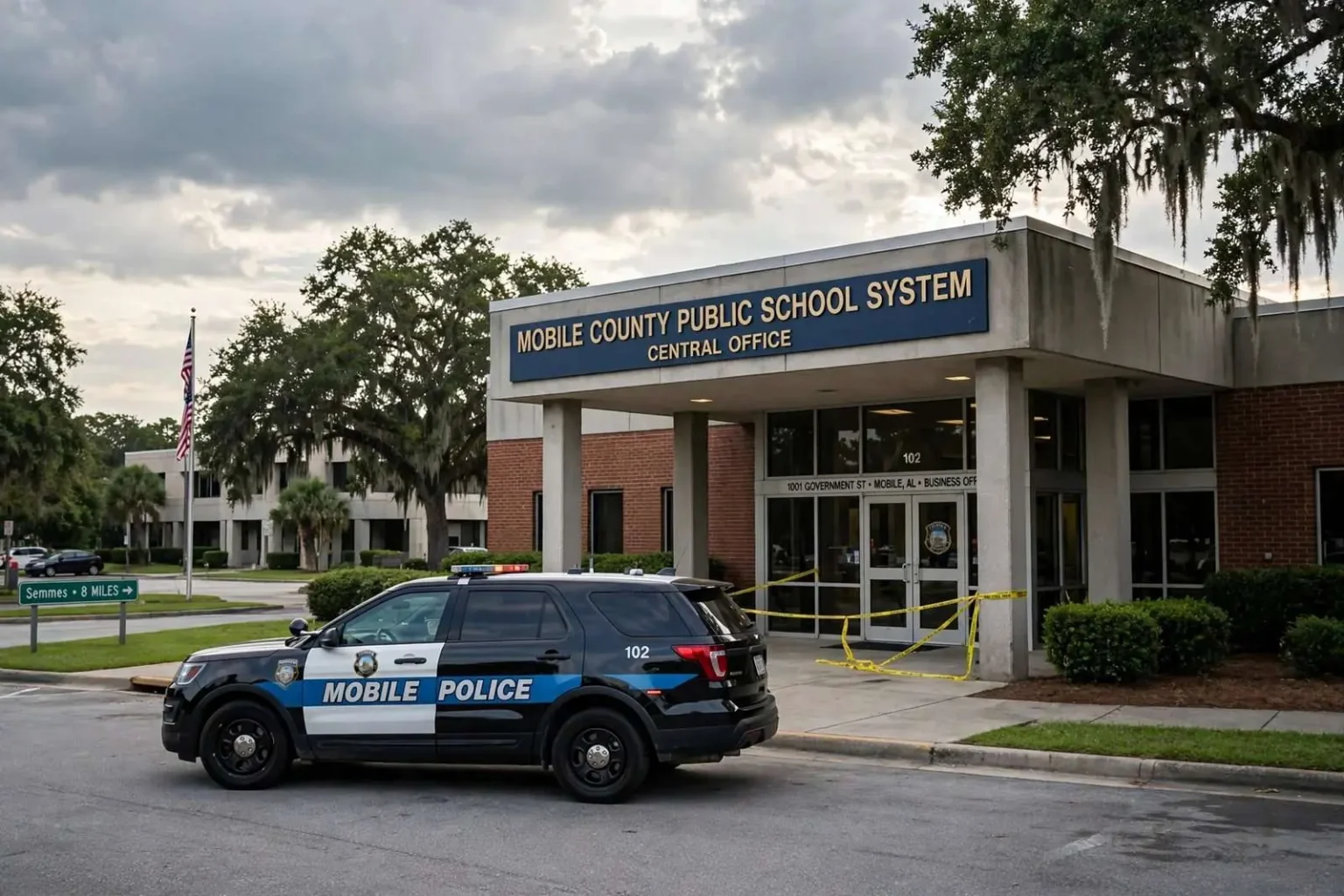
MOBILE COUNTY, Ala. — A Mobile County Public School System board member is accused of threatening another person Wednesday following a personnel meeting regarding a former Mary G. Montgomery High School football coach. The accusation now sits with Mobile police, who took a report but cited no injuries.
Mobile Police Department officers were called to the MCPSS central office Wednesday, Aug. 12, for a disorderly complaint. According to police, officers determined that District 5 Board Member Johnny Hatcher had threatened another man who was in attendance at the meeting. A police report was filed, but no one was injured, according to MPD officials. Additional information from the department was still being sought.
According to Semmes Mayor Brandon Van Hook, Hatcher threatened him after the meeting, which involved former Mary G. Montgomery High School football coach Zach Golson. Van Hook said the city had wanted to keep Golson at the high school after the Alabama High School Athletic Association ruled that Golson could not coach at any public high school in the state this season. Golson was subsequently moved from Mary G. Montgomery to Orchard Elementary School, where he now teaches physical education.
Hatcher was reached for comment and said he had no comment at this time. With no charges announced and the police report still the only official record, the dispute remained a war of accounts between a veteran school board member and a first-term mayor representing the community where the disputed coaching job sat.
What happened at the meeting
Personnel meetings at the MCPSS central office are not typically the setting for a police call. The session that brought city officials and school administrators together concerned the status of Golson, whose situation had become a point of friction between the Semmes community and the school system since the athletic association’s ruling. Mayors have no formal authority over school personnel, but Semmes officials had pressed publicly for Golson to remain at the high school in some capacity, and the meeting was evidently an attempt to sort through what could be done within the rules.
Van Hook’s account is that after the meeting concluded, Hatcher threatened him in the presence of others. Hatcher’s position, relayed through his no-comment response, leaves the school board’s side of the story untold. Police classified the initial complaint as disorderly rather than as a violent incident, and officers documented that no one was hurt. What, if anything, comes of the report — an investigation, a warrant request, or no action at all — depends on how detectives assess the accounts and any witnesses.
The board member and the district
Johnny Hatcher represents District 5 on the Mobile County Public School System board, a seat covering portions of western Mobile County that include the Semmes area. Board members set policy for the system, hire and evaluate the superintendent, and approve budgets and personnel actions affecting the state’s largest school district, which serves roughly 59,000 students across more than 90 schools and campuses spanning from downtown Mobile to the Mississippi line.
Because board members are elected from geographic districts, individual members often become the public face of controversies at particular schools. A dispute centered on Mary G. Montgomery High School naturally routed through the District 5 representative, which is why Hatcher was in the personnel meeting at all. School board work in Alabama is officially nonpartisan and unpaid, but it is not minor: the Mobile County board controls hundreds of millions of dollars in annual spending and personnel decisions affecting thousands of employees.
The Golson case and the AHSAA ruling
At the center of the dispute is Zach Golson, who had led the Mary G. Montgomery football program before the Alabama High School Athletic Association ruled that he could not coach at any public high school in the state this season. The AHSAA, the nonprofit body that governs interscholastic athletics for Alabama’s public and many private schools, enforces eligibility and coaching rules and can bar individuals from coaching for violations of its regulations. Its rulings are administrative, not criminal, but for a football program and its community they carry enormous practical weight.
With the coaching ban in place, the school system could not keep Golson on the sidelines at Mary G. Montgomery, but it retained him as an employee, transferring him to Orchard Elementary School to teach physical education. That arrangement is standard practice when an athletics ruling removes a coach from a sport: the teaching contract stands, the extracurricular assignment does not. To supporters in Semmes, the transfer was a bitter compromise — the city had lobbied to keep Golson at the high school, and his move to an elementary campus removed him from the program entirely.
The tension between the city and the school board over Golson’s fate formed the backdrop for the Aug. 12 meeting. Semmes, incorporated as a city in 1996 after decades as a rural community in west Mobile County, has invested civic pride in its schools, and Mary G. Montgomery’s football Fridays are among the city’s signature gatherings. A coaching controversy that ended with the program’s leader reassigned to an elementary school left feelings raw on both sides of the city-county line.
About the Mobile Police Department
The Mobile Police Department is the law enforcement agency responsible for policing Alabama’s third-largest city. MPD investigates crimes ranging from property offenses to violent felonies, and it routinely asks members of the public to share tips that may aid an investigation. The department works alongside the Mobile County District Attorney’s Office, which prosecutes state criminal cases, and with state and federal agencies on matters that cross jurisdictional lines. Residents can report non-emergency information through the department’s tip line and through national crime-reporting programs.
Because the alleged threat occurred at the school system’s central office within Mobile city limits, MPD — not the Mobile County Sheriff’s Office — had jurisdiction over the complaint, even though both principals in the dispute represent Semmes-area constituencies. The report’s existence does not itself trigger charges; the department’s investigators and, potentially, the District Attorney’s Office would weigh the evidence before any escalation.
What comes next
Neither the school system nor the mayor’s office had announced any personnel or administrative action in connection with the incident. School board members answer to voters, not to the mayor, and the board’s own discipline of a member would require action by the board itself under state law. For now, the matter sits where most disputed-threat reports do: with a police report, competing accounts and a request from reporters for additional information that the department had not yet released.
The episode adds a fresh strain to relations between the city of Semmes and the county school board at a moment when both were already at odds over the fate of a beloved coach. Whether the threat allegation fades as a misunderstanding or develops into a formal case, it has already complicated the working relationship the two governments need to run schools and city programs that share students, facilities and families across the same neighborhoods.
Wider context: schools and city government in west Mobile County
Alabama’s public schools are administered through a combination of local boards of education and the Alabama State Department of Education, with county and city systems operating independently of municipal governments. Cities may lobby and advocate, as Semmes did in the Golson matter, but they cannot direct school personnel decisions — a structural divide that periodically produces friction like this, when a community’s wishes collide with the rules and authority of a separate elected board.
For Semmes residents, the coming weeks will determine whether the dispute remains a political quarrel or becomes a legal one. For the school board, the incident lands amid ongoing debates about governance and conduct in Alabama school systems, where board member behavior has drawn legislative attention in recent years. And for Mary G. Montgomery’s football program, none of it changes the immediate reality: a season without the coach who built it, and a head start on finding his successor under the association’s rules.
Threat allegations against elected officials also carry a procedural wrinkle: investigators must separate legitimate disputes from criminal threats, and Alabama law distinguishes between heated words and a credible threat of harm. Witnesses who were present when the meeting ended will be central to that assessment, since the two principals offer incompatible accounts and neither has suggested there is a recording. Detectives typically re-interview everyone present, collect any statements made at the scene and consult with prosecutors before deciding whether the report will move forward.
The public’s ability to follow the case will depend on how much of that process becomes visible. Police departments generally do not comment in detail on open investigations involving public figures beyond confirming that a report exists, which means residents may learn of an outcome only if charges are filed or the matter is publicly closed. Until then, the Aug. 12 report stands as the sole official documentation of an afternoon that began as a personnel meeting about a football coach and ended with a call to police at one of the county’s most prominent public buildings.
