Mobile County Sees Unusually Early Start to Flu Season, Officials Expect Cases to Climb
Mobile County health officials report an unusually early flu season, with flu-like illness at double the Alabama threshold and cases expected to climb.
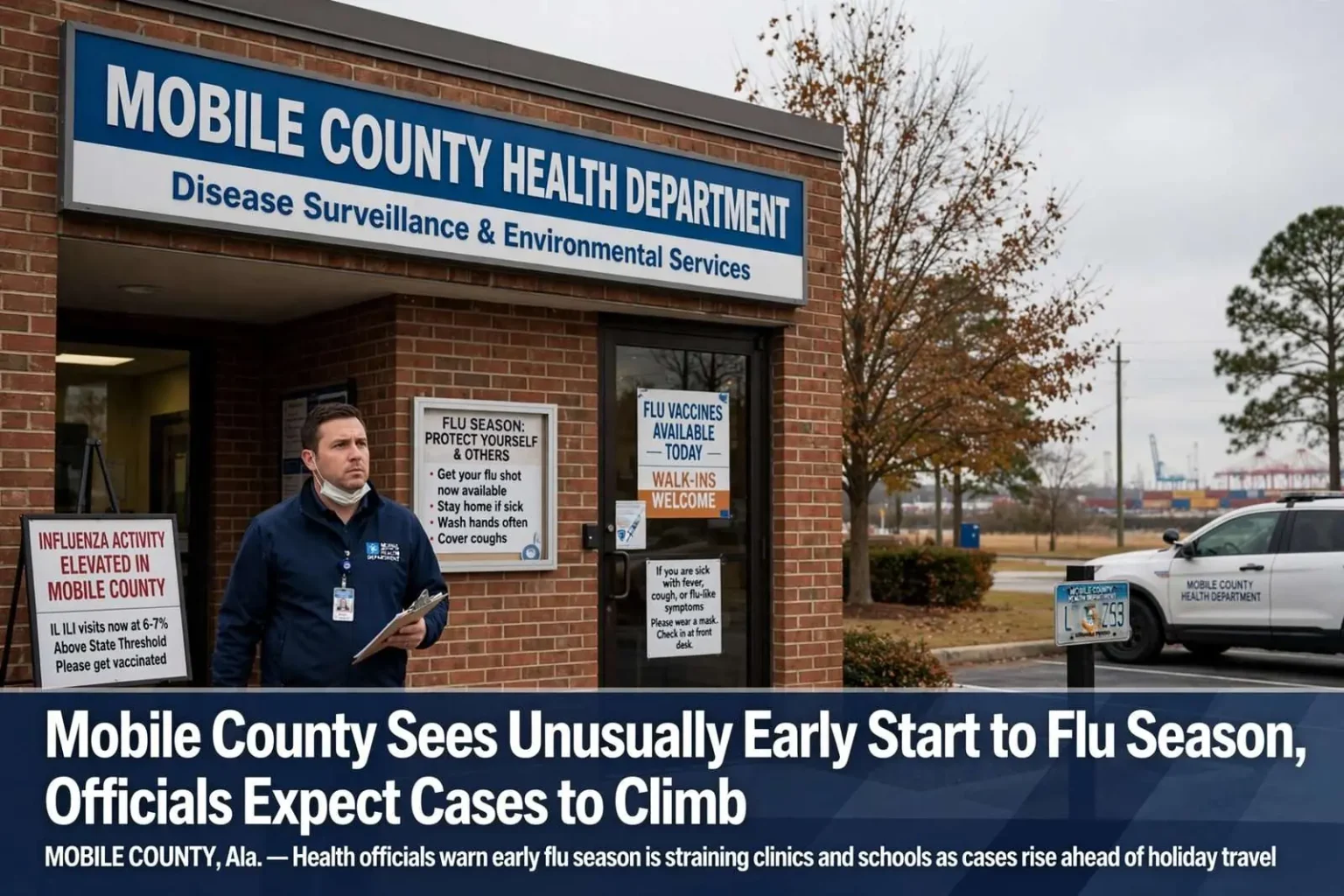
MOBILE COUNTY, Ala. — Health officials say this year’s influenza season arrived earlier than usual in Mobile County, and they expect case numbers to keep rising in the weeks ahead. The early arrival has strained clinics and school nurses across the county and given the holiday travel season an added public health dimension, as families gather indoors just as the virus finds its footing along the Gulf Coast.
Dr. Rendi Murphree, epidemiologist and director of Disease Surveillance and Environmental Services at the Mobile County Health Department, said the local season started early and followed a different pattern than most years, with influenza B circulating more heavily in the early part of the season than is typical. In a standard Alabama flu season, influenza A strains usually dominate the early weeks, with influenza B tending to appear later and fade more quickly. A season led by B strains can catch residents off guard, because people who assume flu activity peaks in January and February may not take early precautions in the fall.
Mobile County’s position as a Gulf Coast hub makes it a natural early indicator for the region. The county is home to a major port, a busy medical corridor, and steady interstate traffic along Interstate 10, all of which move people — and respiratory viruses — through the area quickly. Local health officials have long noted that respiratory illness trends in south Alabama can diverge from national patterns, which is why the health department maintains its own surveillance network rather than relying solely on federal summaries.
Flu activity well above state threshold
According to Murphree, roughly 6 to 7 percent of all health care visits in the area were related to influenza-like illness — about twice the level recorded just a week earlier and double Alabama’s threshold for significant flu activity. The threshold exists so that health departments can distinguish ordinary background coughs and colds from a genuine seasonal surge; crossing it twice over triggers heightened reporting, messaging and school outreach.
The rapid week-over-week climb was the part that concerned surveillance staff most. A season that ramps up gradually gives hospitals and clinics time to adjust staffing and supplies. One that doubles in a matter of days compresses that adjustment into very little time, and it can catch residents who have not yet gotten vaccinated with little runway before the virus reaches their households.
Officials had hoped an early start would mean an early finish, but that has not happened, and Murphree said elevated influenza activity will likely continue for many more weeks. Early seasons sometimes burn out quickly, and that hope was part of the department’s early messaging. Instead, the curve kept climbing, suggesting a long season with a large share of the population still susceptible as winter wore on.
The concern extends beyond Mobile County. Nationally, the Centers for Disease Control and Prevention estimated at midseason that flu had caused about 19 million illnesses, 180,000 hospitalizations, and 10,000 deaths across the country. National figures of that scale underscore a point epidemiologists repeat every year: influenza is not a minor inconvenience but a genuinely dangerous disease, particularly for older adults, infants, pregnant women and people with chronic conditions such as asthma, diabetes or heart disease.
The CDC’s estimates are drawn from a model that combines laboratory-confirmed cases, hospitalization surveillance and mortality data, because most flu illnesses are never formally tested and counted. For southwest Alabama, the practical takeaway is that the same dynamics driving the national numbers are visible locally in emergency room waits, school absence reports and pharmacy shelves, where antivirals and fever reducers sell quickly during heavy weeks.
Children have historically been strong carriers of influenza B, bringing the virus home from classrooms and spreading it to siblings, parents and grandparents. School-age children shed the virus at high levels and have more close contacts than most adults, which is why school nurses and athletic coaches often see outbreaks before the broader community registers the wave. Mobile County’s schools work with the health department on absence monitoring, and spikes in absenteeism are one of the early signals the surveillance network tracks.
Health officials push antivirals and prevention
Murphree urged residents who develop flu symptoms to see a health care provider quickly. Antiviral medications work against nearly all of the viruses circulating this season, she noted, and starting them early can lessen the illness and help prevent complications. The drugs are most effective when started within the first day or two of symptoms, which is why speed matters; waiting out a fever for a week before seeking care can forfeit the main benefit of treatment.
Antivirals are especially important for people at high risk of complications, including residents over 65, children under 5, and anyone with asthma, chronic lung disease, diabetes, heart disease, obesity or a weakened immune system. For those patients, a provider may prescribe antivirals even before test results confirm influenza, simply on the strength of symptoms during a period of heavy local transmission. The medications do not replace vaccination, but they provide a second line of defense that shortens illness and reduces the chance of a mild case becoming a hospitalization.
The department also continues to recommend everyday preventive measures — staying home when sick, covering coughs, washing hands often, and getting a flu shot, which remains the best tool for reducing the risk of illness as the season stretches on. Those measures sound familiar because they are the same habits that became second nature during the COVID-19 pandemic, and health officials say they work against influenza just as well. A fever should keep a worker or student home until it has resolved, both for their own recovery and to break the chain of transmission at workplaces and schools.
Vaccination remains available at private providers, pharmacies and through the health department, and officials stress that it is not too late once the season is underway. Immunity from the shot takes about two weeks to build, so a vaccination in the middle of a long season still protects a resident for the weeks of elevated activity that remain. Because this season is stretching on, that protection covers a meaningful window, including late-season waves that often arrive as travel and gatherings continue.
The Mobile County Health Department, one of the oldest county health departments in Alabama, operates the surveillance and environmental services division Murphree leads, which tracks notifiable diseases, inspects food service establishments, and coordinates immunization clinics across the county. Its flu surveillance relies on a network of sentinel providers who report the share of visits with influenza-like illness, along with laboratory reports and school data, feeding the weekly picture that state and federal epidemiologists use to classify activity levels.
Statewide, the Alabama Department of Public Health publishes weekly influenza reports during the season, classifying activity by region so that residents and providers can see whether south Alabama is running hotter or cooler than the rest of the state. In seasons like this one, with an early start and heavy B circulation, those reports become a planning tool for long-term care facilities, school systems and employers deciding when to tighten visitor policies or step up cleaning.
What residents should watch for
Flu typically comes on abruptly — fever, body aches, fatigue, cough and sore throat arriving within hours rather than building over days, which distinguishes it from the slower onset of a common cold. Officials advise residents to treat a sudden fever with body aches during flu season as probable influenza and to call a provider promptly, particularly if someone in the household is very young, very old, pregnant or chronically ill. Warning signs that warrant urgent care include difficulty breathing, chest pain, confusion, severe weakness, or a fever that returns after improving.
For most healthy adults, the illness runs its course in a week or so, with fatigue lingering longer. Rest, fluids and fever control remain the foundation of home care, and staying home until fever-free helps protect coworkers and classmates. Officials also remind families that flu season overlaps with the holidays, when travel, gatherings and shopping crowds all accelerate transmission, and that a few days of caution — masking around vulnerable relatives, skipping an event while symptomatic — can prevent an illness from reaching the people least equipped to fight it off.
As the season stretches on, the health department says the message does not change: get vaccinated if you have not, act quickly on symptoms, and keep up the simple habits that interrupt spread. An early season is not necessarily a worse one, but a long, elevated season means more opportunities for exposure, and the tools that work — the shot, the antivirals, the everyday precautions — only work if residents actually use them.