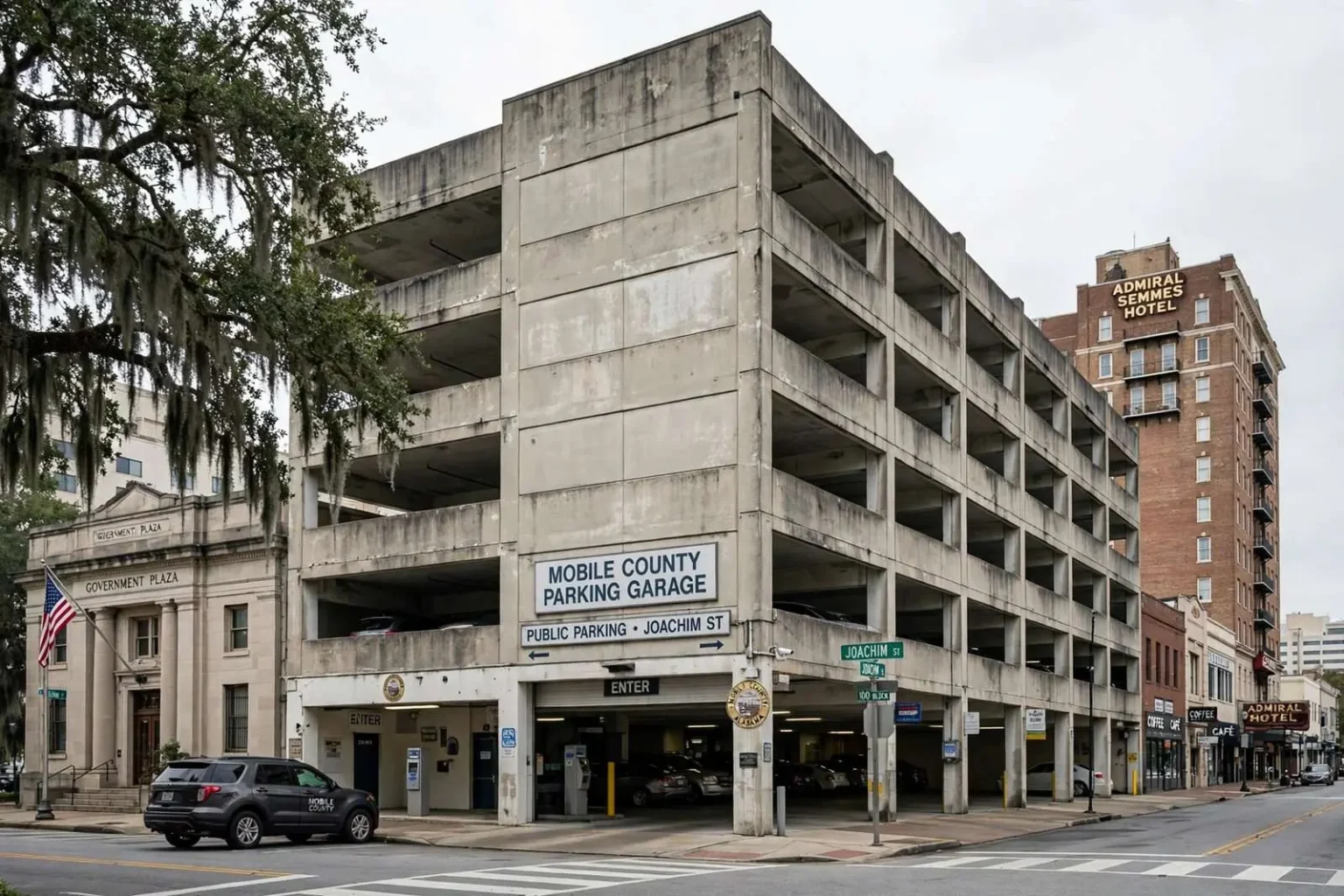
The Mobile County Commission voted Thursday to finalize the sale of the county-owned parking garage next to Government Plaza on Joachim Street, closing a deal that will bring $3 million into the county’s general fund.
The buyer, Downtown Parking LLC, is controlled by hotelier Theodora Mallick, who also owns the nearby Admiral Semmes Hotel on Joachim Street. Mallick’s company has leased the parking structure from the county for years, and the $3 million purchase price came in just above the building’s appraised value of $2.9 million, according to County Attorney Jay Ross.
Commission President Connie Hudson said after Thursday’s meeting that the county had not been profiting from the arrangement, and that officials decided a sale made more financial sense than continuing to hold and lease out the structure. “If we were making a big profit from something, we sure wouldn’t be selling it off. I promise you,” Hudson said. She could not pinpoint exactly when the county took ownership of the garage, saying only that it predates construction of Government Plaza itself.
“The money will go directly into the general fund, but this is not a recurring surplus. It’s a one-time sale of an asset,” Hudson said. County finance officials will treat the proceeds as a one-time revenue item rather than as ongoing support for operations, a distinction Hudson emphasized so that no county department budgets against the windfall in future years.
The sale ends the county’s role as a downtown parking operator, a function it inherited decades ago as Government Plaza rose on the block. County officials have gradually divested from holdings that no longer fit its core mission of courts, public safety and health services, and the garage — a structure with maintenance needs of its own — had become a candidate for that kind of review.
Hudson noted that the parking deck is currently underused, with its top two or three floors sitting largely empty. She said the new owner may look to renovate the facility and begin charging for spaces that have gone unused for years. “They may have plans to completely renovate it and charge for the spaces. At least that’s what I understood them to be doing,” Hudson said.
The deck’s underuse reflects changes in downtown Mobile’s parking market, where newer decks built around the city’s hotel and entertainment districts have absorbed demand in recent years. A private owner with nearby hospitality holdings, as Mallick’s is, has options a county landlord did not — including bundling parking with hotel and event business along Joachim Street.
As part of the sale, the commission negotiated a three-year discounted parking rate for county employees who have long used the deck, along with a similar arrangement for staff at the Mobile County District Attorney’s office. Hudson said the deal covers roughly 50 spaces for county workers, protecting the daily routines of courthouse-area workers while the transition to private ownership proceeds.
Land Option Extended for Soccer Complex
The garage sale was one of several real estate items the commission tackled Thursday. Commissioners also approved a $10,000 extension of the county’s purchase option on 116 acres near the interchange of Interstate 65 and Interstate 10, land that has been eyed for years as the site of a proposed $20.7 million tournament soccer complex. The extension buys the county another 120 days to firm up the land deal.
Under the terms of the option agreement, the $36,000 the county has paid to date to hold the property will be credited toward the eventual $2.9 million purchase price. The city of Mobile has also pledged $1.5 million toward buying the land, a sign of the project’s importance to both city and county leaders looking to boost the region’s sports tourism draw.
Tournament sports complexes have become a competitive pursuit among Gulf Coast cities, which court weekend visitors who fill hotels and restaurants while their children play in youth tournaments. Leaders in Mobile have pointed to the proposed soccer complex as a way to capture more of that market, pairing the land near the I-65/I-10 interchange — one of the most visible sites in the city — with the hotels and attractions that touring families use.
Hudson said Thursday she does not expect the commission to need another extension beyond the current 120-day window, and that a final decision on the land purchase could come before that period runs out. Repeated extensions, she noted, carry their own costs, both the option payments themselves and the risk of losing momentum on a project leaders have pursued for years.
One of the biggest remaining obstacles has been permitting through the U.S. Army Corps of Engineers, which recently asked county officials for more information about a planned water park and aquatic center that would be built during later phases of the sports complex project. Wetlands and water features on and around the site put portions of the plan under federal jurisdiction, requiring the Corps to sign off before construction can begin.
“We think we’re close to getting our permit through the Corps of Engineers, but there’s still some final details to work out,” Hudson said, adding that commissioners planned to meet again Friday to go over the outstanding issues. “I think we’ll be able to answer some of the remaining issues the Corps has, and I feel like we’re really close.”
The Corps’ questions about the water park and aquatic center underscore the phased nature of the proposal. The soccer fields come first in the county’s planning, with the water attractions intended for later phases once the tournament complex is established and drawing visitors. County officials have said the phasing allows them to spread the $20.7 million cost across budget years while showing early results.
A Changing Downtown Market
The Joachim Street corridor where the garage sits has been at the center of downtown Mobile’s revival, with the historic street’s restaurants, bars and shops drawing evening crowds and the convention traffic that moves between the civic centers and the hotels along Government Street. Parking supply in that district has grown with new construction, which is one reason a deck with empty upper floors no longer commanded the role it once did for the county.
The Admiral Semmes Hotel, Mallick’s property nearby, is one of downtown’s landmark hotels, and its location a short walk from the garage illustrates the buyer’s strategy: controlling parking adjacent to hospitality properties gives an owner flexibility to serve hotel guests, event visitors and monthly parkers from a single structure. County officials did not detail the company’s plans beyond what Hudson described, but the sale’s terms suggest the deck will remain in use rather than be redeveloped outright.
For county employees, the three-year discounted arrangement provides a bridge while the county evaluates longer-term parking options for workers around Government Plaza, which houses county and city courts and offices. If the new owner renovates and reprices the deck, the negotiated rates shield county and district attorney staff from immediate increases, but the county will eventually need a permanent plan for the roughly 50 spaces.
What Comes Next for Both Deals
On the soccer complex, county officials have scheduled the Friday session to prepare their response to the Corps of Engineers, with Hudson expressing confidence that the remaining permit questions can be answered quickly enough to close the land purchase within the current option window. The $10,000 extension payment adds to the credits accumulating against the $2.9 million purchase price, alongside the city’s pledged $1.5 million share.
The two transactions, taken together, show the commission balancing the county’s portfolio — shedding an underperforming asset downtown while continuing to invest in land for a project meant to grow the region’s tourism economy. In the garage sale, the county trades future lease income for $3 million in cash today; in the soccer complex, it trades $2.9 million in cash for land intended to anchor a $20.7 million development.
Hudson has framed both moves as deliberate stewardship rather than improvisation. The garage, she noted, was never a profit center for the county, and holding it served neither taxpayers nor downtown’s parking market. The interchange land, by contrast, sits where two of the region’s busiest interstates meet, and county leaders have described it as the best available site for a complex they hope will bring tournaments — and the spending that follows them — to Mobile for years to come.
Both items are expected to return to the commission’s agenda in the months ahead: the soccer complex for a final purchase decision within the 120-day window, and the garage transition as the new owner’s renovation plans become clear. Until then, county workers’ discounted spaces and the Corps’ pending permit are the two details to watch.
The commission’s vote on the garage closed without dissent, according to officials present, capping a negotiation that began with a tenant the county already knew. Because Mallick’s company had operated the lease for years, the county had a record of the structure’s income and maintenance history, which both sides used in arriving at a price slightly above the independent appraisal.