Mobile County Sheriff Launches Petition Drive to Strip City Council’s Supermajority Rule
Mobile County Sheriff Sam Cochran has launched a petition drive called "Grow Mobile Now" seeking to remove the City Council's five-vote supermajority rule, drawing pushback from the mayor's office and some council members.
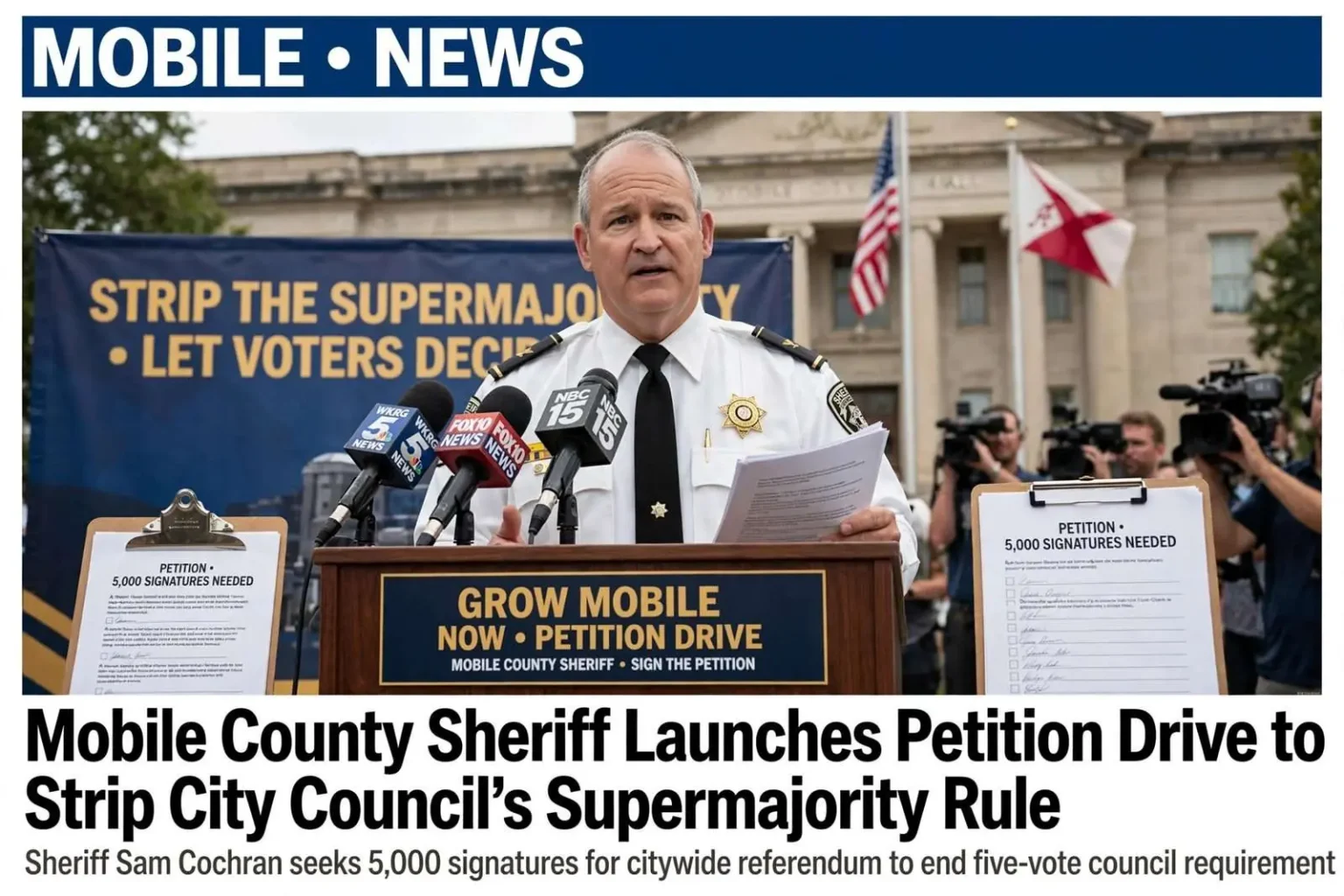
Mobile County Sheriff Sam Cochran is asking thousands of city residents to sign a petition aimed at reshaping how the Mobile City Council does business, arguing that a decades-old supermajority requirement has become an obstacle to growth. The city’s mayor-council form of government, in place since 1985, requires a five-vote supermajority from the seven-member council to pass most measures, with the budget and the hiring of a council attorney as exceptions.
Cochran contends that rule has repeatedly blocked progress on issues important to the city’s future, particularly annexation. “The goal is to create economic growth for the city and county,” Cochran said. “Annexation is the best opportunity to do that.”
Cochran pointed to a vote last November, when a proposal to let roughly 13,000 West Mobile residents decide whether to join the city failed on a 4-3 council vote split along racial lines, following weeks of public debate. “Where do you lose a vote where it’s 4-3 in favor?” Cochran said. “Only in the city of Mobile.”
Under the Zoghby Act, the state law that established Mobile’s current form of government, residents can force a citywide referendum on changing that structure by gathering signatures from at least 10 percent of the number of people who voted in the last municipal election, a threshold Cochran’s campaign puts at roughly 5,000 signatures. Cochran announced the effort, called “Grow Mobile Now,” at a press conference, saying that if enough residents sign on, the council would be required to place the change before voters.
Because a separate section of state law, Alabama Code 11-44C-91, allows the Zoghby Act itself to be amended through the same referendum process, Cochran’s group is not seeking to scrap the mayor-council system entirely or revert to the city’s older commission form of government. Instead, the petition targets only the five-vote requirement.
Mobile Mayor Sandy Stimpson, who has backed previous annexation pushes, is not joining Cochran’s campaign. City spokesman George Talbot said the administration decided not to get involved after Stimpson met with the sheriff.
“The administration is not seeking to change the form of government in the city,” Talbot said. “It’s not an initiative we’re pursuing, nor does the city want to pursue it.” Council President Levon Manzie is more directly opposed, saying he expects the proposal to prove divisive and that the supermajority requirement exists specifically to protect council members who hold minority views.
“I think it’s important that the supermajority and the protections inherent within the supermajority are protected at all costs,” Manzie said. “It’s not an initiative I support at all.” Manzie, who also serves on the Mobile County Board of School Commissioners, said his experience on a board without a supermajority rule showed him how majority votes can be pushed through with little debate.
“A supermajority ensures that the majority from either side has to have a discussion with the minority,” he said. “I’ve served on the school board prior to the City Council. The majority ran issues down our throats.”
Cochran, a former Mobile police chief, said his experience on the other side of the equation left him with a different view, describing instances where he said the supermajority rule led to closed-door negotiations to secure a fifth vote. “It’s an ineffective form of government,” Cochran said. “I’ve seen it time and time again.”
Manzie pushed back on the idea that the rule regularly stalls city business, saying the council has found consensus on most issues during his six years on the body and in the decades since the Zoghby Act took effect. “There isn’t a long list of items and issues stalled or prevented by the supermajority,” Manzie said. “One big one that comes to mind is annexation. Since 1985, there isn’t some long list of items that have been unable to pass.”
Cochran also linked his campaign to a separate proposal before the council to pull back the boundaries of the three-mile police jurisdiction his office patrols outside city limits.
He said that if the council shrinks the jurisdiction without annexing the 13,000-resident section of West Mobile, his department stands to lose about $4.8 million in personnel and equipment needed to police the roughly 70,000 residents who currently live in that jurisdiction. Cochran has said previously that the shortfall could force him to recruit Mobile police officers and hire them as deputies to fill the gap.
Cochran argued further that failing to annex West Mobile could set off a chain reaction that damages the city long-term, predicting that residents there would eventually incorporate their own municipality and pull local schools out of the county system. “So goes Mobile, goes the area,” Cochran said. “We’re at a crossroads. We either grow the city now or we lose it.”
Not every council member is convinced change is needed. Councilman Fred Richardson said the city has seen more progress over the past 35 years than at any other point in its history under the current system and the Zoghby Act. “They want to reverse it and go back to what we used to do,” Richardson said. “Let’s go back and reverse ourselves. I would have to be out of my mind completely to agree with that.”
Richardson also questioned Cochran’s motives, suggesting the sheriff’s push is driven by the financial and staffing stakes his own department faces over the police jurisdiction dispute.
“The people in the police jurisdiction, he doesn’t want to police them,” Richardson said. “He has a vested interest.”
Whether the petition drive gathers enough signatures to force a citywide vote remains to be seen. If it does, the decision on whether to strip the council’s supermajority requirement would ultimately rest with Mobile voters.
How Mobile’s current government came to be
Before 1985, Mobile was governed by a three-member city commission whose members were elected citywide and shared both executive and legislative power. That at-large system was challenged by Black voters in the long-running Bolden litigation, which reached the U.S. Supreme Court as City of Mobile v. Bolden in 1980 and was part of the decades-long push that led to a change in the city’s form of government.
The Zoghby Act, the 1985 state law that replaced the commission, set a special election for May 14, 1985, and created the current structure: a mayor elected citywide and seven council members elected from single-member districts. Because the act is state law, codified in Chapter 44C of Title 11 of the Code of Alabama, Cochran’s group is using the petition-and-referendum process the statute provides rather than seeking a council vote.