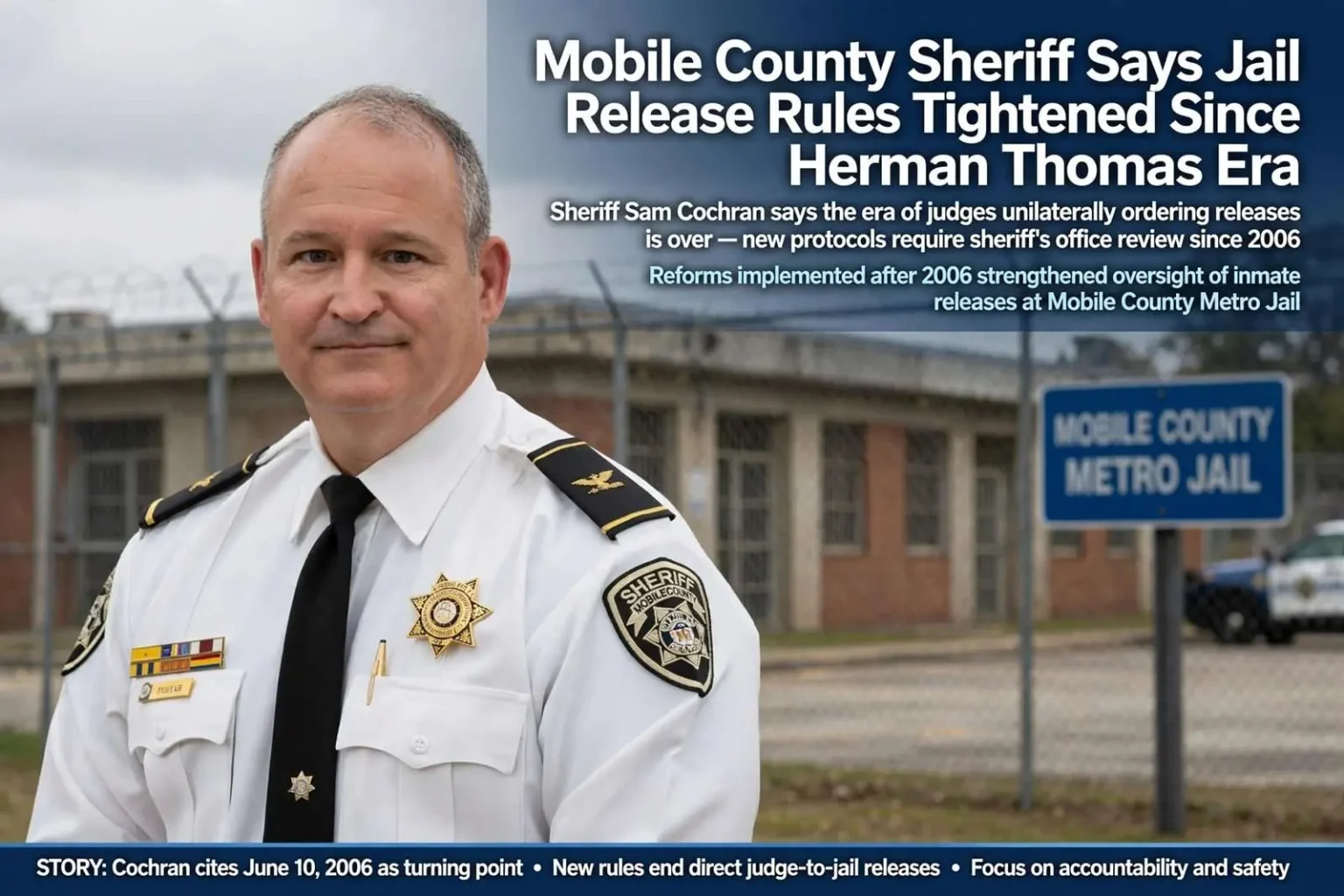
Mobile County Sheriff Sam Cochran says the days of a circuit judge simply calling for a prisoner to be checked out of the Mobile County Metro Jail are over. Cochran points to June 10, 2006 as the last time former Circuit Judge Herman Thomas was able to have an inmate released to him directly — just days before Cochran took office and began tightening a system he describes as having left jailers with little ability to track how releases were actually being handled.
The loose system, according to Cochran, is what may have made it possible for Thomas to have inmates released to him for outside visits and trips, allegations that have followed the former judge since he resigned from the bench in 2007 amid an Alabama Judicial Inquiry Commission investigation into claims he paddled inmates. Since then, additional accusations have surfaced, including claims from men who say Thomas coerced sexual activity from them by threatening further jail time, and claims from local attorney Joe Kulakowski that he interviewed men who say they sold drugs for Thomas.
Thomas has not been charged with or indicted for any crime connected to these allegations and continues to practice law in Mobile. The unresolved question at the center of the matter is how Thomas was able to transfer 356 cases off other judges' dockets and secure the release of numerous prisoners from the jail without raising alarm — and whether the system that allowed it has actually changed. Cochran says it has.
He described a jail system that historically gave judges broad, largely unquestioned authority over releases. "Judges historically had unlimited authority. If a judge said it, by God, that's law," Cochran said.
When he became sheriff, then-Warden Mike Haley briefed him on some of what Thomas had reportedly been doing in terms of requesting inmate releases for events, travel or personal visits. "Warden Haley brought to my attention some of the things Herman was doing, and I said I wouldn't support it," Cochran said. "We put into place some new rules. Just because a judge says do it doesn't mean you have to do it."
Release orders typically arrive at the jail by fax from the Circuit Clerk's Office, and Cochran says the sheer volume — thousands of faxes a year — combined with a long-standing culture of not questioning judicial authority, made it easy for irregular requests to slip through unnoticed. Understaffing compounded the problem: Cochran says the jail was short by as many as 40 to 50 employees in the early 2000s, making it even harder to scrutinize every order that came through.
"The thing with Thomas was he was one of the most active judges, but he would abuse the privileges," Cochran said. Cochran says the system's flaws extended beyond the Thomas allegations. In one instance, he said, a clerk signed a judge's name on a release document for a prisoner the judge had not actually authorized to be freed — an error that was caught before the inmate was let go.
Since taking office, Cochran says he has pushed to ensure releases happen only for legitimate reasons, and has cracked down on practices such as transporting inmates to funerals or medical appointments that could otherwise be handled inside the jail, citing safety concerns for both officers and the public. "I've gotten really good cooperation from the judges since [the new rules]. We might have upset one or two, but most of them understand," Cochran said.
Jack Tillman, who served as sheriff from 1995 to 2006 — spanning the years Thomas was allegedly securing releases — said he was never made aware it was happening and that no one at the time would have thought to question a circuit judge's authority to get a prisoner released. "I had no idea he was getting people out of jail. But who's going to tell a circuit judge he can't get someone out of jail? He transferred over 400 cases from the dockets of other judges and they didn't know he'd done that. How was I going to know he got people out of jail? I would have no clue," Tillman said, adding that he doubted jail wardens at the time were fully aware either. "They couldn't be there 24 hours a day. If he went over there at 7 o'clock at night and got somebody, I probably wouldn't know it, and even if I did what would I tell a circuit judge?"
Presiding Circuit Judge Charles Graddick and Circuit Clerk JoJo Schwarzaur were contacted multiple times about their offices' procedures and how Thomas managed to transfer so many cases undetected, but neither responded before deadline.
Cochran says viewing the situation with the benefit of hindsight makes the lack of earlier scrutiny hard to fathom. "Now it all looks really odd in 20/20 hindsight," he said. "It's unbelievable to think red flags didn't go up."
A continued role mentoring youth
Since his suspension from the bench on March 10, 2007, Thomas has remained active in youth mentoring through the Phoenix Program, which works with at-risk students facing dropout risk or long-term suspension. The program, taught at the former Blount High School and serving students in sixth through 12th grades, is run by 100 Black Men of Greater Mobile, Inc. using federal and local funds channeled through the Mobile County School System. Thomas sits on the group's board of directors.
Former Mobile County School Superintendent Harold Dodge said Thomas had long been involved with the Phoenix Program and became even more engaged after his suspension, crediting him as instrumental in creating both 100 Black Men's local chapter and the Phoenix Program itself. "Herman was an outstanding mentor," Dodge said. "He would check on the kids at all times of the day." Asked whether Thomas had ever been paid through the Phoenix Program, Dodge said the program's budget documentation submitted to the school system didn't list individual personnel by name, so he couldn't say for certain.
Ralph Wilson, the program's director, said Thomas had never been on the program's payroll, though he confirmed Thomas' wife works for the program. Marcy McNeil of the Mobile County School System said the district had no indication Thomas had ever drawn a Phoenix Program paycheck, though the system doesn't track who the program pays directly. Dodge acknowledged feeling uneasy when the allegations against Thomas first surfaced publicly. "When the trouble started a while back and someone said Judge Thomas was volunteering at Phoenix, my first reaction was to put my hand to my head and say 'shit,'" Dodge said. "But I went over there and watched him and everything looked OK. But I sometimes wonder if I looked at it through rose-colored glasses."
Dodge also credited Thomas with saving the Phoenix Program from being shut down by the school board after a previous board member's legal troubles made the program unpopular among members. "When David was involved, they didn't want to do it. The judge saved it. I don't think he ever got any financial out of it, at least I hope not," Dodge said. "There were just great stories about how Herman would stop by people's houses at all hours to check on your son."
How judicial complaints are handled in Alabama
Complaints about the conduct of Alabama judges go to the Judicial Inquiry Commission, a state body created by the Alabama Constitution that investigates alleged violations of the Canons of Judicial Ethics. When the commission finds reason to proceed, it files formal charges with the Alabama Court of the Judiciary, which hears the case and can impose discipline ranging from censure to suspension or removal from office.