Mobile County Treasurer’s Anti-Gay Facebook Remarks Spark Bipartisan Backlash
Mobile County Treasurer Phil Benson is facing criticism from LGBTQ advocates and members of his own party after defending a slur-laced Facebook comment he made about a Colorado baker's discrimination case.
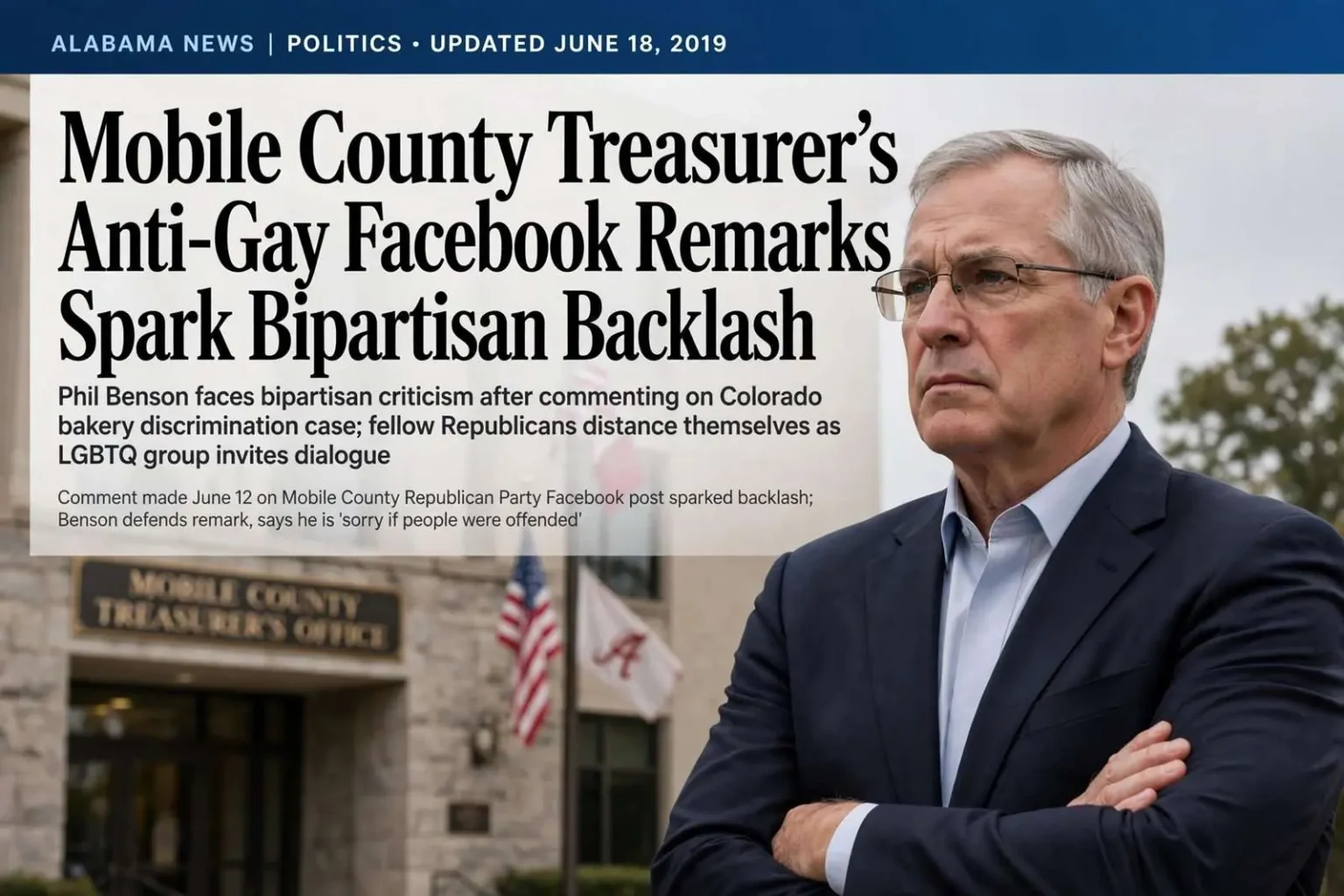
Mobile County Treasurer Phil Benson is facing mounting criticism after a Facebook comment he wrote about a national discrimination case drew accusations of homophobia and calls for accountability from across the political spectrum. The remark appeared on June 12 beneath a post on the Mobile County Republican Party’s Facebook page and might have drawn little attention had a local television reporter not spotted it days later and begun asking questions.
The post Benson commented on linked to an article about Jack Phillips, the Colorado bakery owner whose 2012 refusal to make a wedding cake for a same-sex couple sparked a long-running legal fight over discrimination and religious liberty. The article specifically detailed a newer lawsuit filed against Phillips by Autumn Scardina, a transgender woman who says the baker also refused to make her a cake to mark her gender transition.
Commenting on the story, Benson wrote that Phillips “needs to move to a place he is wanted,” adding, “Freaking queers have gotten too much sympathy. A real abomination.”
The comment sat largely unnoticed for several days before the reporter’s inquiries brought it to public light. Once the story broke, criticism from LGBTQ advocates and their allies was swift, with many describing Benson’s word choice as hateful, homophobic and inappropriate for a public official who handles county government’s money. Screenshots of the exchange circulated widely on social media in the days after the story surfaced, with many calling for Benson to resign or be removed from office.
Rather than walk the remark back, Benson doubled down. He told reporters this week that he was “sorry if people were offended,” but argued the public should be more troubled by the government’s treatment of Phillips than by his own language.
“It didn’t bother anyone that the government stuck their nose into a private business and fined some poor guy $135,000 because he refused to bake a cake for some ‘freaking queers,’” Benson said. “It’s a ’60s term. It’s not politically correct today, but it was the term when I grew up.”
That framing — an apology for offense taken rather than for the words themselves, paired with a generational defense — did little to quiet the uproar. Critics noted that Benson did not dispute writing the comment or suggest he had been misunderstood, and that his follow-up remarks repeated the same slur he had used online.
The Colorado case behind the post
The dispute that drew Benson’s attention began in 2012, when Phillips, owner of the Masterpiece Cakeshop in Lakewood, Colorado, declined to create a wedding cake for a same-sex couple, citing his religious beliefs. The couple filed a complaint under Colorado’s public accommodations law, and the case wound through years of administrative hearings and court battles, becoming one of the most closely watched religious liberty disputes in the country.
Colorado officials ultimately ordered Phillips to change his practices and imposed penalties that, in the amount cited by Benson, totaled $135,000. The case reached the U.S. Supreme Court, which ruled in 2018 in Phillips’ favor on narrow grounds, holding that the state civil rights commission had shown hostility toward his religious beliefs in evaluating his case, while stopping short of a sweeping ruling on whether religious objections can ever justify refusing service to same-sex customers.
The lawsuit described in the article Benson commented on raised the issue again in a different form. Scardina, a transgender woman and attorney, says Phillips refused her request for a cake celebrating her gender transition. Her case tests whether the same public accommodations principles apply to gender identity, and it has kept the bakery at the center of the national argument over where religious freedom ends and anti-discrimination protections begin.
An office outside the commission’s reach
County officials were quick to note that, despite carrying the title of county treasurer, Benson is not a county employee. A Mobile County Commission spokesperson declined to comment on the controversy, pointing out that the treasurer’s office, like the sheriff, license commissioner and revenue commissioner, is a separately elected, at-large position with no direct oversight from the commission itself.
That structure, common across Alabama’s county governments, means the three-member Mobile County Commission cannot discipline, reprimand or remove the treasurer no matter how much pressure builds. Alabama law provides no recall process for county constitutional officers, and removal short of criminal conviction generally requires action by state authorities. In practical terms, accountability for a county treasurer in Alabama runs through the ballot box, through the voters who elect the office every four years, or through the official’s own decision to resign.
The treasurer’s office itself is far from ceremonial. The county treasurer serves as one of the custodians of public funds, involved in the deposit and disbursement of county money and in the day-to-day cash management that keeps county operations running. That responsibilities place Benson’s name on the machinery of county finance is precisely why critics argued his language mattered more than that of a private citizen.
Benson has held the treasurer’s office since 2012 and said he does not expect the fallout to derail his plans to seek another term in 2020. He said he has received only a handful of emails and comments in response to the controversy, though he acknowledged some messages struck him as “offensive” and “almost threatening.”
Whether the episode follows him into the next campaign is an open question. Mobile County’s electorate has historically been conservative, and no challenger had publicly announced a run against Benson as of this week. But the breadth of the criticism — which extended beyond LGBTQ advocacy groups to fellow Republicans and commentators of varying political leanings — suggested the comment had alienated voters well beyond one community.
A measured invitation from Rainbow Mobile
Rainbow Mobile, one of the region’s most active organizations supporting LGBTQ residents and their allies, responded to the controversy with a measured statement rather than an outright condemnation. The group chose to frame its response around engagement rather than confrontation, addressing the treasurer directly.
“We at Rainbow Mobile are working to make the city and county of Mobile a better place for everyone, no matter our differences,” Executive Director Bryan Fuenmayor said in a statement. “To that end, we would like to invite Phil Benson to sit down with us and learn more about the LGBTQ people he serves in Mobile County. We hope he will take us up on this offer.”
The invitation underscored the organization’s position that the treasurer’s words were not merely an insult but a statement about constituents he is elected to serve. LGBTQ residents of Mobile County pay the taxes the treasurer’s office collects, and advocates noted that an elected official’s public characterization of any group of constituents carries weight precisely because of that relationship. As of this week, Benson had not responded publicly to the invitation.
Fellow Republicans move to distance themselves
The backlash has not been limited to LGBTQ advocacy groups. Fellow Alabama Republicans have moved to distance themselves from Benson’s remarks, an indication of how quickly party officials judged the comment to be a liability rather than a position they were willing to defend.
The Mobile County Republican Party removed his original comment from its Facebook page once the story gained traction, noting in a statement that the six-day-old post did not reflect “appropriate language.”
“The comments made by a Mobile County elected official are his own and they do NOT in any way reflect the policies or beliefs of the Mobile County Republican Party nor any of its other members,” the local party wrote. “We do not wish for his comments to be published further on our Facebook page. He can express his comments in any way he wishes on his own page.”
Alabama Republican Party Chairman Terry Lathan also weighed in, saying Benson’s remarks reflected only on himself.
“Mr. Benson’s comments represent his own personal opinion,” Lathan said. “I find them to be unnecessary, divisive and reflect solely on himself.”
The statements stopped short of calling for Benson’s resignation or any formal sanction, but together they drew a clear boundary between the party organizations and the treasurer’s language. Party officials rarely rebuke their own elected officeholders publicly, and the speed with which both the county and state parties did so in this case was itself notable. Neither statement addressed whether the episode would affect Benson’s standing within the party heading into the 2020 election cycle.
What happens next
As of this week, Benson had not issued any further public statement beyond his initial defense of the comment, and no formal action to remove him from office had been proposed by county or state officials. Without such a step, the controversy remains a matter of public opinion rather than government process, with the treasurer’s future resting on how the episode sits with Mobile County voters.
For advocates, the episode has become a test of how the region responds when an elected official’s private words become public. Rainbow Mobile’s invitation remains open, and community organizations have pointed to the moment as an opportunity for dialogue about language and representation in county government. Benson, for his part, has given no sign that he intends to change course, apologize in fuller terms, or reconsider his plans to run again.
What is clear is that the comment is no longer an overlooked line on a Facebook thread. It has been quoted in coverage across the region, disavowed by his own party at two levels, and answered by the very community it targeted with an offer of conversation rather than condemnation. Whether any of that changes the treasurer’s standing will be decided not in a commission chamber but at the polls, where Mobile County voters will get their say on Benson’s term when he next appears on the ballot.