Mobile County Weighs Extra Sales Tax Break to Match City Incentives for Kimberly-Clark Mill Growth
Mobile County officials are weighing whether to add a $750,000 sales tax abatement to match the city's incentives for Kimberly-Clark's tissue mill expansion, part of a package now worth more than $4 million.
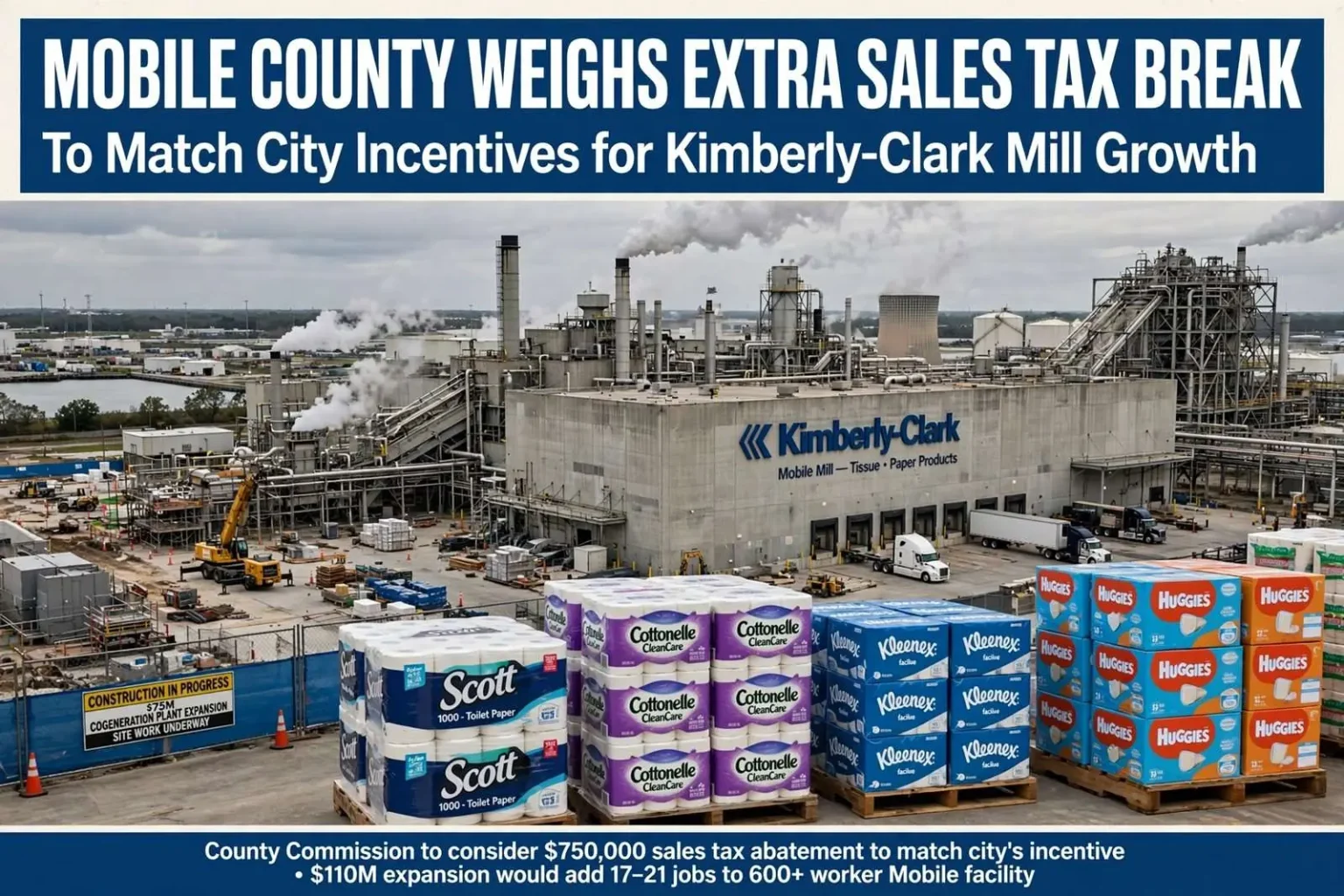
Mobile County officials are considering whether to add another sales tax abatement to the incentive package already offered to Kimberly-Clark, as the paper products giant pushes forward with a major expansion of its tissue mill in Mobile.
The request, brought before the Mobile County Commission, asks the county to match a one-year sales and use tax abatement the city of Mobile has already approved for the project. If granted, the addition would bring the total public incentive package tied to the expansion to more than $4 million spread over the next decade.
Kimberly-Clark’s Mobile facility manufactures a range of well-known household paper products, including Scott, Cottonelle, Kleenex, Kotex and Huggies brands, and currently employs more than 600 workers at the site. The company announced earlier this year that it plans to build a $75 million on-site combined heat-power plant at the mill, part of a broader $110 million capital investment planned for the facility over the next two years.
The remaining $35 million of that investment is earmarked for new machinery used to produce toilet tissue, along with a new assembly line. Local officials say the additions are expected to create between 17 and 21 new jobs at the plant, with average annual salaries for the positions listed at $88,235.
The numbers illustrate how modern industrial incentive deals are structured. The bulk of the $110 million — the cogeneration plant and the new tissue machinery — is spent by the company, not the public. The abatements simply forgive a portion of the taxes those investments would otherwise generate, allowing construction materials and equipment to move through the site without local sales tax and shaving the property tax bill on qualifying improvements for a defined period.
Under Alabama’s industrial incentive framework, such abatements typically exclude the portions of property and sales taxes that fund public schools, which is why local officials describe them as “non-educational.” The design reflects a decades-old compromise in state law: school funding is protected from the deals, while cities and counties compete for manufacturing projects with the tools left to them.
The Pieces of the Package
To help secure the project, the Industrial Development Board, which oversees economic development agreements within the city of Mobile, approved roughly $1.4 million in incentives earlier this year. That package includes $350,000 that will accumulate over a 10-year abatement of non-educational ad valorem taxes, along with a one-year, $1.1 million abatement of sales and use taxes tied to construction of the new facilities.
Mobile County’s Industrial Development Authority, which handles similar agreements on behalf of the county, has already approved a separate $1,025,000 property tax abatement spanning 10 years. The new request under consideration by the County Commission would tack on an additional $750,000 sales tax abatement, a contribution slightly larger than the one already granted by the city.
Combined with a limited contribution from the state of Alabama, the full incentive package offered to Kimberly-Clark for the expansion is now valued at roughly $4,175,000 over 10 years, in exchange for the creation of 17 direct jobs at the mill.
On its face, a per-job cost in the low six figures prompts the question taxpayers always ask about incentives — whether the trade is worth it. The answer offered by the project’s backers turns on what the abatements preserve rather than what they cost: more than 600 existing jobs, a taxpaying industrial campus that has anchored its corner of Mobile for decades, and $110 million in construction activity that would otherwise face taxes that competing sites could waive.
According to an analysis prepared by the Mobile Area Chamber of Commerce, the expansion project is projected to generate a combined tax benefit of about $4.6 million for the city and county, even after accounting for the cost of the abatements themselves.
The chamber’s arithmetic is the standard argument for abatement deals: the property and sales taxes forgiven are measured against the taxes still collected — on the expanded plant’s value, on the payroll, on the construction activity — and the balance comes out positive for the governments that surrendered part of their take. Whether the projection holds depends on the project performing as advertised, which is why commissions scrutinize the terms before signing.
Chamber representative Shelby Glover presented the county’s proposal to commissioners, walking through the scope of the investment and the projected return for local governments. Commissioners raised a handful of questions about the terms of the deal but did not voice objections to the additional allocation.
The questions commissioners asked centered on the mechanics that always matter in abatement requests: how much tax is actually deferred, over what period, and what the county receives if the project underperforms. Incentive agreements generally specify the qualifying property, the abatement schedule and the consequences if investment falls short of plan — terms that give the public bodies a measure of protection against paying for a project that never materializes at scale.
For the company, the abatements are a meaningful but modest share of a $110 million investment. For the governments, the calculation includes factors a spreadsheet cannot capture: the mill’s presence in the company’s national manufacturing network, the credibility of Mobile’s incentive process for the next prospect, and the multiplier effects of construction spending and steady industrial employment in the local economy.
Why the Mill Matters to Mobile
Economic development officials in Mobile have increasingly leaned on abatement packages to compete for industrial expansions, arguing that the long-term tax revenue and stable manufacturing jobs generated by projects like the Kimberly-Clark expansion outweigh the short-term cost of the incentives. The mill has been a fixture of Mobile’s industrial base for decades, and local leaders have pointed to the current expansion as evidence that the facility remains competitive within the company’s broader manufacturing network.
Competition for those projects is national. When a consumer-products company decides where to spend $110 million, it compares sites across states, weighing energy costs, logistics, labor and the tax treatment of new equipment. A combined heat-power plant — the largest single piece of this expansion — signals a facility being positioned for a long run, since cogeneration both cuts energy costs and insulates a paper mill from grid price swings.
Manufacturing payroll ripples beyond the plant gate. Six hundred jobs at a tissue mill support suppliers, contractors, transport and the service economy around an industrial district, and the 17 to 21 new positions, at salaries averaging $88,235, land well above the county’s median wage. Those wages, spent locally, generate the sales tax receipts that make the abatement math work over the decade the package spans.
The Kimberly-Clark brands made in Mobile — Kleenex, Scott, Cottonelle, Kotex and Huggies — are household names shipped nationally, which ties the local plant’s fortunes to consumer demand rather than to any single industrial customer. Stability of that kind is part of what local officials prize when they assemble incentive packages for existing manufacturers rather than chasing only new arrivals.
A final vote on the county’s additional sales tax abatement is expected as the commission continues to review the terms of the agreement.
When the commission takes that vote, it will be completing a package assembled across three public bodies — the city’s Industrial Development Board, the county’s Industrial Development Authority and the County Commission itself — plus a contribution from the state. The layered structure is deliberate. Alabama’s incentive framework routes different abatements through different entities depending on where a project sits and which taxes are involved, and large deals routinely require sign-offs from each body with a stake in the outcome.
The division of labor between the Industrial Development Board and the Industrial Development Authority can confuse residents following a deal like this one. The two entities do similar work for different jurisdictions — the board for agreements within the city of Mobile, the authority for the county — and both exist to administer the abatements state law allows for qualifying industrial projects. Their public meetings, resolutions and agreements form the paper trail through which a package like Kimberly-Clark’s moves.
The city’s piece of the deal came first, in two parts: the $350,000 accumulated over a decade of non-educational ad valorem tax abatement, and the $1.1 million, one-year sales and use tax abatement on construction purchases. The county’s authority matched the property tax piece with its $1,025,000, 10-year abatement, and the commission’s pending request — $750,000 in sales tax abatement — would match and slightly exceed the city’s contribution on the construction tax side.
State involvement rounds out the package. The state’s limited contribution reflects its own stake in manufacturing retention, administered through the incentive programs that operate alongside the local abatements. Between them, the layers bring the total to roughly $4,175,000 over 10 years — the figure local officials cite when they describe the deal’s cost to the public.
What Residents Should Watch
For county residents, the terms worth following as the deal closes are the same ones the commissioners probed: the schedule of abatements, the job commitments attached to them, and the projected $4.6 million in combined tax benefits the chamber’s analysis projects for the city and county. Incentive agreements typically include reporting or clawback provisions tied to those commitments, and the difference between a projected benefit and a delivered one is where public scrutiny matters most.
The construction phase itself is also worth watching. A $75 million cogeneration plant and a new tissue assembly line mean a year or more of heavy construction activity — contractors, equipment shipments and building materials moving through the site — much of it covered by the sales and use tax abatements that make up the bulk of the public contribution. Those abatements expire, as the one-year city and county construction pieces illustrate, leaving the expanded facility on the tax rolls at its improved value once the work is done.
That cycle — abate the construction, collect on the improvement — is the essential bargain of Alabama’s industrial incentive system. The public forgoes the tax on building the thing; the public then taxes the thing itself, plus the payroll it supports, for as long as it operates. Kimberly-Clark’s expansion, with its six-figure average salaries and its decades-old anchor in the community, is the kind of project the system was designed to keep.
The commission’s final vote will conclude the local side of that bargain. Whether the projected return materializes will be measured in the tax rolls and payroll figures of the years that follow — and in whether the next manufacturer weighing an expansion in the Southeast reads the Kimberly-Clark deal as evidence that Mobile delivers.