Mobile COVID Fraud Scheme: Glennie McGee, Echandza Maxie Get 20 Years as Six Are Sentenced
Six people, including Mobile tax preparer Echandza Maxie and husband Glennie McGee, were sentenced for COVID-19 tax credit and PPP/EIDL loan fraud that prosecutors say produced more than $1.5 million in bogus refunds.
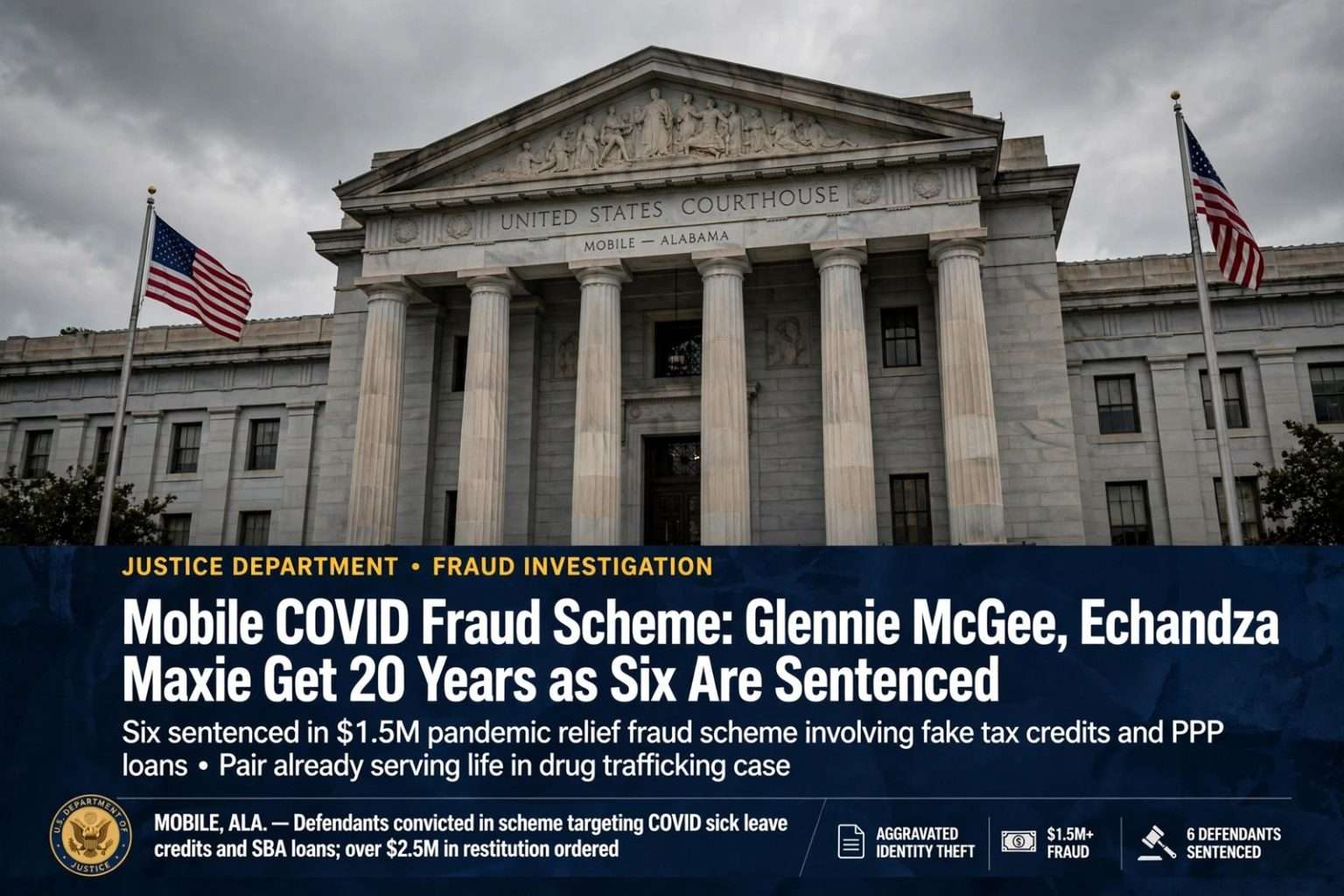
MOBILE, Ala. — A Mobile tax preparer and her husband, already serving life sentences in a drug trafficking case, have each been sentenced to 20 years in federal prison, plus a mandatory two years for aggravated identity theft, in a Mobile COVID fraud scheme that prosecutors say siphoned more than $1.5 million in pandemic-era tax credits, according to the U.S. Department of Justice.
Echandza Maxie and Glennie McGee were among six people sentenced in connection with the schemes, which federal prosecutors say targeted two kinds of pandemic relief: refundable tax credits for COVID-19 sick and family leave, and Small Business Administration loans made through the Paycheck Protection Program and the Economic Injury Disaster Loan program.
Five defendants were sentenced in the main case, and a sixth, Jamael Nettles, was sentenced separately for his role in the tax fraud scheme, according to a Justice Department news release. All of the defendants pleaded guilty.
How the Mobile COVID fraud scheme was uncovered
According to the release, the schemes came to light during a different investigation that led to a wiretap of a phone belonging to John David Clarke of Mobile. While monitoring that phone, FBI agents uncovered what the release described as a “large-scale tax fraud scheme.”
Court documents show that Echandza Maxie owned and operated a tax preparation business in Mobile called “Self Made Taxes,” which reportedly operated alongside a clothing store, an eyelash business and other businesses. Her sister, Edeszann Maxie, also worked as a tax preparer.
The two sisters, along with Echandza Maxie’s husband, Glennie McGee, as well as Tiveria Populus, Jamael Nettles, Clarke and others, took part in a number of fraud schemes, the release said.
Recruiters, finder’s fees and stolen identities
Prosecutors said the operation depended on gathering personal information from people who had not yet filed their taxes.
“The defendants enlisted recruiters who were paid finder’s fees to obtain names, dates of birth, and Social Security numbers belonging to prospective taxpayers,” the release said.
The only requirements, according to the release, were that the prospective taxpayer had not yet filed taxes and did not owe child support. No effort was made to determine whether the people actually ran businesses.
“They did not obtain information necessary to determine whether the taxpayer actually operated a business or otherwise qualified for the COVID-19 tax credits,” the release said.
Fictitious landscapers and hairstylists
Using that information, Echandza and Edeszann Maxie created fictitious self-employed businesses — frequently landscaping or hairstyling businesses — and filed fraudulent tax returns claiming the maximum COVID-19-related sick and family leave credits of $30,000 per return, according to the release. The pair also fabricated business revenues for the 2021 tax year.
Many of the resulting refunds were sent to bank accounts controlled by the defendants. Although a number of the returns were identified as fraudulent and rejected by the IRS, the scheme still generated more than $1.5 million in fraudulent tax refunds, prosecutors said.
Taxpayers who trusted the preparers
The release said the people whose information was used fell into several groups. Some believed they truly qualified for pandemic relief and relied on the defendants to prepare accurate returns.
“Some individuals whose information was used in the scheme believed they were legitimately eligible to receive COVID-19 relief and trusted the defendants to prepare accurate tax returns on their behalf,” the release said. “Some individuals unfamiliar with the tax-filing process paid between $10,000 and $15,000 to have their returns prepared, believing the payments were legitimate tax-preparation fees.”
Others did not know returns had been filed in their names at all. Still others did not know their returns contained false information, including claims that they operated businesses they never owned or ran.
For taxpayers, a fraudulent return filed under their name can create real problems, because the person whose identity appears on a return is generally the one the IRS will contact about it. Anyone who suspects a return was filed using their information can report identity theft to the IRS.
PPP and EIDL loan fraud
The tax scheme was not the only fraud. Every defendant except Nettles also applied for and received dozens of PPP and EIDL loans using fraudulent information, according to the release.
Both programs were run through the Small Business Administration. The Paycheck Protection Program offered forgivable loans meant to help businesses keep workers on the payroll, while the Economic Injury Disaster Loan program provided financial assistance to businesses suffering economic losses because of the pandemic. Because the programs were designed to move money quickly to struggling businesses, they became frequent targets of fraud nationwide.
What the COVID leave credits were meant to do
The tax credits at the center of the case were refundable credits for paid sick and family leave. Congress created them during the pandemic to reimburse eligible employers and self-employed people for qualified leave taken because of COVID-19.
Because the credits were refundable, a claim could generate a cash refund even if the filer owed no tax. That feature is what made inflated or invented claims lucrative: a return claiming a fake self-employed business and the maximum credit could produce a substantial payout if it was not caught.
The sentences
The defendants pleaded guilty and received the following sentences, according to the Justice Department:
Echandza Maxie
Maxie was sentenced to 20 years in prison, followed by a mandatory two-year consecutive sentence for aggravated identity theft. She was ordered to pay $1,576,358.88 in restitution to the IRS and $257,413.93 to the SBA.
Her 20-year sentence, not counting the mandatory consecutive term for aggravated identity theft, will run concurrently with her life sentence on convictions related to a multimillion-dollar cocaine and fentanyl trafficking organization. If she is released, she will be on supervised release for three years. She was also ordered to pay a $300 special assessment and to forfeit about $85,000 in fraud proceeds that the FBI seized during the investigation.
Glennie McGee
McGee was sentenced to 20 years in prison, followed by a mandatory two-year consecutive sentence for aggravated identity theft. He was ordered to pay $672,219 in restitution to the IRS and $340,910.16 to the SBA.
His 20-year sentence, excluding the mandatory consecutive term, will run concurrently with his life sentence stemming from his multimillion-dollar cocaine and fentanyl trafficking organization. If released, he will face three years of supervised release. He was also ordered to pay a $300 special assessment.
Edeszann Maxie
Edeszann Maxie was sentenced to 135 months in prison — 11 years and three months — followed by a mandatory two-year consecutive sentence for aggravated identity theft. She was ordered to pay $187,301 in restitution to the IRS and $298,667.70 to the SBA. After her release, she will be on supervised release for three years. She was also ordered to pay a $300 special assessment.
John David Clarke
Clarke was sentenced to 20 years in prison and ordered to pay $28,764.10 in restitution to the IRS and $55,167 to the SBA. His sentence will run concurrently with a separately imposed 20-year sentence for his convictions related to a large-scale cocaine trafficking conspiracy. After release, he will be on supervised release for three years. He was also ordered to pay a $200 special assessment.
Tiveria Populus
Populus was sentenced to time served and ordered to pay $28,764.10 in restitution to the IRS and $46,206.29 to the SBA. Populus will be on supervised release for five years and was ordered to pay a $200 special assessment.
Jamael Nettles
Nettles, whose case was handled separately, was sentenced to five days in prison and ordered to pay $29,339 in restitution to the IRS. He will be on supervised release for three years and was ordered to pay a $100 special assessment.
By the numbers
- More than $1.5 million: Fraudulent tax refunds generated by the scheme, according to prosecutors
- $30,000: Maximum sick and family leave credit claimed on each fraudulent return
- $10,000 to $15,000: What some taxpayers paid, believing it was a legitimate preparation fee
- About $85,000: Fraud proceeds seized by the FBI that Echandza Maxie must forfeit
- About $2.5 million: Combined restitution ordered to the IRS across all six defendants
- Nearly $1 million: Combined restitution ordered to the SBA across the five defendants in the loan scheme
What the prosecutor said
U.S. Attorney Sean P. Costello of the Southern District of Alabama said the case involved theft from programs meant to help people in an emergency.
“The defendants exploited programs created to provide relief to businesses and individuals during an unprecedented national crisis, stealing millions of dollars through fraudulent tax returns and applications for pandemic relief,” Costello said. “Fraud of this kind does more than steal money from the government — it undermines the integrity of our tax system and diverts resources away from the people and businesses who were entitled to receive them.
“I commend IRS Criminal Investigation and our other law enforcement partners for following the financial trail, uncovering this scheme, and holding fraudsters responsible.”
Understanding the sentences
Aggravated identity theft carries a mandatory two-year prison term under federal law, and that term must be served consecutively — on top of — any other sentence. That is why the two-year terms for Echandza Maxie, McGee and Edeszann Maxie were added after their other prison time rather than running alongside it.
A concurrent sentence, by contrast, is served at the same time as another sentence. The 20-year terms for Echandza Maxie and McGee, and Clarke’s 20-year term, were ordered to run concurrently with sentences they are already serving in drug cases. The federal system does not offer parole, and supervised release begins only if a defendant is released from prison.
Restitution orders require defendants to repay victims — here, the IRS and the SBA — for losses caused by the crimes. Special assessments are fixed fees imposed on each count of conviction in federal court.
Background: The McGee drug case
McGee and Echandza Maxie have been at the center of one of the most closely watched federal cases in Mobile in recent years. A federal jury convicted them in a drug-and-gun conspiracy case, and a judge later sentenced both to life in prison. Prosecutors alleged McGee ran a large-scale drug distribution network that used children as couriers. After those life sentences, a judge scheduled a hearing over forfeiture amounts as prosecutors alleged the couple had been moving assets.
The case has continued to generate related prosecutions. A federal grand jury recently charged a Mobile woman with retaliating against witnesses who testified against McGee at trial; she has pleaded not guilty and is presumed innocent.
What happens next
With guilty pleas entered and sentences imposed, the defendants will serve their prison terms in the custody of the federal Bureau of Prisons, while restitution, forfeiture and special assessments are collected under the court’s judgments. The Justice Department release did not say whether any defendant plans to appeal, and it did not identify the other participants it referred to as having taken part in the schemes.