Mobile Doctors Hope Chadwick Boseman’s Death Spurs Colon Cancer Screenings
Chadwick Boseman's death at 43 is a 'wake-up call,' say Mobile oncologists urging earlier colon cancer screenings, especially for African Americans.
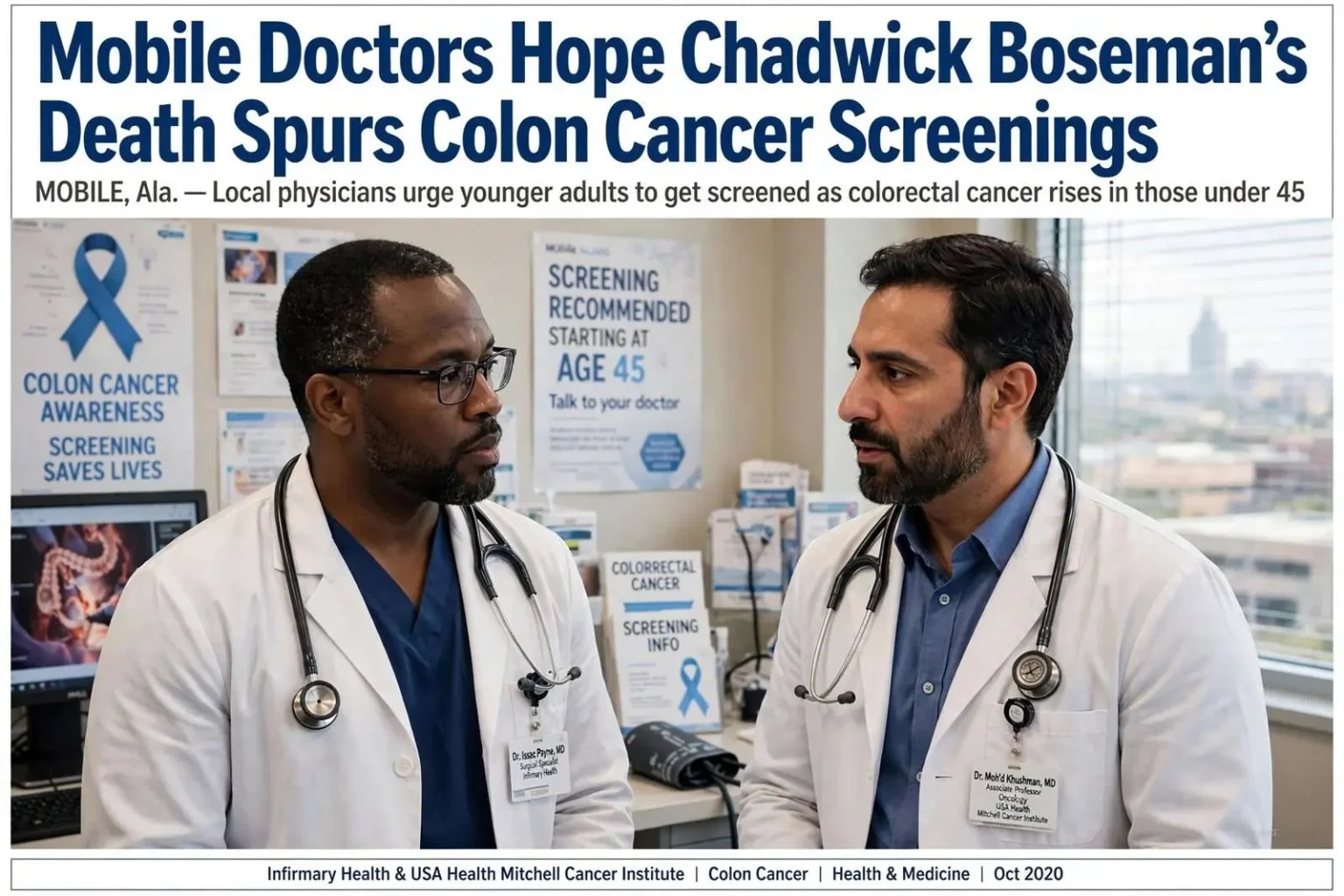
MOBILE, Ala. — The death of actor Chadwick Boseman at just 43 has Mobile doctors and oncologists using the moment to deliver a pointed message about colon cancer: it does not care how young or healthy you seem. Boseman, best known for his portrayal of Black Panther, died in late August 2020 after a private battle with the disease, and the news landed with particular force in exam rooms and clinics across Mobile County, where physicians have spent years trying to persuade patients to take colon cancer screening seriously.
“It’s kind of a wake-up call,” said Dr. Issac Payne, a surgical specialist with Infirmary Health. “Colon cancer is the third leading cause of cancer-related deaths in the United States.” Payne noted that about 1 in 23 Americans will develop colon or rectal cancer at some point in their lives — odds that put the disease in a category few people appreciate until it touches someone they know. For a cancer that is often slow-growing and highly treatable when caught early, those numbers are a standing argument for screening rather than waiting for symptoms.
The shock of Boseman’s death, doctors here say, comes from the mismatch between his public image and the disease that killed him. He was young, physically demanding roles were his signature, and his illness was never disclosed publicly until his death. Physicians hope that surprise translates into action among patients who have long assumed colorectal cancer is an older person’s disease — particularly the large group of adults in their forties who have never discussed screening with a doctor.
Local physicians point out that Mobile’s medical community is well positioned to absorb a surge of interest in screening. Infirmary Health operates hospitals and clinics across the region, and USA Health — the University of South Alabama’s health system — runs the Mitchell Cancer Institute, the area’s academic cancer center. Between the two systems, residents have access to gastroenterologists, surgical oncologists and medical oncologists who can take a patient from a first screening conversation through treatment without leaving the Gulf Coast.
Screening age is dropping
Screening is now recommended starting at 45 — a threshold that was lowered from 50 as evidence mounted that colorectal cancer is appearing in younger adults at rising rates. But Boseman’s death at 43 underscores that the disease can strike earlier still, and that guideline ages are statistical starting points, not guarantees. Doctors stress that anyone with warning signs — persistent changes in bowel habits, unexplained weight loss, fatigue, or blood in the stool — should raise the issue with a physician regardless of age.
The change in the guideline itself was years in the making, driven by data showing new cases climbing steadily in adults in their forties while rates in older groups fell as screening took hold. Health systems across Alabama, including the ones serving Mobile, have since adjusted their outreach to remind patients approaching the new threshold that a screening conversation belongs on the calendar alongside other midlife checkups. The hope among physicians here is that Boseman’s story reaches exactly the adults the lowered guideline was written for — people who feel too young to be thinking about colon cancer at all.
Dr. Moh’d Khushman, an associate professor of interdisciplinary clinical oncology at USA Health Mitchell Cancer Institute, said earlier screening for younger patients is becoming part of the norm as oncologists see more cases in people under the guideline age. He urged younger adults not to dismiss symptoms simply because they fall outside the recommended screening window.
“If you’re younger than 45, do not ever assume because you’re younger you’re not going to have colon cancer,” Khushman warned. “If you have symptoms that are persistent, then do not take it lightly.” His message is directed squarely at the generation that grew up hearing colorectal cancer described as a disease of grandparents, and at primary care doctors who may need to weigh symptoms in younger patients against a screening schedule that does not yet call for a colonoscopy.
The screening options themselves have widened in ways that make starting easier than it once was. A colonoscopy remains the gold standard because it allows a physician to both detect and remove precancerous polyps in a single procedure, but stool-based tests offer a less invasive first step for patients who are hesitant about the preparation and time commitment of a full scope. Doctors in Mobile emphasize that the best test is the one a patient will actually complete — an abnormal result on any screening test is followed by a colonoscopy.
Payne and other surgeons here see the consequences of delayed screening directly. Colon cancer caught at an early, localized stage is associated with far better outcomes than disease discovered after it has spread, and surgery — Payne’s specialty — is often curative in early-stage cases. That gap between early and late detection is the single most important reason physicians seize on moments like Boseman’s death to press the message home.
Disparities and hope
Boseman’s death also shines a light on another reality: African Americans face a disproportionately high risk of being diagnosed with the disease, and at younger ages than other groups. In a city like Mobile, where Black residents make up a large share of the population, physicians say that disparity is not an abstraction but a daily feature of the cases they see.
“African Americans are disproportionately affected compared to Caucasians,” Payne said. “And while it’s an unfortunate situation with Mr. Boseman, colon cancer is survivable.” The warning comes paired with deliberate reassurance: despite the disease’s standing among the deadliest cancers in the country, it is among the most preventable when precancerous polyps are found and removed, and among the more treatable when it is caught before it advances.
The reasons behind the racial disparity are complex and layered. Differences in screening rates, access to primary care, insurance coverage, diet and the age at which screening begins all contribute, and researchers have debated for years whether African American patients should begin screening even earlier than the standard recommendations. What doctors on the Gulf Coast emphasize in the exam room is simpler: know your family history, get screened on schedule, and never talk yourself out of pursuing persistent symptoms.
Family history is one of the strongest predictors in colorectal cancer, and it is a detail many patients have never assembled. First-degree relatives — a parent, sibling or child — diagnosed with colon or rectal cancer put a patient in a higher-risk category that typically moves the recommended start of screening earlier, sometimes by a decade or more. Physicians here encourage patients to ask relatives about diagnoses and to bring that history to their first screening conversation, because it changes the calendar.
Both doctors stressed that early diagnosis is key — and that even for those who have missed recommended screening windows, catching the disease early can still make all the difference. A patient who has never been screened and is now well past 45 has not lost the chance to benefit; the conversation simply becomes more urgent. The tools, the specialists and the treatment infrastructure are already in place across Mobile.
What Mobile patients can do now
The practical takeaway local physicians are offering is a short list. Adults at average risk should plan to begin screening at 45, either with a colonoscopy or a stool-based test discussed with a primary care provider. Anyone younger than 45 with persistent bowel changes, bleeding, unexplained anemia or weight loss should be seen rather than wait. Patients with a family history of the disease should start that conversation earlier still. And a symptom that does not resolve should never be dismissed as too minor to raise.
Cost and access, often the quiet barriers behind Mobile County’s screening gaps, have eased somewhat as insurers have moved to cover preventive colorectal screening without out-of-pocket charges for patients who follow the recommended schedule. Community health centers in the area can help uninsured patients arrange screening or a referral, and both major health systems accept patients whose first contact comes through an emergency room or a family member’s urging. Doctors say the hardest step remains the first one — the phone call — and they are urging residents to make it while they feel healthy rather than after symptoms appear.
Boseman’s illness, kept private until his death, became a national conversation about a disease that kills quietly and preventably. Mobile’s doctors say the actor’s legacy on this front could be measured in screening appointments scheduled by people who had spent years putting them off. The message they are repeating in clinics from Infirmary Health facilities to the Mitchell Cancer Institute is the one Payne distilled: the disease is common, it strikes young, it hits some communities harder than others — and it is survivable when found early.