Mobile Downtown Airport Opens as Via Air Stays Grounded
Mobile's new downtown airport celebrated its opening with a ribbon-cutting at Brookley, but Via Air remains grounded as officials shift their focus to growing Frontier Airlines service and planning the terminal's next expansion.
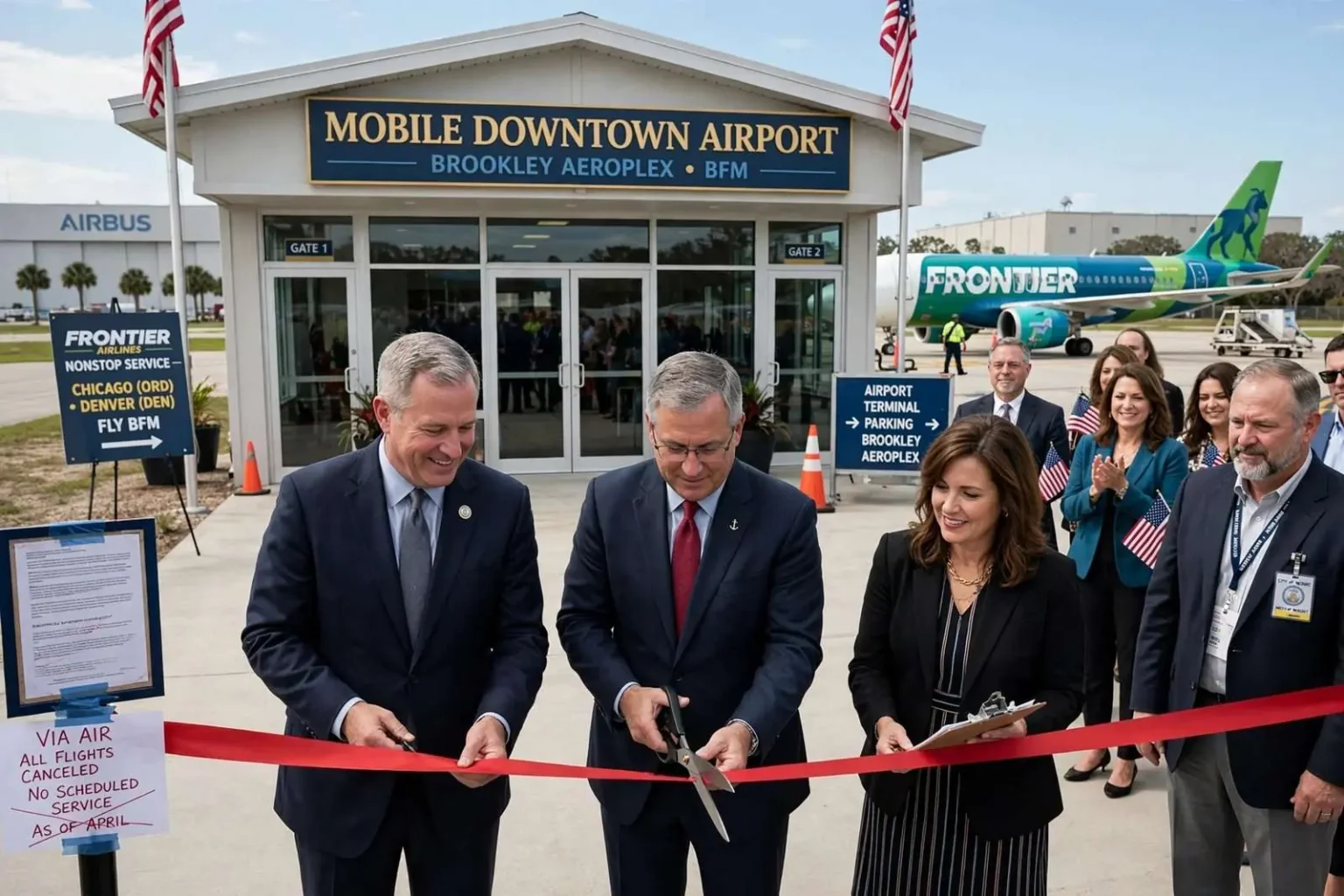
Mobile’s new downtown airport officially celebrated its opening with a ribbon-cutting ceremony at the Brookley Aeroplex, even as one of the carriers that had been expected to anchor the terminal remains absent from the flight schedule. Via Air, which had operated flights between Mobile Regional Airport and Orlando Sanford International Airport in Florida, has not flown out of the Port City since mid-April, and the airline’s future plans locally remain unclear.
“They’ve canceled all their flights for the foreseeable future,” Mobile Airport Authority President Chris Curry said.
Via Air was the first carrier to say it intended to use the new downtown terminal when it announced plans to begin flying out of Mobile in February 2018. Even so, Curry said the airline was never expected to play a major role in the airport’s operations.
“They were scheduled to fly out four times per week on 50-seat jets,” Curry said. “So far, Frontier has five flights per week on 186-seat jets. So, Via was a small part of the plan.”
The arithmetic told the story: one carrier’s four weekly 50-seat departures were a gesture at the new market, while Frontier’s five weekly flights on aircraft more than three times the size were the actual service. From the authority’s perspective, losing Via Air — however awkward the optics at an opening ceremony — subtracted a fraction of the schedule, not the terminal’s reason for existing.
Curry said Via Air’s struggles appear to extend well beyond Mobile, as the airline reevaluates its overall business model.
“They’ve pulled back on flights out of Austin, Texas, as well as plans in Birmingham,” Curry said. “They’re looking system-wide to re-address what they’re trying to do.”
In the meantime, airport officials said their attention is focused on supporting Frontier Airlines and pursuing expansion opportunities, as well as recruiting additional low-cost carriers to serve the region.
“We never did slow down on our pursuit to get more carriers,” Curry said.
The downtown terminal is currently a modest facility with only two gates, meaning slow, steady growth will be necessary to make the best use of the space until the authority can move into the second phase of construction, according to Curry.
Officials said they are working to boost the number of inbound passengers traveling to Mobile from Frontier’s current destination cities, Chicago and Denver.
“We’re working with Visit Mobile to market to destination cities,” Curry said.
Despite being open only a short time, the Mobile Downtown Airport is already the subject of expansion discussions among Mobile Airport Authority leadership. Authority Chairman Elliot Maisel told a crowd gathered for the ribbon-cutting that expansion could move forward once Airbus vacates half of the building it has used as a logistics center, a move expected by June 30.
The shared building is a distinctly Brookley arrangement. Airbus, which assembles A320-family aircraft at the adjacent final assembly line, had occupied half of the structure the authority plans to grow into; when the planemaker vacates its share, the airport gains a building’s worth of usable square footage without pouring a new foundation. That timing, more than any ceremony, set the pace of the downtown airport’s growth curve.
Maisel said the airport’s long-term plans could ultimately include two or three separate terminals as the facility grows.
“This is a temporary terminal,” Maisel said. “We’ll have a primary and a main terminal in a few years.”
Maisel also told the crowd that the authority has already fielded inquiries from a primary carrier currently based at Mobile Regional Airport about the possibility of relocating downtown, though he said the new terminal isn’t ready for that kind of move yet.
“We’re just getting started,” Maisel said. “Stay tuned and come support it. We want it to transform the city and we think it can, but you have to support it.”
Maisel urged the public to back the airport by booking flights on Frontier Airlines’ routes from Brookley Field, known by the airport code BFM, to O’Hare International Airport in Chicago and Denver International Airport.
Use It or Lose It
“We’ve got to support Frontier in order to see more flights to more destinations,” Mobile Mayor Sandy Stimpson said at the event. Mobile Area Chamber of Commerce President and CEO Bill Sisson also encouraged residents to choose Frontier and the downtown airport when booking travel.
“The phrase is ‘use it or lose it,’ and we need to use it,” Sisson said. “If we can do that, we’ll get more flights to more destinations, and I think we can.”
The relocation inquiry Maisel referenced pointed to the structural question underneath the ribbon-cutting: whether Mobile’s air service eventually consolidates downtown. The Brookley site — minutes from downtown hotels, the convention district and the port — has an accessibility advantage Mobile Regional, off Airport Boulevard in west Mobile, cannot match for business travelers. But moving a primary carrier means gates, customs capacity if international routes are sought, and terminal space the two-gate facility does not yet have. Maisel’s point was that the inquiry existed and the answer waited on construction.
The terminal’s modest footprint was a deliberate first phase rather than a limitation imposed by doubt. The authority converted part of an existing Brookley building, kept the capital outlay proportional to the known demand, and reserved the bigger investments — a second phase, and eventually separate terminals — for the point where passenger counts justify them. It is the same sequencing any growing airport follows; Mobile is simply doing it with a building it already owns.
The warning was grounded in how airlines actually make route decisions. A carrier commits airplanes and crews to a market when the flights fill; if load factors sag, the route is the first item on the next schedule review. Frontier’s Chicago and Denver service, launched from a two-gate terminal weeks old, was a bet on Mobile travelers behaving like travelers in any other city — that convenience would draw them off the regional airport and onto the new one. Sisson’s message to the business community was that the bet’s outcome sat partly in their own booking choices.
Sisson said the nonstop flights to Denver, which open access to West Coast markets, and to Chicago have already begun to benefit the local business and economic development community.
“Having nonstop flights to Denver and Chicago is important for the business community,” Sisson said. “It’s already getting interest for economic development.”
For Mobile recruiters, a nonstop to Denver or O’Hare changes a conversation. Prospective employers considering a Gulf Coast expansion ask practical questions — how far is the airport, who flies where, how long is the trip to headquarters — and the answers in Mobile had long involved a connection through Atlanta or Dallas for anything west or north. Two nonstops to Fortune 500 territory made the city easier to reach and easier to sell.
David Clark, president and CEO of Visit Mobile, said the new airport has already played a role in landing 1,400 hotel room nights from a Midwest group scouting locations for a 2022 convention.
“No pun intended, but this will give us a major lift in travel and tourism,” Clark said. “It’s a major game changer in travel and tourism.”
The ribbon-cutting ceremony also included the swearing-in of Rod Young as the Mobile Airport Authority’s new police chief. Young, a Theodore native, joins the authority after more than two decades of service with the Tallahassee Police Department in Florida, from which he recently retired.
For a facility opening with two gates and an uncertain second carrier, the day’s announcements were pitched deliberately at the long term: a shared building half-empty now, a terminal described as temporary, an airline courtship that continued without pause. The officials who cut the ribbon were asking Mobile to measure the airport not by its opening week schedule but by what the Brookley field — runway, rail, interstate and all — could become once the flights proved the market. The distinction between the two, everyone at the podium agreed, would be decided by the tickets Mobile residents bought.
Behind the growth plans sits the fact that made the whole project possible: Brookley is no longer an abandoned base. The Airbus final assembly line, which turned out its first Mobile-built aircraft in 2015 and has expanded multiple times since, rebuilt the old airfield into one of the Gulf Coast’s premier industrial sites — thousands of jobs, supplier plants, and the credibility that let the airport authority describe a downtown airline terminal as plausible rather than aspirational. The passenger terminal and the assembly line share the field, and each has made the other’s pitch easier.
Young’s appointment rounded out the day’s housekeeping. An airport police chief at a two-gate terminal might seem a small portfolio, but Brookley’s security picture is unusually broad for its size — a shared industrial campus, a growing passenger operation, and the general-aviation traffic that has always used the field. A chief with two decades of big-city policing, and hometown roots in Theodore, brought both the experience and the local knowledge the authority wanted as the operation scales.