
Mobile Fire-Rescue Battles Blaze at Abandoned Birdville Apartment Building
Mobile Fire-Rescue crews were dispatched around 9:36 p.m. Friday to an abandoned two-story apartment building in the Birdville community near Raven Drive and Cardinal Drive West, arriving to heavy flames. No injuries were reported.
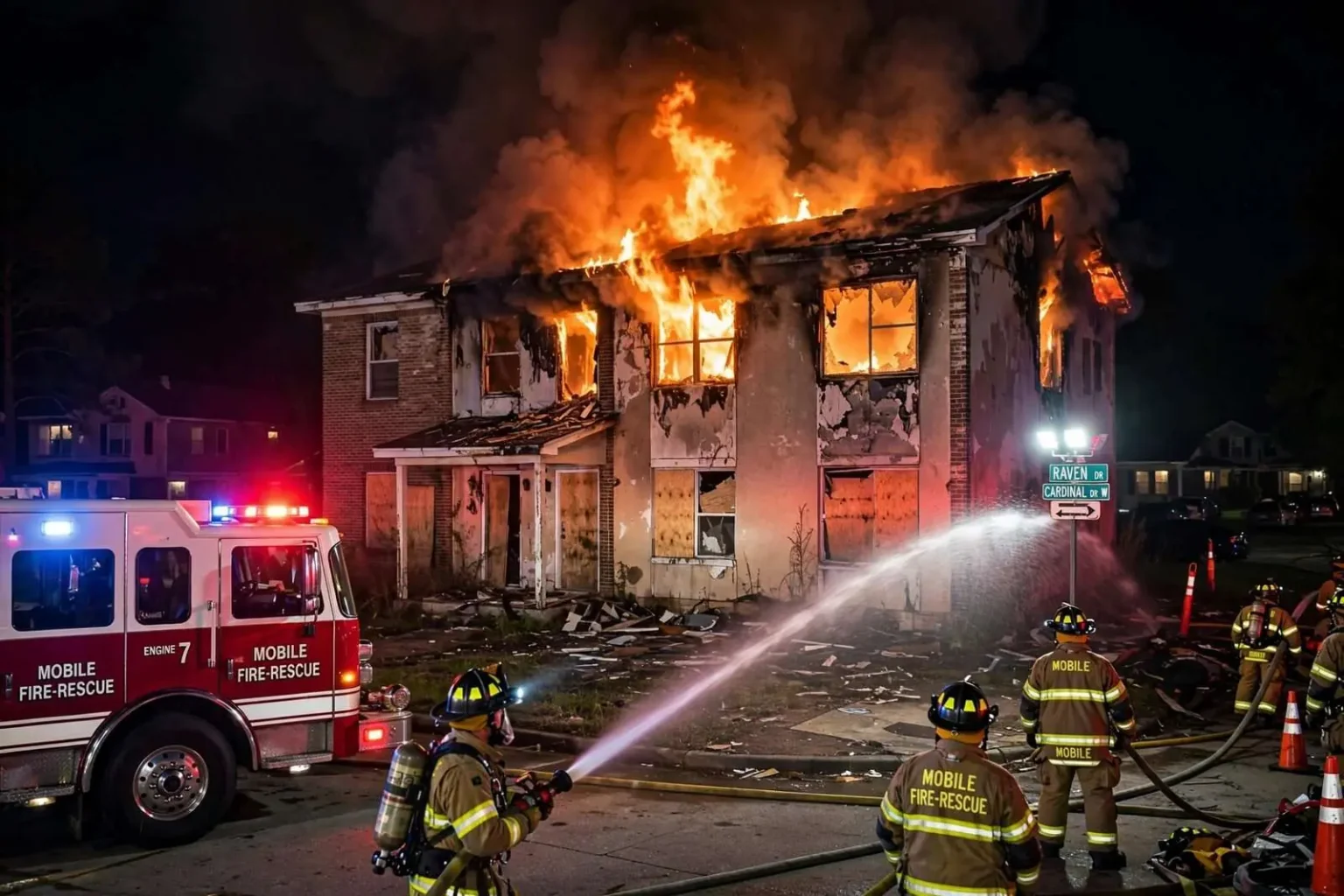
MOBILE — Mobile Fire-Rescue Department crews battled heavy flames at an abandoned two-story apartment building in the Birdville community late Friday night, according to fire officials.
MFRD said in a news release that crews were dispatched around 9:36 p.m. to a reported fire at the apartment complex near Raven Drive and Cardinal Drive West, and arrived to find flames showing in a structure with no residents inside. No injuries were reported.
A Vacant Building Changes the Tactics
Without residents, an abandoned building often goes unnoticed in its early stages, allowing a fire to burn freely until flames or smoke show from the exterior. Neighbors reporting a glow or smoke from a property they believed was empty are frequently the first alarm, and by the time companies arrive the fire has often advanced further than it would in an occupied home, where smoke alarms and waking residents shorten the interval between ignition and the 911 call.
Fires in unoccupied buildings occupy a difficult space in firefighting. Because no one is known to be trapped, crews can fight the fire defensively, but vacant structures bring their own dangers: weakened floors, accumulated debris, stripped wiring, unknown utility status and the possibility of squatters or trespassers inside.
Firefighters typically approach a reported vacant-structure fire assuming someone could still be inside until a search says otherwise, which slows the attack and adds crews to the assignment. In a two-story layout, the risk of floor collapse sends companies to defensive positions faster than in a sound, occupied structure.
Missing fixtures, holes cut into walls and floors and accumulated debris give crews less stable footing and more fuel to work against, and fire officers weigh those conditions against the value of an aggressive interior attack. A fire that has already extended into the attic or the open wall cavities of a deteriorating building is rarely stopped without significant overhaul afterward.
A Late-Night Call in West Mobile
The intersection sits in a residential stretch of west Mobile where apartment complexes and single-family neighborhoods sit side by side. The late-hour dispatch added the usual complications of a nighttime call — limited visibility, and a residential neighborhood settling in for the night around a working fire. Crews worked to knock down the flames and keep them from spreading to occupied homes or buildings nearby.
A response of that kind follows a familiar sequence: a first-arriving engine reporting conditions, incident command established, a water supply laid in from a hydrant, and crews assigned to attack, ventilation and search as the situation on scene allows. Because the building was abandoned, the search priority shifts from rescuing residents to confirming that no squatters, trespassers or firefighters are inside — a check that vacant buildings make both more necessary and more dangerous.
About Birdville
Birdville is a long-established community in west Mobile, an area of older neighborhoods, churches and small businesses west of the city’s core. The community’s housing stock includes apartment complexes built decades ago, and like many such properties across Mobile, some have aged out of active use.
Mobile Fire-Rescue’s Response
Mobile Fire-Rescue is the primary fire and emergency medical service for the city, operating fire stations across the city limits and responding to tens of thousands of calls a year, the majority of them medical. Structure fires make up a smaller share of the workload but demand the largest deployments, often pulling units from multiple stations and leaving neighboring districts covered by mutual aid or repositioned crews. A typical structure fire assignment brings multiple engines, a ladder truck, a district chief and support units, with mutual aid from neighboring volunteer and municipal departments when a scene demands more manpower than the initial assignment can supply.
The department’s history runs nearly as deep as the city’s. Organized in the nineteenth century, when Mobile’s dense downtown and its riverfront warehouses made fire the perennial fear of the port city, the service expanded as the city spread west and south from Mobile Bay, adding stations as neighborhoods like the one near Raven Drive filled in during decades of postwar growth. Today it trains for a mix of urban and suburban risks, from high-rise and port facility incidents to the residential fires and medical calls that make up the bulk of its workload.
Investigation and What Follows
The department typically follows significant fires with an investigation to determine the cause. Investigators look at a fire’s point of origin, burn patterns, utility history and any evidence of human activity, and in vacant-structure cases the question of cause carries extra weight. Officials generally ask anyone with information about a suspicious fire to come forward through the department’s arson tip channels.
Deliberately set fires in abandoned buildings are a persistent category nationwide, and determining a point of origin in a structure with a history of intrusions takes careful examination before any cause can be ruled in or out. Departments bear recurring costs from the pattern as well: beyond the expense of the response itself, crews must return to a burned vacant property for overhaul.
As of the department’s release, the immediate questions — the fire’s cause, the extent of damage and the building’s fate — sit with investigators and the city’s code processes. Residents near the scene can expect activity at the property in the days ahead as crews confirm the structure is stable and secure.
A Recurring Hazard
Vacant apartment buildings are a recurring challenge for fire departments in cities of Mobile’s size. Once a structure sits empty, it can attract trespassers, and any fire there draws questions about security, ownership and demolition. The National Fire Protection Association has long documented that a disproportionate share of structure fires occur in vacant or unused buildings, along with a disproportionate share of firefighter injuries, since those fires are fought in compromised structures under less predictable conditions. Fire officials urge residents to report smoke, flames or suspicious activity at vacant properties immediately rather than assuming someone else has called, and to give dispatchers an accurate address or intersection so the right companies are sent the first time.
When a multifamily property empties out, the buildings can sit for months or years while owners and lenders sort out the property’s future, and in that interval an unsecured unit becomes a target for vandalism, copper theft and unauthorized occupancy. Each of those activities raises fire risk: stolen wiring leaves energized lines exposed, scavenged materials pile up as fuel, and occupants without electricity resort to candles or open flames for light and heat.
For the people who live around an abandoned complex, the risks are not abstract. A fire in a vacant building can threaten adjacent occupied homes, and repeated incidents depress property values and invite further blight. Neighborhood associations and crime-prevention groups in Mobile have pressed for years for tighter code enforcement on vacant properties, faster demolition of structures deemed unsafe, and better communication from owners about security measures such as boarded windows, fencing and working exterior lighting.
Residents are also urged to keep their own properties clear of the conditions that feed such fires — accumulated debris, overgrown lots and unsecured outbuildings — and to make sure their own smoke alarms are working, since a fire in one structure rarely stays contained to it.


