Mobile Fire-Rescue Gives Trailblazing Chief LeAnn Tacon a Downtown Send-Off
Mobile Fire-Rescue paraded downtown for District Chief LeAnn Tacon, the department's first female firefighter, captain and chief, retiring after 33 years.
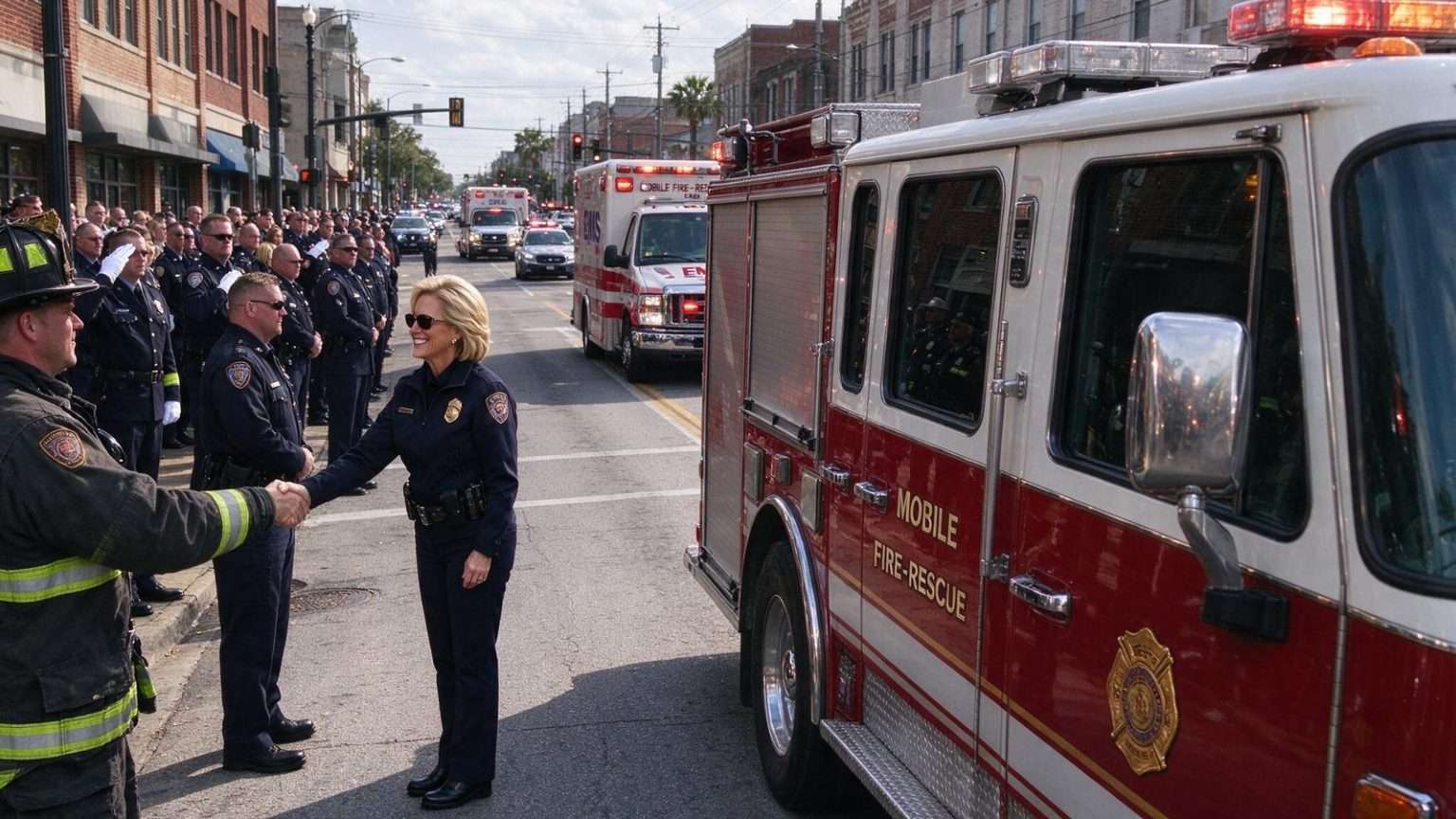
MOBILE, Ala. — After 33 years with the Mobile Fire-Rescue Department — and a career full of firsts — District Chief LeAnn Tacon got a parade. Fire trucks, police cruisers and county EMS units rolled through downtown Mobile on Wednesday morning, joined by city and county leaders, to honor Tacon on the eve of her retirement after more than three decades of service. The procession traced the city’s downtown streets in her honor, sirens and lights announcing a career that began in 1988 when a young woman walked into a fire station and changed what the department would look like forever.
The send-off drew responders from across the region, a measure of the respect Tacon earned in a career spent largely behind the scenes of the department’s emergency medical operations. Apparatus from Mobile Fire-Rescue led the way, joined by Mobile police cruisers and county EMS units whose crews climbed down to shake her hand. City and county leaders turned out along the route, and the morning procession doubled as a working farewell from the men and women who staff the region’s ambulances and engine companies — the workforce Tacon served for a generation from her post at Central Fire Station.
Parades through downtown Mobile usually honor Mardi Gras mystic societies or championship teams; Wednesday’s belonged to a retiring district chief, and no one who has followed the department’s history questioned whether she earned one. Tacon’s 33 years spanned an era in which the department transformed — from a firefighting agency with an ambulance service into the city’s full-spectrum emergency response organization — and she was a pioneer in that transformation from her first day on the job.
A Career of Firsts
Tacon broke barriers from the day she joined the department in 1988 as its first female firefighter. At a time when fire service nationwide remained overwhelmingly male, she took the same physical tests, worked the same shifts and rode the same calls as her colleagues, opening a door in Mobile that had never been opened before. Her hiring was more than a personnel note — it reset expectations inside a department and across a city about who could wear the badge, and in the years that followed, other women followed the path she cleared.
She went on to become the department’s first female captain and later its first female district chief, climbing the promotional ladder rung by rung in a profession where each advancement tests a different set of skills. By the time she reached district chief, Tacon was overseeing the EMS division’s administrative operations at Central Fire Station — the administrative nerve center that keeps the medical side of Mobile’s emergency response running. The rank also made her the highest-ranking woman in department history to that point, a capstone to a career that had accumulated firsts the way other careers accumulate routine promotions.
Colleagues describe a through-line across those decades: the same steadiness whether she was answering calls as a rookie firefighter or managing division-wide operations as a chief. The parade’s mix of fire, police and EMS participants reflected the breadth of that career — a responder respected across disciplines, in a profession where respect is earned one call, one shift and one crisis at a time.
Keeping the City’s Medical Lifeline Running
The division Tacon oversaw handles work most residents never see until they need it. Under her administration, the EMS division managed medical reporting, licensing for department personnel and controlled-drug inventory — the regulatory backbone that keeps every ambulance and medic unit in compliance and every paramedic certified to practice. Controlled-drug accountability in particular is a discipline of constant documentation, a responsibility that places the division at the intersection of emergency medicine and regulation, where errors carry consequences both legal and clinical.
The division also coordinates medical coverage for more than 300 special events across the city each year. The list reads like a calendar of Mobile life: Mardi Gras, with its parade routes packing downtown crowds night after night through the Carnival season; college football and baseball games drawing tens of thousands to the city’s venues; the Azalea Trail Run winding through the city’s historic streets each spring; and the Greater Gulf State Fair filling its grounds each fall. Every one of those events requires a medical plan — staffing, positioning, communications and transport routes — worked out in advance with event organizers, police and other agencies, so that when someone goes down in a crowd, help is seconds away rather than minutes.
That logistical invisible work is where Tacon’s career made its daily mark. The parade route coverage plans, the fairgrounds medic stations, the stadium standby crews — all of it flows through the division she ran. Generations of Mobile eventgoers who never knew her name were protected by systems she administered, a legacy written in the emergencies that were handled quickly rather than the ones that made the news.
A Department Built Around Medicine
Understanding Tacon’s role requires understanding how central emergency medicine became to the Mobile Fire-Rescue Department during her career. The department has served as the city’s lead EMS agency since 1975, a role that grew as pre-hospital medicine evolved from basic first aid into an advanced clinical discipline. In 1991, the department added ambulance transport capability, meaning its crews could not only respond and stabilize but also carry patients to the hospital — completing the modern emergency care chain and putting Mobile’s fire department in the business of running a fleet of ambulances alongside its engine companies.
That dual identity — fire service and EMS provider — shapes the department’s budget, training and staffing, and it makes the administrative operations Tacon oversaw genuinely consequential. Medical reporting feeds the state and national data systems that shape emergency medicine. Personnel licensing keeps the city’s paramedics and EMTs credentialed. The controlled-drug inventory sustains the legal authority under which medics administer the most powerful tools of their trade. When any link in that chain falters, the whole system feels it; Tacon’s job was to make sure it never did.
Her retirement removes from daily duty a walking institutional memory of how Mobile’s EMS system matured. The chiefs and firefighters who came up under her administration inherit a division that runs — and, on the department’s proudest measure, has always run when the city needed it.
Opening Doors for the Women Who Followed
Tacon’s trailblazing reached beyond her own promotions. When she pinned on her badge in 1988, women in fire service were fighting for footholds in departments across the country, and each first — first hire, first captain, first chief — required proving what opponents said could not be proven. Mobile’s department now counts women among its ranks and leadership in ways that would have been unremarkable to no one in 1988 precisely because paths like Tacon’s made them possible. Young women interviewing for firefighter positions in Mobile today are interviewing at a department her career helped shape.
The significance is not lost on the region’s fire service community. Departments across the Gulf Coast have watched one another’s milestones for decades, and Mobile’s early integration of women into firefighting and EMS leadership stood as an example for neighboring agencies. Tacon’s retirement closes a personal chapter, but the institutional changes she represents are now permanent features of the department she leaves behind.
Downtown Says Farewell
Wednesday morning’s procession gave the city a chance to say what it rarely says in time: thank you. The sight of fire trucks, police cruisers and county EMS units rolling together through downtown Mobile — agencies that daily share the region’s emergencies — united for a single purpose, with city and county leaders looking on. For the retirees and veterans in the crowd, the parade carried the weight of shared history; for the younger responders, it offered a picture of what a full career in the service can look like.
Tacon’s 33 years — from first female firefighter in 1988, to first female captain, to first female district chief, to the administrator who kept the EMS division’s paperwork, licensing and drug inventory airtight while planning medical coverage for more than 300 events a year — trace the arc of a department’s modernization and a city’s growth. Her career outlasted fire chiefs and city administrations, through hurricanes and Mardi Gras seasons without number, and she leaves as she arrived: a pioneer who did the work.
The parade is over and the desk at Central Fire Station is cleared, but the marks of District Chief LeAnn Tacon’s service are permanent — in the women who followed her into the fire service, in the EMS division she administered, and in a Mobile that stands a little safer for her 33 years on the job. The department’s loss on Wednesday was, by every measure, a career to celebrate.