
Mobile Fire-Rescue Knocks Down Shelton Beach Road Extension House Fire; No One Home
Mobile Fire-Rescue knocked down a Shelton Beach Road Extension house fire in 15 minutes; no occupants were home and no one was hurt.
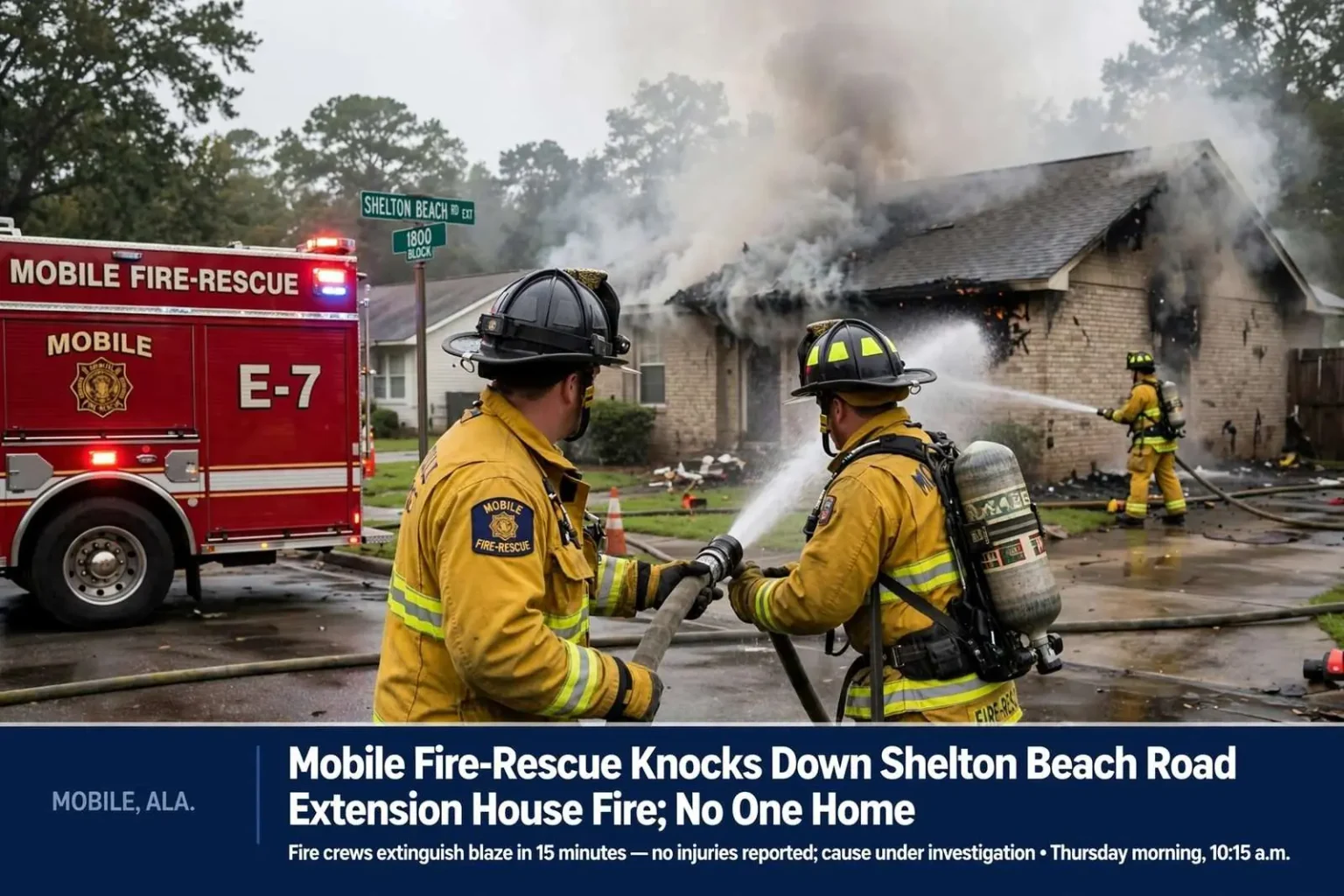
MOBILE, Ala. — Mobile Fire-Rescue crews extinguished a house fire on Shelton Beach Road Extension Thursday morning, and no one was inside the home when it caught fire. The morning blaze brought multiple fire companies to a residential street in west Mobile and ended without injuries, though investigators continued to work the scene into the day to determine what started it.
Fire companies were dispatched around 10:15 a.m. to the 1800 block of Shelton Beach Road Ext, where they found flames and heavy smoke pouring from the rear of the single-story residence. The report of fire showing from a structure typically draws an upgraded response — additional engines, a ladder truck and a command officer — because crews arriving to smoke and visible flames must be ready for the worst: occupants trapped inside, fire spreading into the attic, or structural conditions that could deteriorate without warning.
Crews stretched charged hose lines into the structure while search teams swept the interior to confirm the home was empty — neighbors told firefighters the residents had not been home for several days. That information shaped the search but did not end it. Firefighters cleared room by room anyway, working through smoke conditions with thermal imaging and systematic sweeps, because the only way to be certain a burning house is unoccupied is to walk it. Confirming an empty house is one of the most consequential tasks on a fire scene: it is the difference between an aggressive offensive attack and the more cautious approach crews must take when someone may be inside.
Knocked down in 15 minutes
The department said all visible fire was out within roughly 15 minutes. That pace reflects both the crew’s training and the construction of the home — a single-story structure gives firefighters fast horizontal access to every room, and an attack through the rear, where the fire was concentrated, put water on the burning material quickly. Fire attacks are built around interrupting the fire’s growth before it reaches the attic or breaks through the roof, and a 15-minute knockdown suggests crews arrived while the fire was still contained to the rear portion of the house.
Crews then ventilated toxic smoke and heated gases from the house. Ventilation is the unglamorous science that follows a knockdown: burning materials leave behind a building full of superheated, poisonous gas — carbon monoxide, hydrogen cyanide and a catalog of chemicals from everything synthetic that burned. Crews open the structure in a planned sequence to push those gases out, cool the interior and make the building safe to work in. Without it, smoldering contents can reignite, and the smoke damage that follows even a contained fire can render a home unlivable until it is cleaned and restored.
No firefighters were injured in the response. That is the outcome every fire department aims for, and it is never guaranteed — structural fires are the leading context for firefighter injuries nationwide, and even routine house fires involve collapsing ceilings, hidden fire in wall voids and exhaustion in heavy gear. Thursday’s call ended with every crew accounted for and uninjured, a quiet but essential mark of a well-run scene.
The investigation into the cause
Cause-of-origin investigators continued working the scene, and the fire’s cause remained undetermined pending their findings. Fire investigation is a slow, deliberate discipline: investigators walk the structure from the area of least damage to the area of most, reading burn patterns and char depth to find where the fire started, then working outward from that point to identify the ignition source. Electrical systems, appliances, heating equipment and smoking materials are the usual candidates in residential fires, and reaching a determination can take days if samples are sent to a lab or the damage is extensive.
The fact that the residents had been gone for several days adds a wrinkle to the investigation. An empty house changes the likely scenarios investigators consider — an electrical fault that no one was present to notice, for example, or a fire that smoldered undetected before breaking into open flame. It also means no one was on hand to hear a smoke alarm or call 911 at the first sign of trouble, which allowed the fire to grow before a neighbor spotted smoke or flames and summoned help. Fire officials regularly remind residents traveling out of town to unplug nonessential appliances and ask a neighbor to keep an eye on the property — steps that can turn a day-old fire into a five-minute one.
Shelton Beach Road Extension runs through a residential area of west Mobile where single-family homes sit on established streets, and house fires there draw the kind of neighborhood attention that spreads quickly by phone and social media. By the time crews arrived, the fire’s location in the rear of the home meant much of the action was hidden from the street — one reason early reports can understate or overstate what crews are actually facing.
What happens to a house after a fire
Once the flames are out and the scene is released by investigators, the homeowner’s ordeal is just beginning. Even a fire confined to one part of a house fills the rest with smoke residue that penetrates walls, fabrics and ductwork; water and the holes cut for ventilation add their own damage. Restoration companies handle the cleanup — soot removal, odor treatment, drying — but insurance claims, contractor schedules and temporary housing turn the weeks after a fire into a project of their own. Families in that situation are typically advised to contact their insurer immediately, document everything with photographs, and secure the property against weather and theft before repairs begin.
The Mobile Fire-Rescue Department uses calls like this one to reinforce the basics that determine outcomes: working smoke alarms on every level of a home, two ways out of every room, and a family meeting spot outside. Crews in the city regularly install smoke alarms for residents who need them, and the department urges anyone without them to ask — because the difference between a fire discovered in one minute and one discovered after ten is, in most cases, the difference between a scare and a tragedy. Thursday’s fire on Shelton Beach Road Extension ended without injuries to residents or firefighters, but it still sent one family’s home to the restoration list and reminded the surrounding streets how quickly an ordinary morning can change.
How a house fire response unfolds
The sequence that Mobile Fire-Rescue crews followed Thursday mirrors the playbook used by fire departments across the country, refined over decades of hard lessons. The first-arriving company gives a size-up report — what is burning, where, and what the building looks like — and the incident commander uses it to assign positions: one line to the fire, another as backup, a ladder crew to open the roof or check the attic, and search teams inside. Each task happens simultaneously, coordinated by radio, because fire doubles its growth in the early minutes and the response is a race against the building’s own structure.
Timing matters at every stage. The 10:15 a.m. dispatch put crews on the road at mid-morning, when traffic is lighter than rush hour but when many residents are at work — meaning the neighborhood’s first line of defense, alert homeowners, is thinned out. Dispatchers gathered details from the 911 callers while units rolled, so firefighters arrived knowing which parts of the house were reported burning and whether anyone was believed to be inside. That information, combined with neighbors’ reports that the residents had been away for days, let commanders commit crews to an interior attack with reasonable confidence about the human risk.
The 15-minute knockdown also limited the total damage in ways that will matter to the family that returns. Fire doubles roughly every minute in its growth phase, so each minute saved in extinguishment is minutes of cleanup and reconstruction saved later. A fire stopped at the rear of a single-story home — rather than burning through the attic and roof — can mean the difference between a restoration project and a teardown, and between an insurance claim measured in months and one measured in years.
Learning from the scene
Every fire, even a small one, feeds the department’s institutional knowledge. After the scene is released, crews typically debrief: what the fire behavior showed about the home’s construction, how the attack lines performed, whether the search went smoothly and what the dispatcher’s information added. Firefighters also note the details that help the next call — narrow driveways that complicate apparatus placement, hydrant locations, fences and gates that slow access to rear yards. Residential streets like Shelton Beach Road Extension present their own geometry, and the crews who worked this fire will carry that map to the next one.
For the surrounding community, the episode closes with a single undetermined cause and a family facing repairs, but with the outcomes that matter most intact: no one hurt, no firefighter injured, and a fire stopped before it could spread to neighboring homes. Investigators will finish their work and file their determination, and the department’s public report will fill in the final detail. In the meantime, the scene on Shelton Beach Road Extension stands as a familiar kind of reminder — that fires do not wait for anyone to be home, and that the systems built around them, from smoke alarms to the crews who respond, are what stand between a burning house and a far worse morning.


