Mobile Fire-Rescue’s EMS Division Earns Rare National Accreditation
Mobile Fire-Rescue Department's EMS Division has earned CAAS accreditation, making it one of only 25 fire departments nationwide with the national certification.
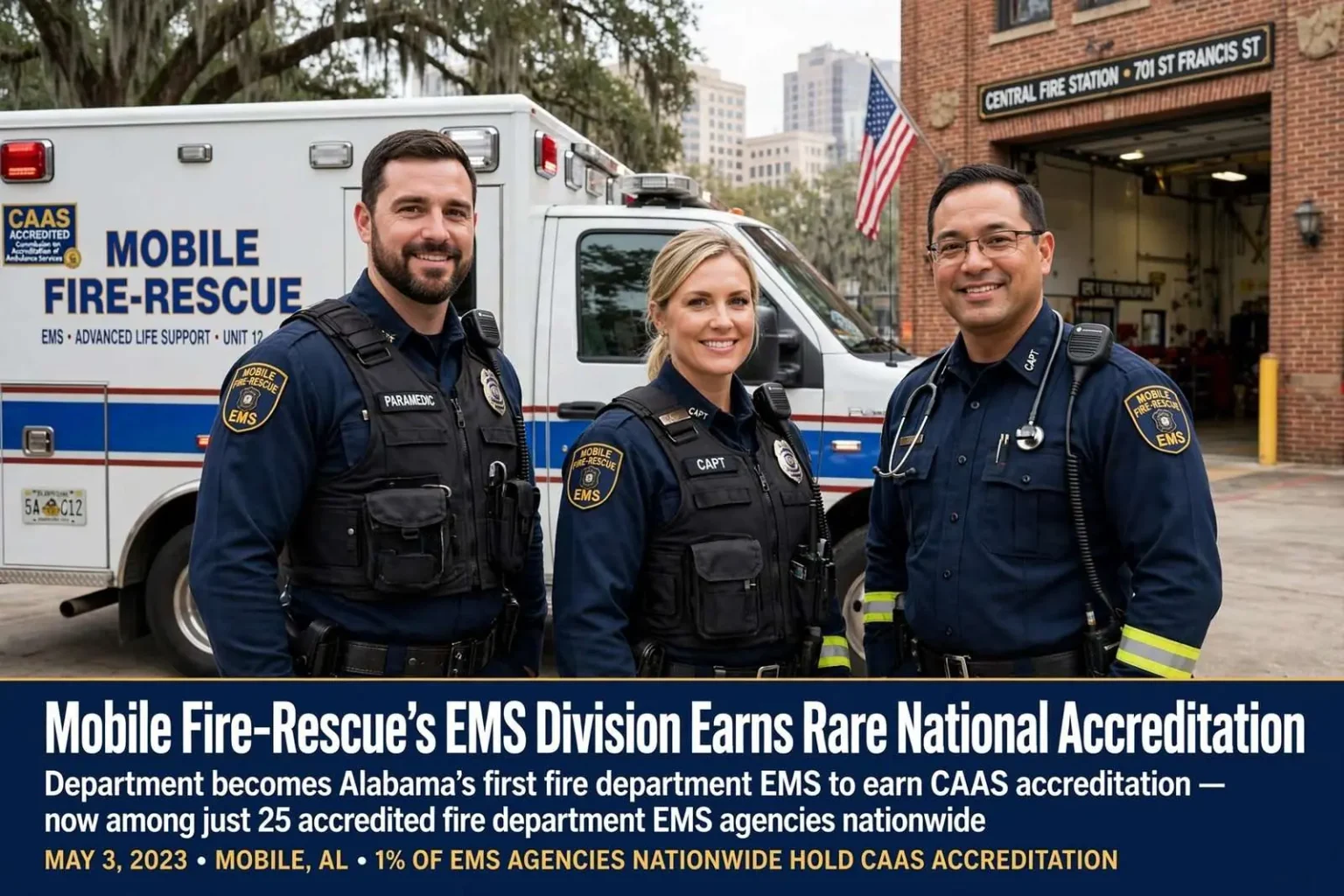
The Mobile Fire-Rescue Department’s Emergency Medical Services Division has become one of only a handful of fire department EMS operations in the country to earn accreditation from the Commission on Accreditation of Ambulance Services, known as CAAS, marking a first for the department. As of May 3, 2023, the Mobile Fire-Rescue Department became one of just four CAAS-certified EMS providers in Alabama, and the only fire department in the state to hold the national accreditation. The distinction is a significant one: among the more than 18,200 EMS agencies nationwide, including private, public and hospital-based services, only 185 are CAAS accredited, and just 25 of those are fire departments.
The achievement places Mobile Fire-Rescue among the top 1% of emergency medical agencies in the United States. CAAS accreditation is widely regarded as the gold standard for ambulance operations, and earning it requires an agency to open its policies, training records, vehicle maintenance logs, clinical protocols and patient care documentation to an outside review. Accredited agencies must demonstrate compliance with standards covering everything from staffing and credentialing to fleet upkeep, communications, fleet safety, and the handling of patient medical records. For a city the size of Mobile, the designation signals that its prehospital care system stands up against the best-run operations in the country, not merely against state minimums.
For residents, the practical meaning is straightforward: the crews who arrive on an engine or an ambulance in Mobile are part of a system that has been measured, externally and rigorously, against national benchmarks for clinical quality and operational reliability. Accreditation is not a one-time award but an ongoing commitment, with the agency expected to maintain its standards and document continuous compliance. In a city that runs thousands of medical calls a year, that oversight touches a great many households.
A Long History of EMS Service
Mobile Fire-Rescue has been the lead EMS agency in the community since 1975, when it began providing paramedical services to residents. The move came in the era when cities across the country were building out modern paramedic programs, and Mobile put its fire department at the front of that effort. Fire stations already stood distributed across every neighborhood, staffed around the clock, which made them natural launching points for medical response long before dedicated ambulance transport became part of the department’s mission.
The department expanded its capabilities in 1991 by adding ambulatory transport, allowing its own units to carry patients directly to medical care rather than relying solely on outside transport providers. That change turned Mobile Fire-Rescue into a full-service EMS operation — first on scene and also the agency that takes the patient to the emergency department — and it simplified care for patients and families, who no longer had to wait for a second agency to arrive before transport could begin.
Today, the EMS Division provides prehospital basic and advanced life support for acute illness and injury, focused on aggressive field stabilization and rapid transport to the appropriate medical facility. Field stabilization means starting treatment at the scene — airway management, cardiac monitoring, IV therapy, medication administration — rather than simply loading a patient and driving. Rapid transport decisions also involve matching the patient to the right destination, whether that is the closest emergency department or a facility better equipped for trauma, cardiac or stroke care. The division also supports other divisions within the department, extending its medical expertise across the department’s full range of operations.
Staffing and Structure
The EMS Division’s administrative offices are located at Central Fire Station, 701 St. Francis Street, and the division is supervised by District Chief Jared Parker. Its administrative responsibilities include managing medical reports, maintaining and renewing the medical licenses held by department personnel, and overseeing the inventory and distribution of controlled drugs. Those administrative functions are the paperwork backbone of a modern EMS system: every patient encounter generates a medical report, every paramedic’s license must stay current, and controlled medications carried on ambulances require strict accounting from stock to administration.
Division staff include Capt. Cary Hunter, Capt. Michael Balmes and Capt. Kristen Folsom, who help oversee the division’s day-to-day operations alongside Parker. The division’s leadership structure reflects how intertwined firefighting and emergency medicine have become in a modern fire department. Captains responsible for EMS work alongside line officers on shift, coordinate training, and keep equipment and protocols current across stations, so that the standard of care is the same whether a call comes in downtown, in Spring Hill, or out toward the city’s western neighborhoods.
The core of Mobile Fire-Rescue’s EMS program is made up of nationally registered paramedics assigned to 12 advanced life support transport units, each stocked with advanced prehospital medical equipment and pharmaceuticals. An advanced life support transport unit is the highest-capability ambulance configuration, staffed and equipped to perform cardiac interventions, advanced airway procedures and medication therapy before a patient ever reaches a hospital emergency department. Keeping twelve of those units in service across a city of Mobile’s size and geography is the operational heart of the prehospital system.
Department-wide, Mobile Fire-Rescue has approximately 150 nationally registered paramedics assigned to engine companies and rescue ambulance units. Because these personnel are also certified firefighters, they serve in a dual role that improves the overall efficiency of the city’s emergency response system, allowing crews to handle both fire and medical emergencies without needing to dispatch separate specialized units. The dual-role model has become the national norm for a reason: the closest unit to a medical emergency is usually an engine company, and when its crew carries paramedic certifications, care begins minutes earlier than it otherwise would.
That arrangement also gives the city resilience. A fire engine crew that is first on scene at a cardiac arrest can begin advanced care immediately and hand off seamlessly when an ambulance arrives, and a rescue ambulance crew that rolls up on a working structure fire can pick up hose lines or a ladder assignment once its patient is transferred. National registry certification for each paramedic means the credential is portable and standardized, but the department’s internal training keeps those skills sharpened around Mobile’s actual call load and geography.
Covering Mobile’s Biggest Events
Beyond day-to-day emergency response, the EMS Division is also responsible for arranging medical coverage at more than 300 special events across the City of Mobile each year. That includes Mardi Gras festivities, football and baseball games, the Azalea Trail Run, the Greater Gulf State Fair and numerous other city-sponsored gatherings that draw large crowds and require on-site medical readiness. Event coverage is a specialized discipline of its own: planners have to forecast crowd sizes, position units where they can reach patients despite street closures and traffic, and coordinate with event organizers, police and hospitals.
Mobile’s event calendar makes that work unusually demanding for a city of its size. The city’s Carnival season fills downtown streets with parade-goers over several weeks each winter, the Azalea Trail Run draws runners and spectators to the streets in spring, and the Greater Gulf State Fair brings large nightly crowds each fall. Ballgames at the city’s collegiate and minor-league venues add dozens more dates. At each of them, the same paramedic crews who run 911 calls also stand ready on the periphery of the crowd, and the division plans that coverage on top of its regular emergency response duties.
The accreditation process itself demands that an agency document its entire operation before outside reviewers ever arrive. Protocols, continuing education records, quality assurance reviews of patient care reports, preventive maintenance schedules for the ambulance fleet and supply chains for medications all have to be produced and defended. Passing that kind of audit typically takes an agency years of preparation, and maintaining the designation requires that the discipline continue long after the certificate is hung. The four Alabama providers that hold it represent a small slice of the state’s licensed EMS operations, which makes Mobile Fire-Rescue’s status as the only accredited fire department in the state a genuine outlier among Alabama’s municipal departments.
The CAAS accreditation reflects an evaluation of the quality of the division’s EMS operations against national standards, and the recognition underscores the level of training, equipment and oversight behind a system that both responds to emergencies and safeguards the health of residents at large public gatherings throughout the year. For Mobile Fire-Rescue, the milestone in May 2023 capped a nearly fifty-year run as the city’s lead EMS agency — from the first paramedical services in 1975, through the addition of ambulance transport in 1991, to a place today among the small fraction of American EMS operations that have met the national commission’s benchmarks. It is a credential the department shares with only three other certified providers across Alabama, and one that city officials and residents alike can read as an independent confirmation that Mobile’s prehospital care is in capable hands.