Mobile Hip-Hop Duo 2 Major Twinz Reflect on 15 Years of Their Mardi Gras Anthem
Twin brothers Wesley and Whitney Grant of 2 Major Twinz look back on 15 years of their staple track "Mardi Gras Song," the local hip-hop scene, and how their music found a second life in New Orleans.
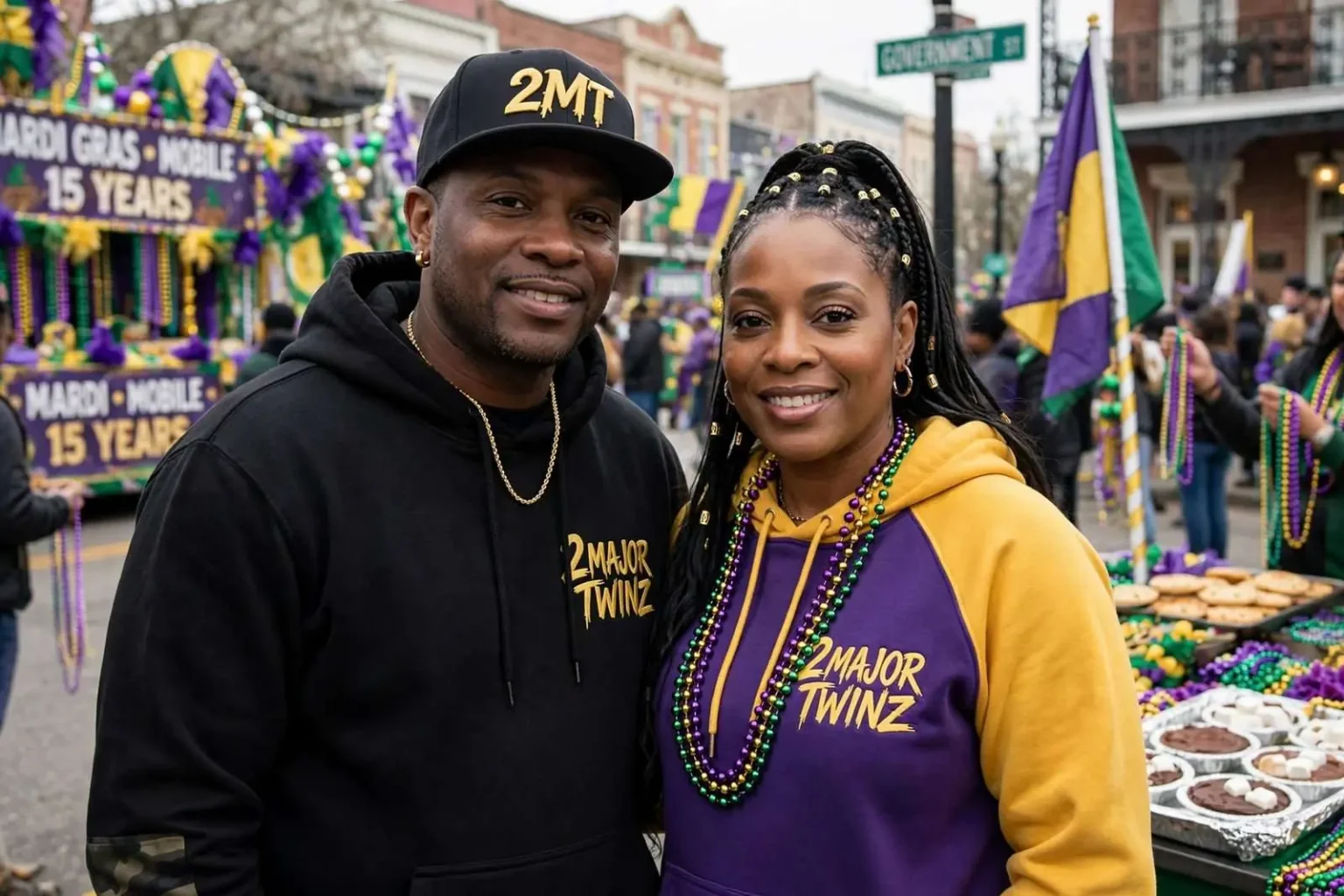
Mardi Gras in the Azalea City has a soundtrack that goes well beyond brass bands. For 15 years, one of the most recognizable entries in that local songbook has come from twin brothers Wesley and Whitney Grant, known together as the hip-hop duo 2 Major Twinz. Their track “Mardi Gras Song” has become a fixture at parades and Carnival-season events across Mobile, and with this year’s festivities building toward their climax, the twins looked back on how the song came to be and why it has stuck around so long.
Whitney Grant, describing Mardi Gras itself, said it offers an escape from ordinary life. “It’s an experience that takes you away from your everyday worries,” she said. “It’s an experience where you’re having fun trying to catch simple things such as moon pies and beads. On a normal day, they’re things that you wouldn’t pay attention to. During Mardi Gras, they become this important commodity.”
Mobile’s Carnival season is the oldest in the country, dating to the early 18th century and predating New Orleans’ celebrations, and its modern version — with mystic societies, moon pies, parade routes through downtown and along Government Street — has long had its own musical culture. While brass bands and second-line traditions fill much of the airtime, local hip-hop has carved out its own place in the season, and “Mardi Gras Song” is its signature track.
Roots in hip-hop’s formative years
The duo’s roots in hip-hop stretch back to childhood, growing up during the genre’s formative years in the late 1970s. An older brother kept the household stocked with the latest tapes from acts like Run-DMC, the Fat Boys, EPMD, Public Enemy and Whodini.
“We were influenced by the newness of hip-hop,” Whitney said, “and one day, we wanted to be a part of it.”
The twins say they got their own start in the local scene around 1998, alongside other Mobile-area artists such as Sonny Bama, Mr. Bigg and C-Nile. They’ve watched that scene transform dramatically since then.
“It’s a lot different, because there’s a ton of artists now,” Wesley said. “There was kinda a lot back then. Now, it’s hundreds. With social media and all this technology, anybody can be a star, per se. There’s not many gatekeepers anymore. As long as you got an electronic device, you can be a hip-hop artist.”
He pointed to promotion as another major shift: what once required grinding it out in person can now happen with a single post. Whitney added that social media has also let local artists connect with performers outside Mobile, helping build reputations back home in the process.
Mobile’s hip-hop scene in the late 1990s and early 2000s produced a handful of nationally recognized names, and artists like the ones the twins came up alongside gave the city a distinct Gulf Coast sound — Southern bounce and slow-rolling production that sat between New Orleans and Atlanta. That scene has grown into hundreds of active artists today, most of them building audiences through streaming and social media rather than record-label gatekeepers.
A song built to last
“Mardi Gras Song” itself grew out of a simple calculation about longevity. “For one, it’s the love of Mardi Gras,” Whitney said. “As far as our career, we were thinking of a song that would last forever. So, we thought about making a Mardi Gras song. We thought, ‘Well, they have to play it every year if it catches.’ So, that was pretty much the reason — to get it played every year and describe Mardi Gras.”
That bet paid off. The twins say audiences respond to the song with the same enthusiasm no matter how many times they’ve heard it.
“It’s like we’re doing it for the first time every time,” Wesley said. “People just love the song and react to it while we’re performing. After we get through performing, they tell us how much they love this song. It’s a year-round thing. People talk about it all the time, no matter what part of the year. It’s been well received.”
The strategy behind the song is one other Gulf Coast performers have followed: tie your work to something the community repeats every year, and the calendar itself becomes your promoter. In Mobile, where Carnival season runs from early January through Fat Tuesday, a Mardi Gras anthem gets an annual window at parades, second-lines, balls and bar playlists — and a reputation that carries through the other ten months of the year.
Still belonging, at any age
For Whitney, the reaction carries extra weight given how hip-hop can treat its veteran artists.
“It’s a great feeling to get that reaction,” she said. “It’s further validation that even though we’ve gotten older, we still belong. With hip-hop, you reach a certain age where people want to toss you aside. So, that song actually transcends age groups. From young to old, they like it. That’s why it’s been able to have the staying power that it has.”
Age and hip-hop have a complicated history. The genre’s commercial culture has often favored new voices, but veterans — from the founding generation onward — have increasingly found second acts on festival bills, radio specials and anniversary tours. In a local scene like Mobile’s, where the same acts have headlined the same celebrations for years, staying power is its own credential.
Viral in New Orleans
The song’s reach eventually extended beyond Mobile, thanks to the good-natured rivalry between the Azalea City and New Orleans over Mardi Gras bragging rights.
A videographer working in the New Orleans area was searching YouTube for Mardi Gras footage and music when she came across “Mardi Gras Song.” She used it in a video that went on to rack up roughly 2.5 million views on Facebook.
Wesley said he initially missed the tag notifying him of the video before learning from someone else that the track had gone viral in New Orleans. The moment even generated its own write-up about the video’s popularity.
For a Mobile act, going viral in New Orleans — the city most outsiders assume owns Mardi Gras — carried a particular satisfaction. Mobile and New Orleans have argued for two centuries about which Carnival came first, and a Mobile song soundtrack to New Orleans parade footage flipped the usual direction of cultural traffic along the Gulf Coast.
What’s next for 2 Major Twinz
Looking ahead, the twins say new music is on the way, including a club-oriented rap single called “Straight Drop” aimed at car-audio culture and club atmospheres. They don’t expect it to be their last rap release, even as they continue building a parallel presence in Southern soul.
Over the past couple of years, the duo said they’ve also had songs played on WDLT 104.1 FM, balancing output across genres. WDLT’s adult-oriented format reaches much of the Mobile area’s older listening audience, making it a natural home for the twins’ Southern soul material alongside their hip-hop catalog.
Working across two genres is more common among Gulf Coast veterans than newcomers might expect. The region’s radio market rewards soul and blues as much as hip-hop, and artists who can write for both audiences — the club and the slow-drag crowd — tend to build the longest careers.
As for what they look forward to most each Mardi Gras season, Whitney pointed to the chance to perform the song live year after year, along with the parades themselves and reconnecting with old friends. Wesley added one more thing to that list: seeing their fans.
Mobile’s Mardi Gras economy gives songs like “Mardi Gras Song” an outsized role. The season draws visitors from across the Gulf Coast into downtown Mobile, where parade-goers line routes around Mardi Gras Park, Bienville Square and the Civic Center area, and where local music acts like the twins perform at balls, block parties and club nights throughout the season. A song that defines the season becomes part of the city’s identity as much as any brass band or second-line.
The twins’ story is also a story about the durability of local anthems. Fifteen years on, “Mardi Gras Song” plays at events its writers never attend, gets pulled into videos by strangers in other cities, and still draws the same reaction from crowds that have heard it dozens of times. Few local recordings achieve that kind of permanence, and the Grants say the formula was never complicated: write about what your city loves, make it good enough to repeat, and let the calendar do the rest.
As this year’s Carnival season builds toward Fat Tuesday, 2 Major Twinz will once again be part of the soundtrack — the same twin brothers from Mobile who heard Run-DMC tapes through their older brother’s boombox, decided to make their own music, and ended up writing one of the Azalea City’s most enduring Mardi Gras songs.