Mobile Police Investigate Home Invasion That Ended in Gunfire
A predawn home invasion on Jackson Road in Mobile ended with an armed resident firing on an intruder after being beaten with a baseball bat.
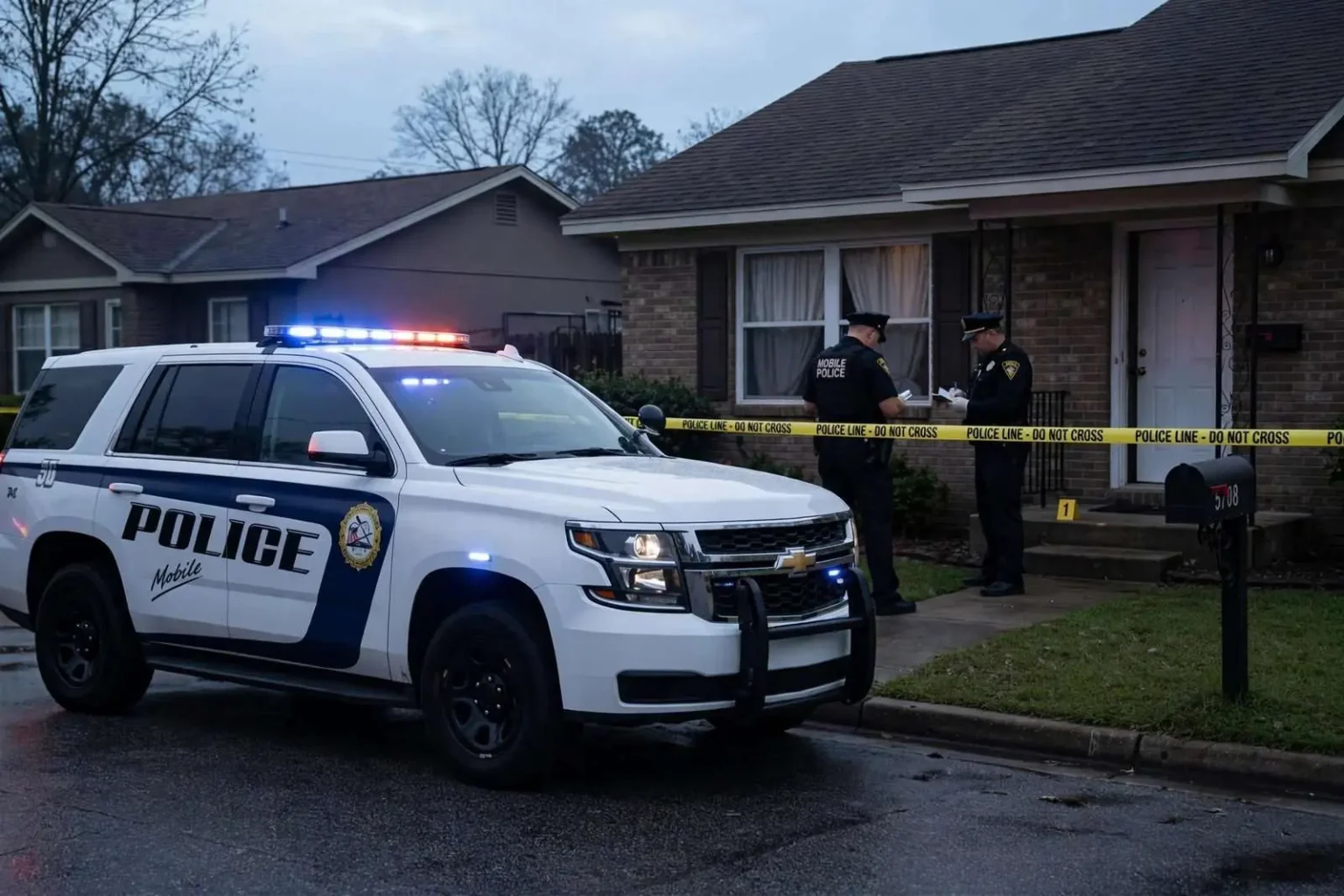
Mobile police are investigating a violent early-morning home invasion in the 5700 block of Jackson Road that left one man wounded after the resident he allegedly attacked fought back with a firearm. According to police, officers were called to the residence shortly before 6 a.m. after four men forced their way into the home and assaulted the resident with a baseball bat. During the struggle, the resident was able to reach a gun and fired at one of the intruders, striking him in the chest. Both the resident and the wounded suspect were taken to a hospital for treatment, and the intruder who was shot was initially listed in critical condition before being upgraded to stable.
The details of the confrontation, as recounted by the Mobile Police Department, describe an invasion that turned on its intruders within seconds. Four men allegedly breached the front of the home in the pre-dawn darkness, and the assault with a baseball bat began almost immediately. Somewhere in the chaos that followed, the resident gained access to a firearm kept inside the house and fired at least one round, hitting one of the four men in the chest. The remaining intruders were not reported to have been injured or taken into custody at the scene, and police have not described how they left the property or whether any of them have been identified since.
A Mobile Police Department spokesman confirmed the basic details of the incident but said it remained under active investigation, with no arrests announced in the days following the attack. Investigators have not released the identities of those involved, which is consistent with the department’s practice in cases where charges have not yet been filed and where the person who fired the weapon has not himself been arrested. Detectives were expected to continue canvassing the neighborhood and reviewing any available surveillance footage from homes and vehicles near the Jackson Road address.
What Happened on Jackson Road
According to the account police provided, the sequence of events began when the four men forced their way into the occupied home shortly before six in the morning. The resident was attacked with a baseball bat during the initial breach, and the beating continued until he managed to arm himself. The gunshot that struck one of the intruders in the chest ended the immediate threat inside the home, and emergency medical care was arranged for both men after officers arrived and secured the scene.
Scenes like this one present complications for first responders and investigators alike. When both a wounded victim and a wounded suspect are transported from the same address, officers must document the layout of the residence, collect the weapon involved, interview neighbors who may have heard shouting or a struggle, and attempt to trace the movements of the assailants who fled. The early-morning hour cuts both ways: fewer witnesses are awake and outside, but anyone who was up at that hour, including people leaving for early shifts, may hold useful information that detectives will pursue in the days ahead.
Police did not say whether anything was taken from the home, whether the intruders arrived in a vehicle, or what condition the resident was in beyond the need for hospital treatment. Those details often determine how a case is ultimately charged, and investigators frequently withhold them in the early stages precisely because releasing them could compromise the integrity of the investigation or the eventual prosecution.
Alabama’s Castle Doctrine and the Law of Self-Defense
Home invasions in which a resident uses force to repel intruders raise recurring legal questions in Alabama, where state law includes a version of the Castle Doctrine allowing people to use deadly force against an intruder who unlawfully and forcibly enters an occupied home, without a duty to retreat first. The principle, rooted in the old English idea that a person’s home is his castle, has been codified in Alabama statute for years and was strengthened by the state’s stand-your-ground law, which extended the no-retreat principle beyond the home to any place a person lawfully occupies.
Under the Alabama provision, a resident is presumed to hold a reasonable fear of death or serious bodily injury when someone unlawfully and forcibly breaks into an occupied dwelling, and that presumption supports the use of deadly force in response. The law also provides civil immunity in many circumstances, meaning a person found to have acted justifiably generally cannot be sued by the intruder or the intruder’s family for injuries inflicted during the encounter.
Whether a shooting in a case like this is ultimately deemed justified typically depends on the specific facts investigators gather, including how the confrontation unfolded and what threat the resident reasonably believed they faced. Prosecutors review the evidence gathered by detectives before deciding whether the shooter’s actions fall squarely within the protection of the statute or whether any part of the encounter falls outside it. In practice, cases in which residents confront armed intruders who have forcibly entered an occupied home are the clearest applications of the doctrine, and outcomes can differ when the facts are muddier — for instance, when an intruder is shot while fleeing, or when the relationship between the parties is in dispute.
The fact that no arrests have been announced does not mean the legal questions are settled. Investigators will reconstruct the timeline, examine the firearms evidence, and await the results of any forensic testing before presenting findings to the District Attorney’s Office. That review can take weeks, and authorities often decline to comment while it is underway.
Multiple Assailants Draw Closer Scrutiny
Multiple-assailant home invasions, while less common than single-intruder break-ins, tend to draw close scrutiny from investigators given the added danger to residents and the increased likelihood that at least one participant will attempt to flee before police arrive. When several people coordinate an entry into an occupied home, prosecutors and detectives treat the act as evidence of planning rather than impulse, and the departure of the uninjured participants becomes a central focus of the investigation.
Those who flee a home invasion leave behind a trail investigators know how to follow: vehicles caught on cameras in the area, discarded clothing, phone records, and statements to acquaintances. The wounded man inside the home represents the most direct link to the others, and once his condition permitted questioning, detectives would have sought to learn who was with him and why the house was targeted. Whether any of that has produced leads has not been made public.
The participation of four people also raises the stakes for any eventual prosecution. Each participant in a home invasion can face liability for the acts of the others under Alabama’s accomplice-liability rules, meaning the man who fired the bat does not have to be the one who pulled the trigger of the resident’s gun for charges related to the shooting to attach to all four. Investigators will weigh that framework as they evaluate what evidence ties each individual to the coordinated entry.
An Open Case With Many Unanswered Questions
Neighbors in the Jackson Road area were not immediately aware of a motive for the break-in, and police have not said whether the intruders and resident knew each other prior to the confrontation. That question — whether the attack was random or targeted — shapes both the direction of the investigation and the level of concern in the surrounding blocks. Random invasions prompt warnings to residents across a wider area, while cases involving acquaintances tend to be worked through personal connections rather than neighborhood canvassing.
What residents can do in the meantime is straightforward: report anything unusual seen near the home that morning, secure their own properties, and resist speculation about the people involved until authorities release verified information. Police have asked that anyone with information about the case contact the Mobile Police Department, or leave an anonymous tip through Mobile Area Crime Stoppers, which accepts tips by phone, through its website, and via its mobile app, and may pay a reward for information that leads to an arrest.
The Mobile Police Department investigates cases of this kind through its precinct detectives and centralized investigative units, with serious felonies committed in the overnight hours typically reviewed by supervising investigators the following morning, once overnight evidence has been logged and hospital updates on those wounded have been received. Canvassing officers gather statements from neighbors while forensic technicians process the scene, and the two streams of work are later combined into the case file prosecutors will eventually see.
Home security practices take on renewed attention after incidents of this kind in any Mobile neighborhood. Law enforcement agencies across the region routinely advise residents to keep exterior doors locked and well lit, to record serial numbers of valuables, and to consider doorbell or exterior cameras, which have become among the most productive sources of evidence in home-invasion cases. Residents are also reminded that personal safety comes before property: nothing inside a home is worth a life, and complying with an intruder’s demands while looking for an opportunity to escape or call 911 is the guidance officers most often repeat when they speak at neighborhood meetings.
The investigation remains active, and the department has not indicated when it expects to announce arrests or release further details. Until then, the shooting on Jackson Road stands as a stark reminder of how quickly a home invasion can escalate, and of the split-second decisions Alabama law asks residents to make when strangers force their way through the front door.