Mobile Sent Hurricane Gustav Aid to Baton Rouge in 2008
A 2008 WKRG report documented Mobile's deployment of water, meals, generators and crews to Baton Rouge after Hurricane Gustav.
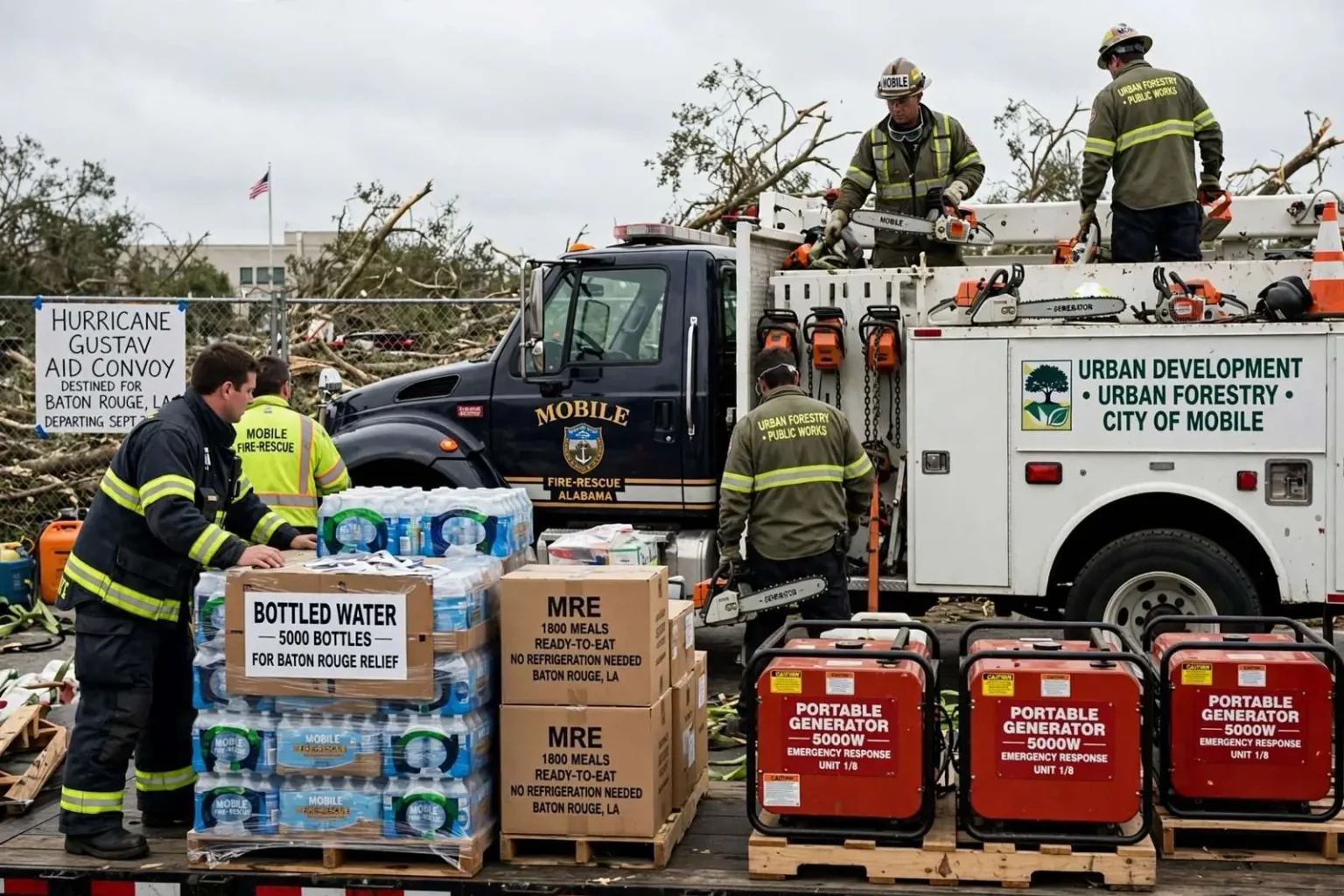
In the days after Hurricane Gustav struck the Gulf Coast in 2008, Mobile turned its attention west — not to its own recovery, but to helping a neighbor. According to a local news report from September 2008, Mobile sent supplies and city crews to Baton Rouge, where Gustav’s landfall and inland track had left much of the Louisiana capital without power, blocked by fallen trees, and struggling to restore basic services. The effort was organized quickly, with Mayor Sam Jones confirming that Baton Rouge officials had specifically identified the resources Mobile was sending.
Mobile Fire-Rescue was to transport 5,000 bottles of water, 1,800 meals ready to eat, and eight generators to the affected area. Alongside the firefighting and rescue personnel, the city’s Urban Development Department was sending an Urban Forestry crew equipped with chainsaws, a bucket truck, and other equipment to clear fallen trees — the single most visible obstacle facing Baton Rouge neighborhoods in Gustav’s aftermath.
Gustav’s Path Through Louisiana
Hurricane Gustav made landfall along the Louisiana coast in the final days of August 2008, coming ashore as a strong storm after cutting through the Caribbean and crossing western Cuba. New Orleans, still scarred and partially rebuilt three years after Hurricane Katrina, had emptied out in one of the largest evacuations in Louisiana history, but the storm’s actual impact landed harder to the west. Baton Rouge, well inland, took a punishing hit from Gustav’s winds, which snapped utility poles and toppled the mature live oaks and pines that line the capital city’s streets and yards.
In the days that followed, the harm to Baton Rouge became one of the underreported stories of the 2008 hurricane season. Hundreds of thousands of residents were without power — some for weeks — and the sheer volume of downed trees overwhelmed the city’s own crews. Entergy and other utility companies brought in line workers from across the country, and municipal governments throughout the region faced the slow job of clearing blocked roads before restoration crews could even reach damaged lines. It was that specific need — tree clearance and power — that Baton Rouge officials flagged when they identified what help they wanted from other cities.
Mobile Answers the Call
Mayor Sam Jones said Baton Rouge officials had identified the water, meals, generators, and forestry support as the resources they needed, and Mobile assembled its contribution accordingly. The shipment from Mobile Fire-Rescue — 5,000 bottles of water, 1,800 MREs, and eight generators — addressed the most immediate daily needs of residents and response workers: drinking water, food that requires no refrigeration or preparation, and portable power for critical equipment in a city where the electrical grid was down.
The generators carried particular value in those first days after the storm. Portable generators kept traffic signals operating, powered communications equipment, ran medical devices in homes without electricity, and supported small businesses and relief staging areas. Eight units from a single sending city may sound like a modest figure, but in the logistics of disaster response, equipment that arrives early and works reliably is worth far more than larger amounts that arrive late or inoperable.
The Urban Forestry Mission
The crews sent by Mobile’s Urban Development Department represent a side of municipal government most residents rarely think about until a storm strips a city bare. Urban forestry teams specialize in the maintenance, health, and removal of street and park trees, and in the aftermath of a hurricane their work becomes the critical first step in nearly every other kind of recovery. Fallen trees block the roads that utility crews, ambulances, and supply trucks need; until they are cut and cleared, a damaged city remains partially paralyzed.
A bucket truck allows crews to reach limbs hanging over roadways and power lines, while chainsaws handle trunks and branches at street level. The equipment Mobile sent was aimed squarely at the reported conditions in Baton Rouge, where city officials had identified debris clearance as a leading need. Sending trained municipal crews with their own equipment, rather than only donating supplies, reflected a judgment that skilled hands mattered as much as the tools themselves.
A Tradition of Gulf Coast Mutual Aid
Mobile’s gesture toward Baton Rouge fits a long tradition of mutual aid along the Gulf Coast, where cities have learned through hard experience that the next major storm could just as easily land on them. After Hurricane Katrina in 2005, the flow of assistance ran the other way — through the region toward the Mississippi Gulf Coast and the New Orleans area — and Mobile itself relied on outside help for recovery after storms that hit closer to home. Fire departments, police agencies, public works departments, and utility crews all maintain mutual aid arrangements that can be activated when a disaster overwhelms local capacity.
Those relationships are built in ordinary times through regional associations, state emergency management frameworks, and the personal contacts between department heads across municipal lines. When a call for help goes out, the paperwork and protocols are already in place, which is how a city like Mobile can assemble water, meals, generators, and a forestry crew and have them moving west within days of a request.
What the 2008 Episode Reminds Us
The September 2008 report is a snapshot of how Gulf Coast cities look out for one another, and it remains relevant every hurricane season. Disaster response is not only the work of federal agencies and national relief organizations; it depends heavily on neighboring municipalities that can move people and equipment quickly because they understand the local terrain, the climate, and the needs of Gulf Coast communities.
For Mobile residents, the story is a reminder that the city’s public employees — firefighters, rescue personnel, and urban forestry crews among them — train and equip for work that sometimes takes them beyond the city limits. The 5,000 bottles of water, 1,800 MREs, eight generators, chainsaws, and bucket truck that left Mobile for Baton Rouge in September 2008 were more than a list of supplies; they were a neighbor’s answer to a specific request, delivered at the speed that a disaster response requires.
Lessons for the Next Storm
Every mutual aid deployment like the one Mobile made in 2008 adds to the region’s collective experience, and those lessons show up in how cities prepare today. Water and MRE caches are now pre-positioned more systematically, generator inventories are tracked regionally, and urban forestry crews are increasingly viewed as first-line responders whose mobilization plans are written into municipal emergency operations documents. The specific list Mobile sent to Baton Rouge — drinking water, shelf-stable meals, portable power, and tree-clearing capability — reads like a checklist of what actually proves useful in the first week after a landfall.
For residents of Mobile and Baldwin counties, the history is worth keeping in mind as hurricane seasons come and go. The same crews, equipment, and coordinating relationships that carried help west to Baton Rouge in September 2008 are the ones that will be needed here when a storm turns toward Mobile Bay. Cities that give help freely tend to receive it promptly, because the favors and frameworks of mutual aid are always mutual in practice if not on paper.
Mobile’s response to Gustav’s damage in Baton Rouge was, in the end, a straightforward act of regional citizenship: officials asked for water, meals, generators, and forestry help; Mayor Sam Jones confirmed the request; and the city’s Fire-Rescue and Urban Development departments delivered exactly what was identified. In a hurricane season that brought plenty of grim headlines, it was one of the quieter stories — a city with its own storm history choosing to share what it had with a neighbor buried in trees and darkness.
The Timing and the Work Ahead
In the first seventy-two hours after a hurricane, the bottleneck in most disaster areas is not willingness to help — it is transportation, staging space, and coordination. Supplies that arrive unrequested can clog distribution points, which is why the mayor’s account that Baton Rouge officials had identified the specific resources they needed is an important detail. The request-and-response model used here is the same one emergency managers still recommend: send what is asked for, labeled and ready to use, with crews who can put it to work the moment it unloads.
Mobile’s own recent history informed the effort. The city had weathered Hurricane Katrina’s edges in 2005 and years of smaller storms, and its public safety and public works departments had practiced the logistics of moving personnel and equipment under emergency conditions. That institutional experience is what allowed Mobile Fire-Rescue to assemble a convoy of water, meals, and generators, and the Urban Development Department to ready a forestry crew with chainsaws, a bucket truck, and supporting equipment, all within days of Baton Rouge’s request.