Mobile International Festival Drew Crowds in 2009
Hundreds attended the 26th annual Mobile International Festival at the Civic Center in 2009, celebrating cultures through food, song and dance.
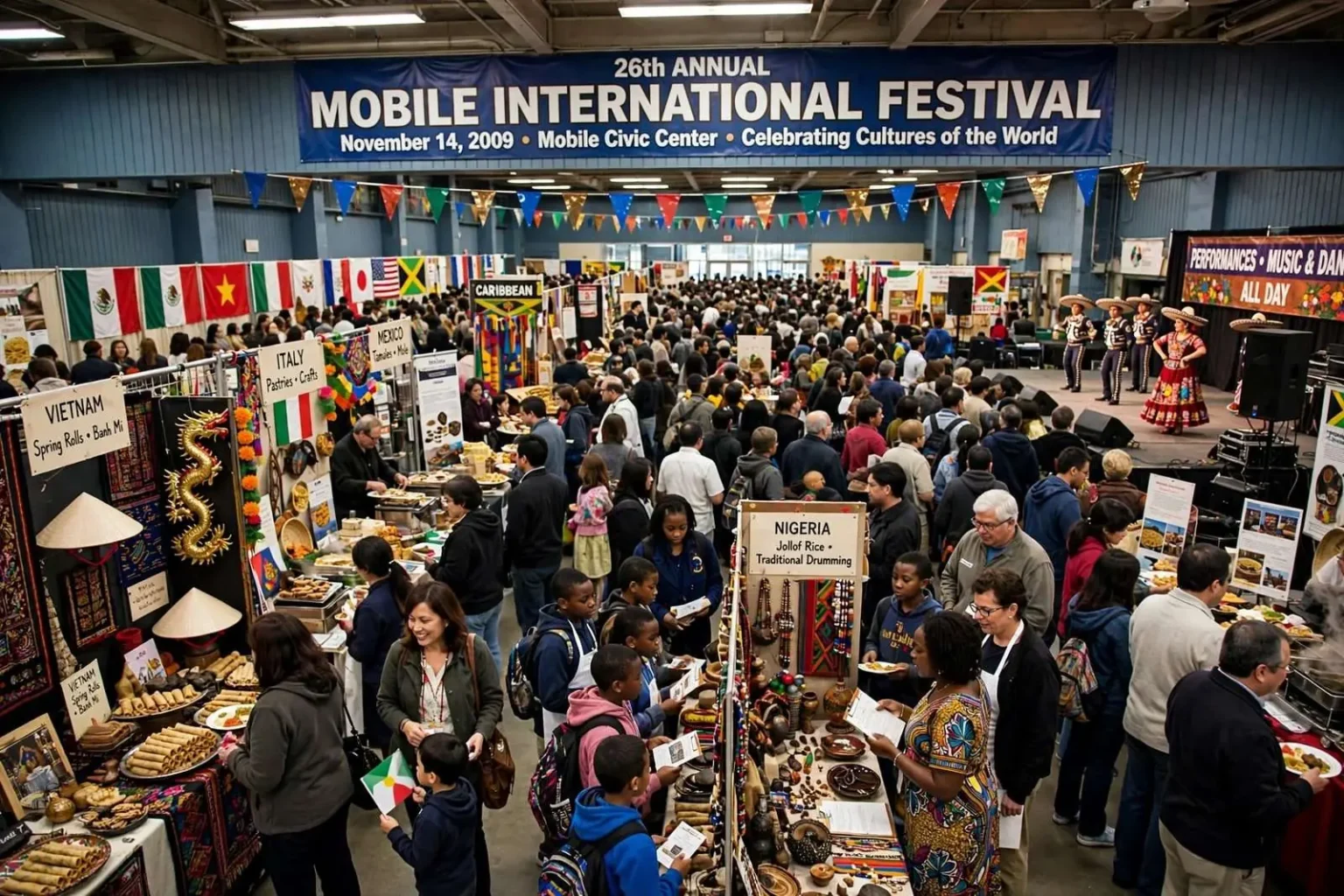
Hundreds of people gathered at Mobile’s Civic Center for the 26th annual Mobile International Festival in November 2009. The event presented food, music and dance from countries and cultures around the world, filling the downtown convention hall with the colors, sounds and aromas of dozens of traditions at once.
Organizers said its continued growth reflected Mobile’s diverse communities and the public interest in sharing traditions across cultural lines. For a quarter century, the festival has been the city’s signature multicultural gathering, drawing schools, families and community groups into one hall for a day built around what Mobilians of many backgrounds share.
The festival transformed the Civic Center into a place where attendees could experience performances and cuisine representing many parts of the world. Booths of heritage — the national displays, traditional dress, crafts and demonstrations that line the hall — gave visitors a tour of the world without leaving downtown Mobile.
Mobile’s long history as a crossroads
The festival’s roots run deep in Mobile’s own history. Founded as the first capital of French Louisiana in 1702, Mobile has been a crossroads of French, Spanish, British, African, Caribbean and American cultures for more than three centuries — a port city where peoples, goods and traditions have always met and mingled.
That layered past shows up in the city’s cultural calendar, from Mardi Gras celebrations that predate the more famous New Orleans version to the churches, cuisines and neighborhoods that trace their roots to waves of immigration and migration across the Gulf Coast. The Mobile International Festival gathers that diversity into a single annual event and presents it to the whole city.
By 2009, the festival had reached its 26th year — a run that made it one of the longest-running cultural events on the Gulf Coast. Its endurance through changing times reflected both the organizing community’s commitment and a genuine public appetite for the experience it offers.
A day of food, music and dance
The festival’s centerpiece has always been its performances. The stage at the Civic Center runs continuously through the day, presenting traditional music and dance from the cultures represented on the floor — performances that range from precision folk dances passed down through generations to contemporary expressions of the communities that have made Mobile home.
For many attendees, the performances are the first encounter with traditions they had only read about. School groups attending the festival get a living geography lesson: costumes, instruments and choreography that carry the history of whole regions, performed by neighbors who live and work in Mobile.
The food may draw even bigger crowds. Vendors and community booths serve dishes from around the world — the recipes families have carried across oceans and borders — and the lines that form through the hall are part of the festival’s character. Sampling a table of cuisines in an afternoon gives visitors a tangible, delicious introduction to the communities behind the food.
Between the stage and the food tables, the floor fills with exhibits: national displays assembled by community organizations, craftspeople demonstrating traditional arts, and informational booths where festivalgoers can talk with the people representing each culture. Children collect stamps and souvenirs as they move from exhibit to exhibit, and many schools build the festival into their fall calendars for exactly that reason.
The Civic Center setting
The Mobile Civic Center has been downtown’s principal venue for large public gatherings since it opened in the 1960s. Its exhibition halls accommodate events of the festival’s scale — hundreds of participants, thousands of visitors — under one roof, with the parking and transit access that a citywide event requires.
Hosting the festival there places it at the center of the city’s civic life, within walking distance of Government Street and the redevelopment corridors of downtown. For one November day, the hall’s usual trade shows and conventions give way to a world’s fair in miniature, with Mobile’s communities as the exhibitors.
What the festival means to the city
Organizers’ description of the 2009 event — a reflection of Mobile’s diverse communities and the public’s interest in sharing traditions — describes the festival’s purpose in a single line. In a port city shaped by centuries of arrivals, the festival gives every community a stage and every resident an invitation.
The educational role is deliberate. Teachers bring classes to see the cultures behind their textbooks; families bring children to see the diversity of their own city; and community groups use the festival to reach new neighbors with the traditions they carry. The event’s growth over 26 years suggests how well that mission has landed.
The 2009 edition — with its hundreds of attendees, its hall full of food, music and dance, and its visible expression of Mobile’s multicultural identity — followed the pattern that has made the festival a Gulf Coast institution. For the communities that organize it, the event is a yearly affirmation: Mobile’s many cultures are not just present in the city, but central to its public life.
That is the legacy the 26th annual festival carried forward in November 2009, and the tradition it handed to the editions that followed — one hall, one day, and the whole world represented in downtown Mobile.
The communities behind the booths
Behind each display at the festival stands a community organization — the cultural associations, church groups, student clubs and family networks that do the work of organizing Mobile’s international traditions through the year. Their volunteers plan the exhibits, cook the food, rehearse the dances and staff the booths, often for months before the event.
The roster of participating cultures has always reflected the city’s make-up. Long-established European traditions, deep African and Caribbean roots, the growing Hispanic and Asian communities of the Gulf Coast and the student populations drawn to Mobile’s universities and hospitals all find a place on the festival floor. Each year’s edition becomes a snapshot of who Mobilians are at that moment.
Participation also builds bridges within and between communities. Preparing a national display brings families together around their own heritage, and sharing it with the city builds the connections that outlast the festival weekend. Organizers have often described the event as a reunion as much as an exhibition — the one day each year when all of Mobile’s cultures share a room.
A teaching moment for the Gulf Coast
Schools across Mobile County have long treated the festival as a field trip with real curriculum value. Geography, history, music and social studies come alive on the festival floor: students hear the languages, see the artifacts and taste the cuisines of places they have studied, often explained by someone from those places standing at the booth.
The lesson for adult visitors is just as direct. In a region where communities can live side by side for years without much contact, the festival creates a shared space where curiosity is the price of admission. The conversations that start over a plate of food or a demonstration table are the quiet work of civic life.
That is the function organizers have described since the festival’s founding: to make Mobile’s diversity visible, celebrated and shared — not as an abstraction but as something residents can see, hear and taste on a November afternoon downtown.
Six decades of Mobile history in one event
The festival’s 26 years by 2009 traced the arc of Mobile’s modern growth. The city’s population has been reshaped across those decades by international industry along the Gulf, by the universities and medical institutions that draw students and professionals from around the world, and by the families who have made south Alabama home from every continent.
Each edition of the festival has registered that change. New communities join the floor as they grow; long-standing participants deepen their presentations; and the event’s audience expands with each generation of schoolchildren who attend. What began as a modest cultural showcase had, by its 26th year, become a fixture of the city’s fall calendar.
The hundreds who gathered at the Civic Center in November 2009 came, as every year’s crowd does, for the food, the music and the dance. What they carried out was bigger: a picture of Mobile as it actually is — a Gulf port city of many origins, sharing its traditions in one hall and marking another year of a festival that has grown right along with the city it celebrates.
For the organizers, volunteers and communities who built it, the 26th annual edition was one more November spent proving the same point the festival has always made: the world is already here, in Mobile, and every fall it opens its doors to the rest of the city.
The tradition continues today, drawing new generations of Mobilians into the same hall every fall.