Mobile Joins National Community Cinema Program With Free Documentary Screenings
Mobile became the only Alabama city to join Community Cinema in 2011, offering free PBS documentary screenings at Space 301, Mobile Museum of Art, and.
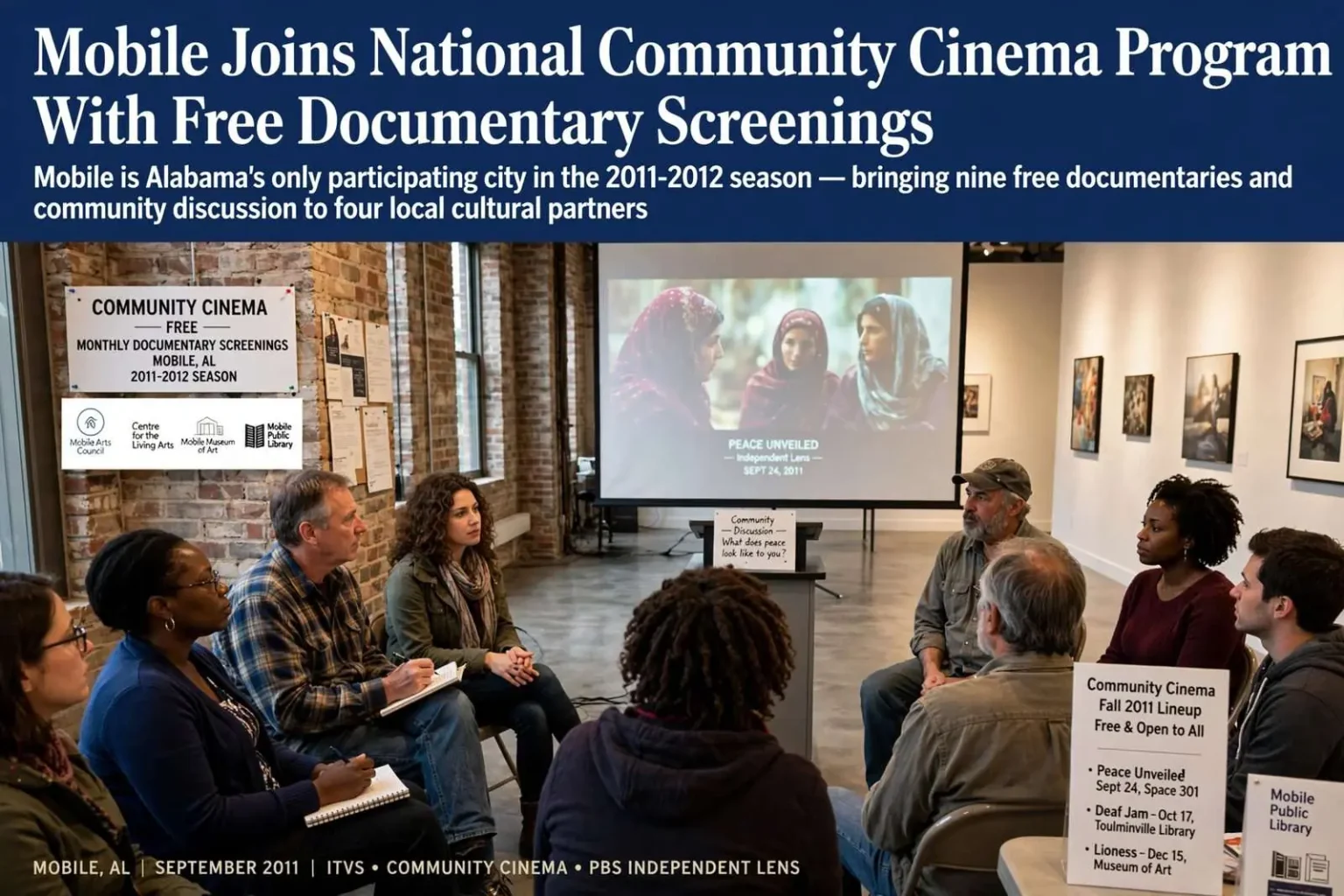
Mobile became the only city in Alabama to participate in Community Cinema, a national civic education initiative that brought free documentary screenings to nearly 100 American cities during the 2011-2012 season.
The program, organized by the Independent Television Service (ITVS), featured monthly showings of films slated to air on the Emmy Award-winning PBS series Independent Lens, each followed by community discussion. For Mobile audiences, Community Cinema offered something the city had not previously had: a standing monthly appointment with first-run documentaries, shown free of charge before their national broadcast, in settings designed to spark conversation rather than passive viewing.
ITVS, funded by the Corporation for Public Broadcasting, commissions and supports independent documentaries for public television, and Community Cinema is its outreach arm — pairing films with local partners who can connect the subjects on screen to the life of their own communities. Nearly 100 cities hosted screenings that season, from major metros to mid-sized markets, with Mobile standing as the program’s only Alabama site.
Local Partners United Behind the Effort
Four Mobile cultural organizations collaborated to bring the program to the Port City: the Mobile Arts Council, the Centre for the Living Arts, the Mobile Museum of Art, and the Mobile Public Library. Between September 2011 and May 2012, the partners planned to screen nine documentaries across multiple venues throughout the city.
“By showing films at various venues, we hope to encourage greater community participation,” said Charlie Smoke of the Mobile Arts Council. “Also, by showing some of the films more than once, we allow larger numbers of people to explore the issues and involve themselves in the discussion.”
The four partners each brought something different to the collaboration. The Mobile Arts Council, housed downtown, serves as the umbrella organization for the city’s arts community and coordinates programs across disciplines. The Centre for the Living Arts operates Space 301, the contemporary art venue in the former 1930s newspaper building on Conti Street. The Mobile Museum of Art in Langan Park is the Gulf Coast’s largest art museum, and the Mobile Public Library’s branch system gives the screenings a neighborhood reach that no single venue could match.
The multi-venue approach reflected Smoke’s point about participation: a screening downtown draws one crowd, a screening at the museum draws another, and a repeat showing at a library branch reaches residents who never set foot in the city’s arts district. Each screening ended with a facilitated discussion, turning the documentary into a starting point for conversation about the issues it raised.
A Diverse Lineup of Films
The documentary lineup tackled a wide range of subjects through personal, human-centered storytelling. Themes ranged from a deaf teenager preparing for a poetry slam competition to a Marine’s struggle to readjust to civilian life after returning from Afghanistan, and from a Black filmmaker’s campaign to rethink Black History Month to a weightlifter’s quest to become the strongest woman in the world.
Five of the nine films were part of Women and Girls Lead, a multiyear public media initiative designed to educate and connect women and girls worldwide in addressing contemporary challenges. The initiative, launched by ITVS with partner organizations, used documentary film as the centerpiece of campaigns on education, leadership and equality for women and girls, and its presence in the Mobile lineup connected local audiences to a national and international conversation.
The subjects were chosen for their resonance beyond the screen. A story about a deaf teenager’s poetry slam speaks to disability, language and ambition; a Marine’s homecoming speaks to the families across the Gulf Coast who have sent sons and daughters to two long wars; a film about rethinking Black History Month lands with particular force in a city where Black history is inseparable from the story of the community itself.
Fall 2011 Screening Schedule
The season opened with Peace Unveiled on September 24 at Space 301, a documentary following three Afghan women risking their lives to ensure women had a seat at peace negotiations with the Taliban. Deaf Jam, about a deaf teen in New York City discovering her voice through sign-language poetry slams, followed in the fall slate, bringing one of the season’s most celebrated films to Mobile audiences.
The fall schedule ran as follows:
- Peace Unveiled – Saturday, Sept. 24, 2 p.m., Space 301 (301 Conti St.).
- Deaf Jam – Monday, Oct. 17, 4 p.m., Toulminville Branch of the Mobile Public Library (601 Stanton Rd.), with performances by winners of the library’s annual poetry slam; repeated Saturday, Oct. 22, 2 p.m., at Space 301.
- We Still Live Here: Âs Nutayuneân – Saturday, Nov. 19, 2 p.m., Space 301. The film documents the Wampanoag community’s revival of its language, reconstructed from centuries-old written documents more than a century after its last native speaker died.
- Lioness – Thursday, Dec. 15, 6 p.m., Mobile Museum of Art (4850 Museum Dr.). The film follows five female Army support soldiers who ended up fighting alongside Marines in Iraq, in cities such as Ramadi, and came home to a system with no category for what they had done.
Peace Unveiled arrived at a moment when the war in Afghanistan remained a daily presence in American life, and its subjects — women navigating a peace process from which they had long been excluded — gave Mobile audiences a view of the conflict from the perspective of the civilians living inside it. The post-film discussion format gave viewers a chance to process the film together, a hallmark of the Community Cinema model.
The season’s monthly rhythm meant Mobile audiences could plan for a documentary night nearly every month through the school year, with the fall screenings at downtown venues and later showings rotating among the partner sites. Each film was scheduled ahead of its national PBS broadcast, meaning Mobile audiences saw the documentaries first, free, in a room full of their neighbors.
What Community Cinema Meant for Mobile
For a city of Mobile’s size, participation in Community Cinema placed it alongside far larger markets in the national program. The designation as Alabama’s only participating city gave Mobile audiences access to films that would otherwise require a trip to New Orleans or a public television pledge week to see, and it gave the city’s cultural organizations a shared project around which to build programming.
The collaboration itself was notable. Mobile’s cultural institutions — the Arts Council, the Centre for the Living Arts, the museum and the library system — operate independently, and joint programming across four organizations requires coordination of schedules, venues and promotional resources. The nine-film season represented one of the most ambitious joint efforts among the city’s cultural groups in years, and the repeated screenings Smoke described were a deliberate strategy to maximize reach: a film shown twice, at two different venues, finds two different audiences.
The discussion component set Community Cinema apart from ordinary film screenings. Rather than simply showing a documentary and sending the audience home, each event built in facilitated conversation — sometimes with local experts, activists or people whose lives connected to the film’s subject. A screening about veterans re-entering civilian life could draw veterans’ advocates; a film about women’s leadership could draw students and community organizers. The format turned each screening into a small civic event, which was the program’s core purpose.
The National Program Behind It
Community Cinema grew out of ITVS’s mission to bring independent documentary voices to public television audiences, and its nearly 100-city footprint made it one of the largest documentary outreach programs in the country. The program’s partnership with Independent Lens gave participating cities a pipeline of films — the same documentaries that would reach national broadcast audiences — months or weeks ahead of their air dates.
For Mobile, the 2011-2012 season also arrived during a period of cultural expansion downtown, with Space 301 and the surrounding LoDa district drawing new audiences to the city center. The screenings fit squarely into that momentum, filling downtown venues on weekday and weekend evenings with audiences gathered around a shared screen.
The season ran through May 2012, with the remaining films in the nine-documentary slate scheduled across the winter and spring. For the four partner organizations, the first season would determine whether Community Cinema became a Mobile fixture — and for the audiences who filled Space 301, the museum and the library branches in those first months, the program offered something simple and rare: documentaries on the big screen, discussion afterward, and no ticket required.
The Films That Filled the Season
The documentary slate reflected the breadth of the Independent Lens brand. Alongside the season opener and the fall titles, the remaining films moved through themes of family, identity, ambition and justice — the human-scale subjects that independent documentary does best. The weightlifter’s story and the Black History Month film arrived with the same discussion-based treatment as the rest of the slate, each paired with the venue and local connections that would draw its natural audience.
Mobile’s library system played a distinct role in that reach. With branches across the city — from West Mobile to Toulminville to the downtown Ben May main library — the library screenings brought Community Cinema into neighborhoods where cultural programming is otherwise sparse. A resident who might never drive to Space 301 for a contemporary art opening could walk into their own branch library on a weekday evening and take part in the same national program.
The Museum of Art screenings added yet another dimension, pairing documentary film with the museum’s galleries and drawing its membership base into the program. That cross-pollination was the quiet ambition of the four-partner collaboration: each screening an introduction not just to a film, but to an institution some attendees had never visited.
Looking Ahead
As the 2011-2012 season moved toward its spring conclusion, the partners’ measure of success would be attendance and participation — whether Mobile audiences turned out month after month and whether the discussions took root. The national program’s track record in other cities suggested the model worked: Community Cinema screenings across the country had built loyal followings among audiences looking for documentary film and civic conversation in the same evening.
For now, Mobile stands alone in Alabama in the program, with nine documentaries scheduled, four institutions collaborating and every screening free to the public. From Peace Unveiled at Space 301 in September to the season’s final film in May, Community Cinema gives the Port City a monthly seat in a national conversation — one documentary, one discussion, one neighborhood venue at a time.