Mobile Jury Awards Family $12 Million Over Funeral Home’s Loss of Cremated Remains
A Mobile County jury awarded a family $12 million against Pine Crest Funeral Home after it could not produce a relative's cremated remains.
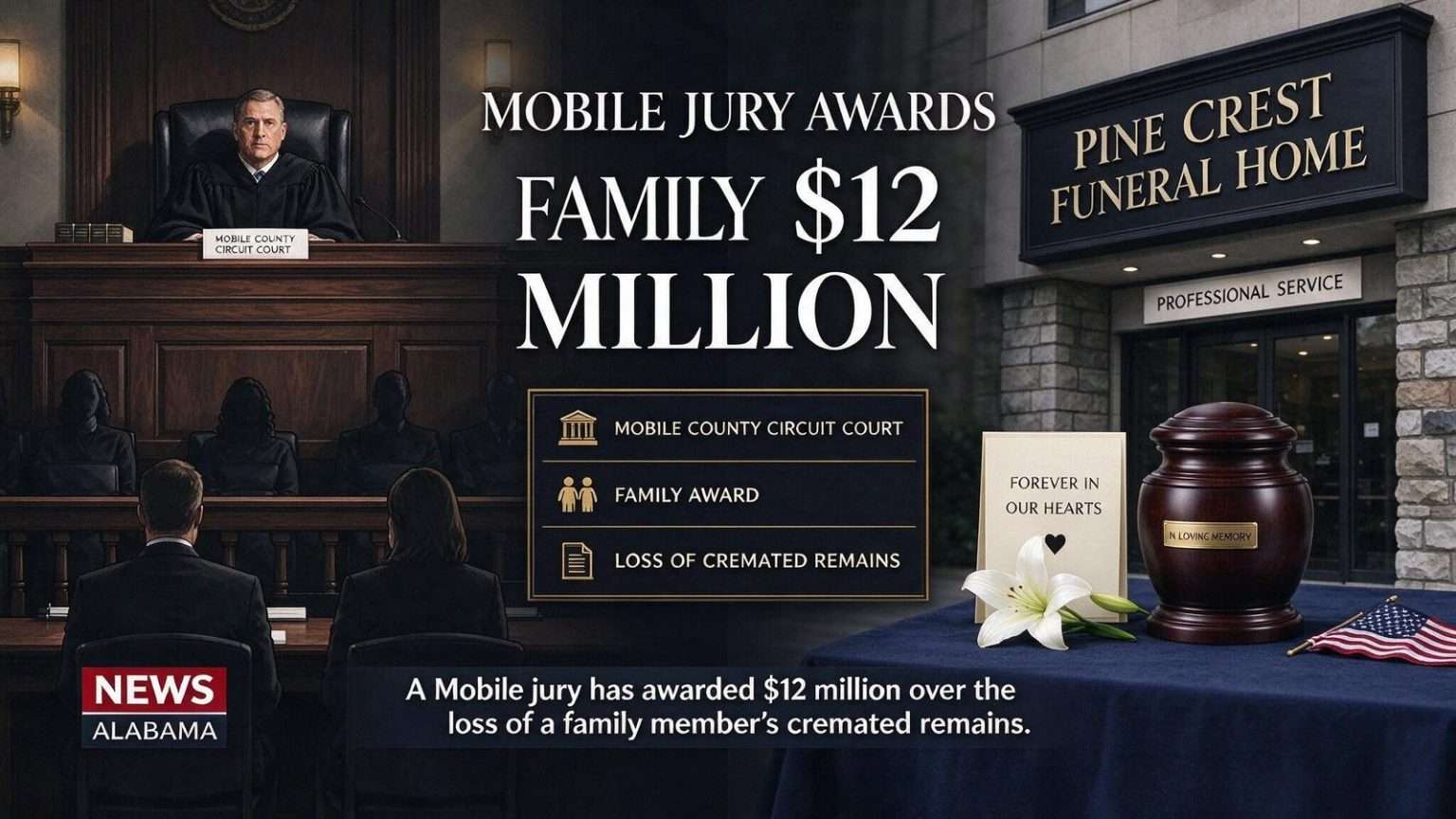
A Mobile family has been awarded $12 million in a lawsuit against Pine Crest Funeral Home over the loss of a relative’s cremated remains and other alleged violations. The jury returned its verdict in late February following a trial in Mobile County Circuit Court that lasted several days, ending a case that centered on one of the most basic obligations a funeral home owes to the families it serves.
According to evidence presented at trial, the funeral home failed to follow both state law and its own internal requirements, and was unable to locate or produce the cremated remains of the family member. The details that emerged during the trial described a failure that began with record-keeping and handling requirements and ended with a family left without the remains they had entrusted to the business — an outcome that, once discovered, led to the litigation that a Mobile County jury has now resolved.
“This case is about a funeral home’s failure to respect and honor the dignity of a family member’s life,” said Donald Knowlton, an attorney for the family. The framing captured the theory on which the case was presented: that the handling of a loved one’s remains is not merely a contractual service but a matter of dignity, and that losing them inflicts a harm unlike any ordinary commercial failure.
The Dignity of a Family Member’s Life
The emotional weight of the case is what separated it from ordinary consumer disputes. Cremation leaves a family with a single, irreplaceable trust — the remains themselves — and the law imposes specific requirements on how they must be tracked, identified and returned. Evidence at trial that the funeral home failed to follow both state law and its own internal requirements meant the jury heard not just about a mistake, but about a series of obligations that were not met, from statutory duties down to the company’s own written procedures.
For the family, the inability to locate or produce the remains foreclosed the final acts that the funeral process exists to enable — the burial or interment the family had planned, and the certainty of knowing where a loved one rests. Jurors hearing such testimony are asked to place a value on a harm that has no market equivalent, which is precisely what verdicts of this size are designed to express. The $12 million award, returned after several days of testimony in Mobile County Circuit Court, reflected the jury’s assessment of both the loss itself and the conduct that produced it.
Funeral service litigation of this kind is uncommon but not unprecedented, and when it occurs it tends to turn on documentation: the chain of custody for remains, the identification procedures in place, and whether the provider followed the state statutes that govern crematory operations in Alabama. The Mobile County verdict demonstrates how seriously juries treat failures along that chain.
A National Operator
Pine Crest Funeral Home is owned by Service Corporation International, one of North America’s largest providers of funeral and cemetery services. The company employs roughly 24,000 people and operates more than 2,000 funeral homes and cemeteries. That scale made the case notable beyond Mobile: when a jury awards $12 million against a locally operated funeral home, the exposure belongs to a national corporation whose operations span the continent and whose brand rests on the promise of careful handling at every location.
Service Corporation International’s business model consolidates funeral homes and cemeteries under national ownership while typically retaining local names — a practice that means many families do not realize the funeral home they have used for generations is part of a large corporate network. In Mobile, Pine Crest has long served families on the city’s western side, and its ownership placed it within a company that reports billions in annual revenue from funeral and cemetery operations across the United States and Canada.
Corporate ownership changes the legal and financial stakes of a verdict. A $12 million judgment against a small independent funeral home could end the business; against a national operator, it functions as a statement about standards across a network. Plaintiffs’ attorneys in funeral service cases often point to that distinction — national companies have the resources and standardized procedures to prevent exactly the kind of failure at issue, which makes the failure harder to excuse.
The Verdict and the Trial
The trial itself, lasting several days in Mobile County Circuit Court, walked jurors through the sequence at the heart of the case: the family’s arrangements with the funeral home, the requirements — statutory and internal — that governed the handling of cremated remains, and the moment the family learned those remains could not be located or produced. Attorneys for the family, including Knowlton, presented evidence aimed at showing the failure was preventable; the defense presented its account of what occurred and what the circumstances warranted. The jury’s answer was the $12 million verdict returned in late February.
Post-verdict options in civil litigation are standard: motions for a new trial or to alter the judgment, and potential appeals that would carry the case to Alabama’s appellate courts. A jury award is therefore the trial court’s chapter in a dispute that may not be fully resolved for months or years, as motions and any appeal work through the system. The size of the award increases the likelihood that the judgment will be contested beyond the trial court.
The family was represented by Knowlton and Mike Roberts of the Cusimano, Roberts & Mills firm in Gadsden, along with attorney Jeff Hester of Pelham. The representation drew firms from across the state — Gadsden in northeast Alabama and Pelham in the Birmingham suburbs working alongside a Mobile County case — a common arrangement in significant tort litigation where trial experience and resources are combined.
What the Case Means for Funeral Consumers
For consumers, the case is a reminder that funeral services are regulated businesses, and that Alabama law imposes specific duties on funeral homes and crematories precisely because the products of their work are irreplaceable. Families arranging cremation are entitled to identification and tracking procedures, documentation of how remains are handled, and the return of what was entrusted. When those duties fail, the courts are the recourse — and the Mobile County jury’s award shows what a jury may do with a failure it finds indefensible.
The verdict also lands in an industry in transition. Consolidation has placed a growing share of American funeral homes under national ownership, raising the stakes of local failures and the scrutiny of local juries. The $12 million Mobile verdict against a facility owned by the industry’s largest operator will be read, in boardrooms and courthouses alike, as a measure of what happens when the trust that families place in a funeral home is broken at its most fundamental level.
For the Mobile family at the center of the case, no verdict restores what was lost. The jury’s answer — delivered in late February after several days of testimony — is the legal system’s acknowledgment of that loss, and a public statement that the dignity Knowlton described is not a courtesy but an obligation.
Inside Mobile County Circuit Court
The venue mattered to how the case unfolded. Mobile County Circuit Court is one of Alabama’s busiest trial courts, and its juries have a long-standing reputation for taking seriously cases involving the conduct of businesses toward local residents. Civil trials in the court follow the standard Alabama sequence: jury selection, opening statements, the plaintiff’s case-in-chief, the defense’s response, and closing arguments before deliberation. A trial lasting several days, as this one did, indicates a full presentation of evidence rather than a stipulated or abbreviated proceeding.
Jury deliberations in cases of this kind weigh two distinct questions: liability — whether the funeral home’s conduct breached the duties owed — and damages, the dollar measure of the harm. The structure of the $12 million award, whether it was allocated among claims or returned as a total, was set out in the verdict form the jury completed. In Alabama, punitive damages in such cases are subject to statutory caps and judicial review, meaning the final figure can be adjusted by the trial judge or an appellate court even after the jury has spoken.
That legal architecture is part of why large verdicts are rarely the end of the story. Alabama’s Supreme Court has reviewed substantial punitive awards many times, and both sides in a case like this one anticipate appellate scrutiny from the outset. The family’s lawyers — Knowlton, Roberts and Hester — will be prepared to defend the verdict on appeal if the defense pursues one; the defense will weigh the cost and risk of retrial against the size of the judgment.
The Funeral Industry’s Regulatory Frame
Understanding what the jury found requires understanding what the law requires. Funeral homes and crematories operate under a layered system of regulation: Alabama statutes governing crematory licensing and the handling of remains, administrative rules adopted by state boards, and the Federal Trade Commission’s Funeral Rule, which governs consumer disclosures and pricing. State law prescribes how remains must be identified, tracked and released — requirements whose purpose is to guarantee that the remains returned to a family are the right ones and that a documented chain of custody exists from start to finish.
Evidence at trial that the funeral home failed to follow both state law and its own internal requirements struck at both layers of that system. Internal requirements — the company’s own written procedures — exist as the operational implementation of legal duties, and a failure to follow both suggests the breakdown went beyond a single lapse to the way the facility actually functioned. That combination is what juries often find most troubling, because it converts an accident into a systems failure.
The case also illustrates why such disputes end up in court rather than in a settlement negotiated quietly. The loss of cremated remains is not a harm that money can reverse, and families who litigate these cases frequently describe the lawsuit as the only avenue that forces a full public accounting of what happened to their loved one. The Mobile County trial produced exactly that accounting, over several days of testimony, culminating in the jury’s late-February verdict and the $12 million award that now stands as the legal system’s measure of the loss.