University of South Alabama Mobile
Mobile Lands $555,092 State Grant to Extend Three Mile Creek Greenway to USA Medical Center
The Alabama Department of Transportation has awarded Mobile $555,092 to extend the Three Mile Creek Greenway toward the USA Medical Center, part of a long-term push to build a 12-mile recreational trail network across the city.
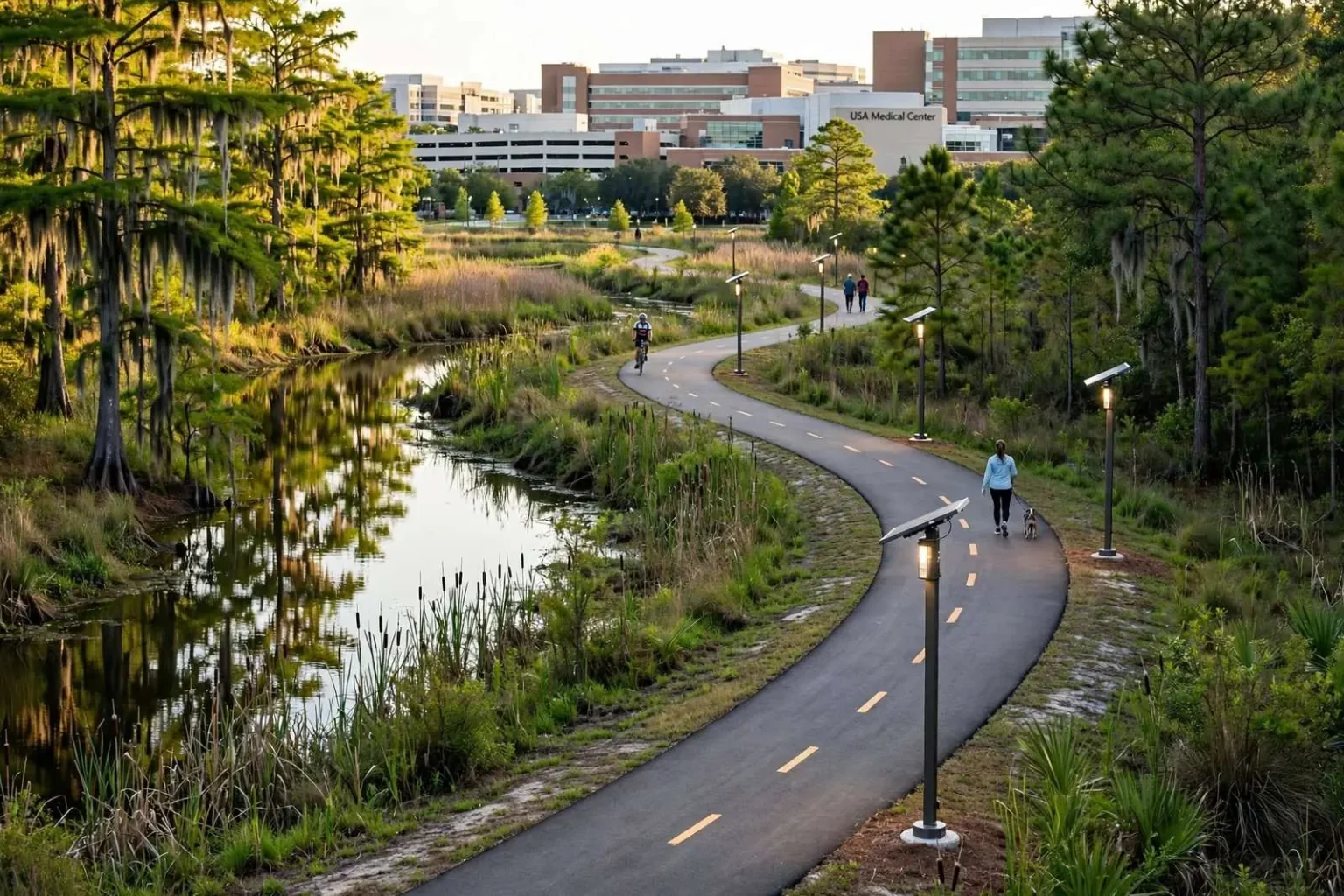
The city of Mobile has been awarded $555,092 in state transportation funding to extend the Three Mile Creek Greenway westward toward the University of South Alabama Medical Center, adding a new stretch to one of the city’s signature outdoor recreation projects. The award pushes a long-planned trail network one step closer to the spine of the city’s medical district, where thousands of workers and students move daily between campuses that have historically been reachable only by car.
The money comes from the Alabama Department of Transportation’s Transportation Alternative Program, a federally backed fund that supports biking, walking and other non-motorized transportation projects across the state. TAP grants have become a primary funding source for trail and sidewalk projects in Alabama cities, which apply through ALDOT and compete for a share of the federal transportation dollars set aside for projects that fall outside the traditional road-and-bridge pipeline.
The new segment will run roughly 3,300 linear feet, picking up where the original greenway construction ended along West Ridge Road, and will include solar-powered lighting to allow for safer use in early morning and evening hours. Lighting has been a recurring request from trail users in Mobile, where summer heat pushes much of the walking and running community into the margins of the day, and solar fixtures allow the path to be lit without extending electrical infrastructure along the creek.
The existing trail currently runs along the north side of Three Mile Creek, beginning at Tricentennial Park and continuing to West Ridge Road. The extension will push the path closer to the medical campus, giving students, hospital staff and nearby residents a more direct connection to the growing trail network.
Three Mile Creek winds through a portion of central Mobile that has carried a heavy share of the city’s infrastructure challenges, and the greenway is designed to do more than provide recreation. City planners have treated the corridor as a natural drainage feature that can be restored rather than buried, with the trail serving as the public face of a healthier creek that carries stormwater from a wide swath of the city toward Mobile Bay.
The greenway’s route threads through neighborhoods near the medical center and downtown, putting daily exercise and car-free commuting within reach of residents who have historically lacked both. For employees at the medical center, the extension could eventually mean the difference between driving to work and walking or cycling along a shaded corridor that follows the water the entire way.
How the project got funded
City leaders pursued the funding last year, when Mobile Mayor Sandy Stimpson and City Councilman Fred Richardson sponsored a resolution authorizing an application for the ALDOT grant. Under the terms of the award, the city will contribute $138,773 in local matching funds to complete the project.
The local match will come from the city’s capital budget, the standard arrangement for federal-aid transportation programs, which typically require a percentage participation from the sponsoring government. Richardson’s sponsorship was notable given that the corridor runs through his district, and the councilman has been among the strongest advocates at City Hall for investing in the creek and the neighborhoods around it.
The grant adds to a larger pool of money already committed to greenway construction in Mobile. Last month, the Alabama Gulf Coast Recovery Council, which oversees the distribution of BP oil spill settlement funds, voted to award the city $9.7 million for the broader Mobile Greenway Initiative. City officials say the ALDOT award will work alongside that funding to keep the trail expansion moving forward.
The two funding streams arrive by very different routes. The ALDOT money is traditional federal transportation funding, awarded competitively to projects that improve options for walkers and cyclists. The recovery council’s award flows from the civil penalties and settlements that followed the 2010 Deepwater Horizon disaster, which Congress directed toward Gulf Coast restoration under the RESTORE Act. Mobile has argued that restoring the Three Mile Creek corridor qualifies as environmental and economic restoration, and the council’s $9.7 million award suggests the city’s case found favor.
The two funding streams arrive by very different routes. The ALDOT money is traditional federal transportation funding, awarded competitively to projects that improve options for walkers and cyclists. The recovery council’s award flows from the civil penalties and settlements that followed the 2010 Deepwater Horizon disaster, which Congress directed toward Gulf Coast restoration under the RESTORE Act. Mobile has argued that restoring the Three Mile Creek corridor qualifies as environmental and economic restoration, and the council’s $9.7 million award suggests the city’s case found favor.
A 12-mile vision, decades in the making
The Three Mile Creek Greenway is part of a broader push by the city to build out a connected network of biking and walking paths throughout Mobile. Officials have said the trail system is intended to ease traffic congestion in nearby neighborhoods, give residents and visitors more places to exercise outdoors, and boost property values along the corridor.
The long-term goal, first envisioned decades ago, is to create a roughly 12-mile recreational path along Three Mile Creek linking the University of South Alabama, Langan Park, downtown Mobile and Mobile Bay.
“I want to thank ALDOT for helping Mobile make this 35-year-old vision a reality,” Stimpson said in announcing the award. “This new trail encourages fitness, beautifies a vital waterway and enhances our quality of life. Our goal is to link neighborhoods, businesses and residents across Mobile and educate our citizens on one of our precious waterways.”
The mayor’s reference to a 35-year-old vision points to how long the creek corridor has sat in Mobile’s planning documents. Greenway concepts along the waterway appeared in city plans going back decades, but pieces of the route remained on paper for want of funding and, at times, the political will to acquire land along a creek that many residents knew only as a flood nuisance. The recent string of grants has turned that paper trail into construction zones.
The full 12-mile route, once complete, would connect some of the city’s most visited destinations into a single car-free corridor: the university campus and medical center in the west, the extensive parkland around Langan Park and the Museum of Mobile area in the center, and the downtown waterfront and bay to the south and east. Planners have pointed to comparable trails in other Southern cities as evidence that connected greenways draw regular commuters as well as weekend recreation, particularly when they link housing to major employment centers the way the Three Mile Creek route would.
What comes next
City officials have not released a construction timeline for the new segment, but the addition of state and BP settlement funding gives the greenway project two major funding sources heading into the next phase of design and construction.
The next steps for the ALDOT-funded segment are the engineering and design work that precedes any federal-aid construction: surveying the route from West Ridge Road toward the medical center, finalizing the trail’s alignment and lighting plan, and putting the segment out for bid. Solar lighting, drainage crossings and connections to the existing trailhead infrastructure will all be settled in that design phase before heavy equipment arrives.
For the neighborhoods along the creek, the visible signs of progress have already changed how residents use the corridor. The completed first phase gave the city its first continuous stretch of protected path along the water, and weekend use along the existing segment has grown as word has spread. Each new segment shortens the distance between the trail and the people most likely to use it daily.
City officials have framed the greenway push as part of a larger strategy to make Mobile a healthier, more walkable city — an argument that has gained traction as cities across the region compete for young professionals and retirees alike. The trail network also dovetails with the city’s drainage investments along the same creek, pairing flood control with public access in a corridor that will see heavy construction from both programs in the years ahead.
The dual purpose is deliberate. Three Mile Creek drains a broad section of central Mobile, and during heavy rains it has historically overflowed its banks into surrounding streets and neighborhoods. Restoring the creek’s natural edges — native plantings, stabilized banks, wider flood-prone areas left undeveloped — gives stormwater somewhere to go while creating the kind of green space that trail users and wildlife both benefit from. Officials have described the greenway and the drainage work as complementary pieces of the same corridor plan, each making the other easier to build and maintain.
With the state award secured and BP settlement money committed, the city now holds funding for the next two phases of a trail it has been sketching for more than three decades.