Mobile Lands in Rent.com’s Top 10 Small Cities for Meat Lovers
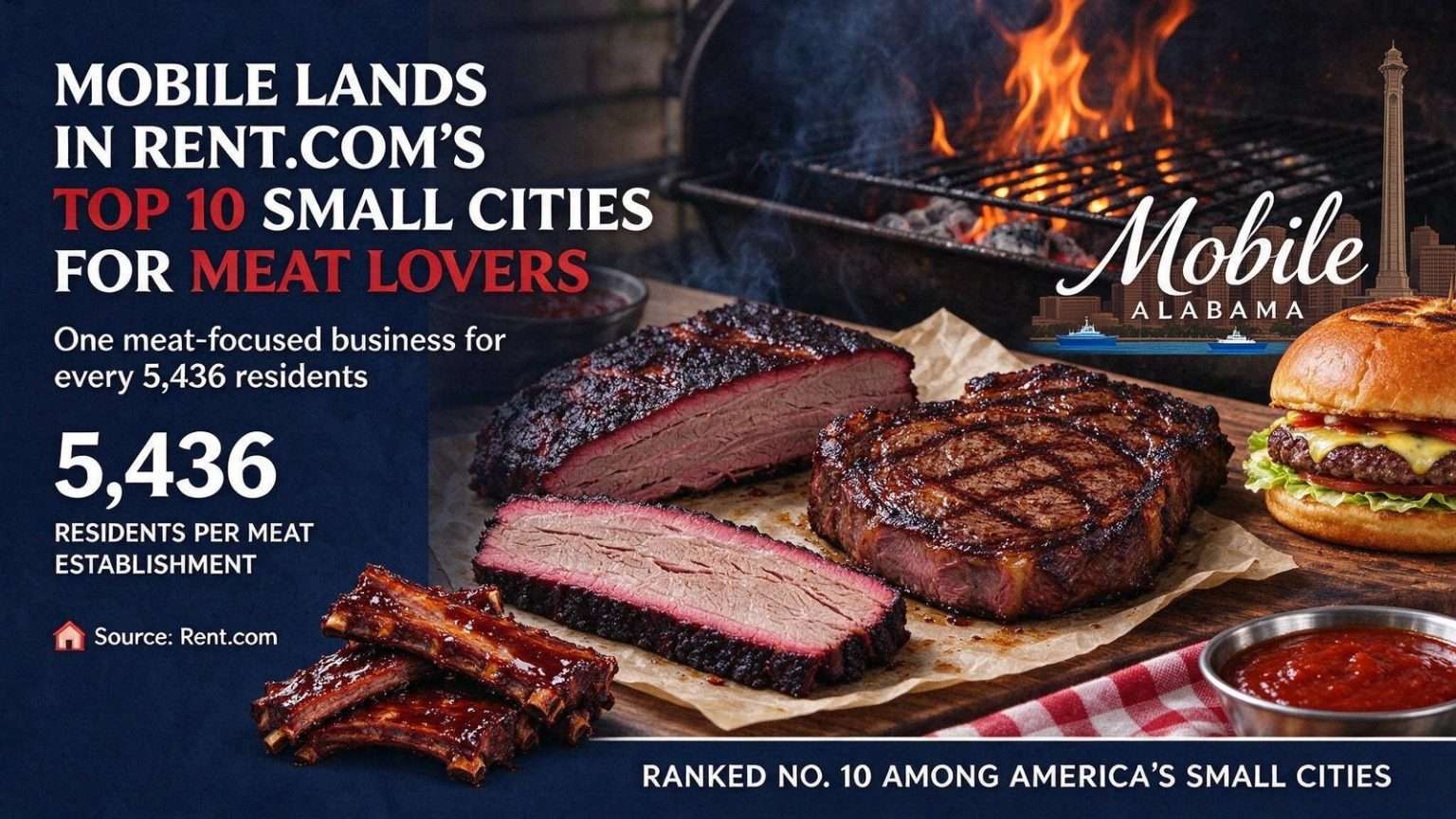
Mobile placed 10th nationally on a new Rent.com ranking of the best small cities for meat lovers, based on the concentration of barbecue, burger and steak establishments per resident.
Mobile has earned a spot on a new national list ranking the best small cities in America for meat lovers, according to a study released by the rental listing service Rent.com. The study set out to answer a simple question for consumers heading into grilling season: which cities offer the greatest concentration of meat retailers and restaurants specializing in steak, burgers and barbecue.
Researchers pulled data from commercially available business listings to count meat-focused establishments in cities across the country, then measured that total against each city’s population to produce a per-capita ranking. Mobile placed 10th nationally among small cities, with researchers calculating one meat-focused business for every 5,436 residents in the city. The ranking covers retailers as well as restaurants specializing in steak, burgers and barbecue, though it does not include every fast-food chain or general restaurant that happens to serve meat.
“With summer right around the corner, ’tis the season for burgers, steak and barbecue joints,” said Kristen Baker-Gezcy, who helped compile the findings for Rent.com. “Foodies and meat lovers in Mobile may be surprised to know that their town ranks number 10 in the Top 10 Small Cities for Meat Lovers with an average of one meat establishment per 5,436 residents.”
For a city that has long considered itself one of the Gulf Coast’s great eating towns, the ranking confirms what locals already know: the butcher shops, steak houses, burger stands and barbecue pits scattered across Mobile’s neighborhoods add up to an unusually dense meat landscape for a city of its size. From the older barbecue joints on the northern side of the city to the burger spots along Government Street and the steakhouses serving the business crowd downtown, meat-centric businesses occupy a permanent place in Mobile’s dining economy.
Because the report is Rent.com’s first attempt at ranking cities by meat consumption, there is no historical data available showing how Mobile’s standing may have shifted over time or where the city might have ranked in previous years. That lack of history means the ranking should be read as a snapshot rather than a trend — a picture of where meat businesses cluster per capita right now, not evidence that Mobile is rising or falling as a carnivore destination. Still, first editions of such lists tend to attract attention precisely because nobody knows how the field will shake out in future years.
How the rankings broke down
Topping the small cities list was Chattanooga, Tennessee, with just 3,894 residents per meat establishment, followed by Birmingham in third place with 4,132 residents per establishment. Lewisville, Texas, also cracked the top 10, landing just ahead of Mobile in the rankings. Birmingham’s high placement gives Alabama two cities in the national discussion, and it fits the state’s long-running reputation for barbecue — a culinary tradition that runs from the smokehouses of Birmingham to the white sauce country of the northern part of the state to the Gulf-flavored pits of south Alabama.
On the list of large cities, Las Vegas took the top overall spot, driven by 48 barbecue restaurants, 112 burger and steak establishments, and 132 combined locations of Burger King, McDonald’s and Wendy’s. The Nevada city’s average monthly rent of $1,063 for a one-bedroom apartment was also noted in the report, though Rent.com did not specify how housing costs factored into the meat-friendliness rankings.
The methodology has limits that residents of any ranked city should keep in mind. Counting business listings does not measure quality, sales or how often residents actually eat at these establishments, and listing databases can overcount or undercount depending on how businesses categorize themselves. A city that hosts many small barbecue carry-outs, for example, can score differently depending on whether those shops appear in the commercial data the researchers purchased. Rent.com’s figures are best understood as a rough measure of density, not a definitive guide to where the best steak dinner awaits.
Why a rental site ranks barbecue
Rent.com is primarily known as a platform for apartment and home rental listings, and the meat lovers study appears to be a seasonal feature built around that core business, tying restaurant and retail data to local rental markets in cities across the country. Rental platforms have increasingly turned to lifestyle rankings as a marketing tool, betting that content about food, nightlife and local culture keeps prospective renters on the site and gives them a feel for cities they may be considering. A list about meat is, underneath it, a list about what makes a city livable — and, for the company, a reason to keep browsing apartments in the cities at the top.
For Mobile, the recognition arrives with a practical angle: the local food scene has become part of how the city markets itself. City boosters and downtown advocates have spent years promoting Mobile as a destination for both residents and visitors, pointing to the restaurant growth downtown, the revival of Dauphin Street and the steady opening of new eateries across the city’s neighborhoods. A national list — even an unusual one — is the kind of mention that local tourism and business groups are happy to circulate.
The ranking also lands at a time when Mobile continues to see growth in its restaurant and retail sectors, with barbecue joints, steakhouses and burger spots regularly opening across the city’s neighborhoods. Population growth on the city’s western side and continued investment in the downtown core have given entrepreneurs reasons to open new concepts, and the per-capita math that landed Mobile on the list reflects both the number of meat-focused businesses and the city’s moderate size relative to its dining options.
Local business leaders have pointed to the city’s expanding food scene as part of a broader push to promote Mobile as a destination for both residents and visitors. Rankings of this kind, while light-hearted, feed into that effort: they give economic development officials a quotable line, give restaurant owners a badge to display, and give residents an excuse to feel good about the businesses on their own streets. Whether the study gets repeated is another question — Rent.com has not indicated whether it plans to repeat the meat lovers ranking in future years or how methodology might change if it does.
For now, Mobile can claim a spot among the top meat-loving small cities in America, sharing a list with barbecue capitals and Texas suburbs. With grilling season approaching, residents have one more reason to fire up the smoker, visit a neighborhood butcher, or settle into a booth at a favorite steak house — and to tell visitors that their city’s meat density is, officially, among the best in the country for a city its size.
Beyond the ranking itself, the list offers a window into how the region eats. Barbecue in south Alabama leans on pork — pulled shoulders smoked low over hardwood, ribs finished with vinegar-based sauces, and the smoked sausage that appears on plates across the Gulf Coast. Burger culture runs from old-fashioned lunch counters to newer fast-casual concepts, and the city’s steakhouses do steady business catering to the executives, shipbuilders and port workers who drive the local economy. Meat retailers — the butcher shops and specialty markets that round out the study’s count — serve a customer base that still cooks at home in large numbers, especially during football season and the holidays.
That culture has deep roots. Mobile’s food traditions draw on the same Creole, Cajun and Southern influences that shape its famous Mardi Gras tables, and meat dishes anchor many of them: gumbo thick with smoked sausage, red beans seasoned with ham hocks, and the seafood boils that share backyard space with burgers every summer. When researchers count “meat-focused establishments,” they are, in a sense, counting the commercial expression of a home cooking tradition that runs back generations in south Alabama.
The seasonal timing of the study matters as well. Released heading into summer, it captures the moment when backyard grills across Mobile come out of winter storage and when families start planning cookouts around Memorial Day and the Fourth of July. Grocery stores and meat markets along the Gulf Coast do a large share of their annual business in those months, and the restaurants that specialize in burgers and barbecue see their heaviest traffic as tourists pass through on the way to the beaches.
For residents who want to put the number in perspective: one meat-focused business per 5,436 residents means that in a city of Mobile’s size, most neighborhoods sit within a short drive of a half-dozen options spanning butcher counters, barbecue pits and burger stands. Whether that density leads the state next year or slips down the list depends on the opening and closing of individual businesses — and, as always in the restaurant trade, on which concepts survive their first few summers.
In the meantime, Mobile’s placement gives the city a boast that few would have predicted and everyone can enjoy: among America’s small cities, this one knows its way around a grill.