Mobile Lands the Old USA Golf Course Tract: Roughly 250 Acres Bought, Half Set Aside for a Bayside Park
Mobile has bought roughly 250 acres of the old USA golf course at Brookley, setting aside half for a landmark bayside park and wetlands preservation.
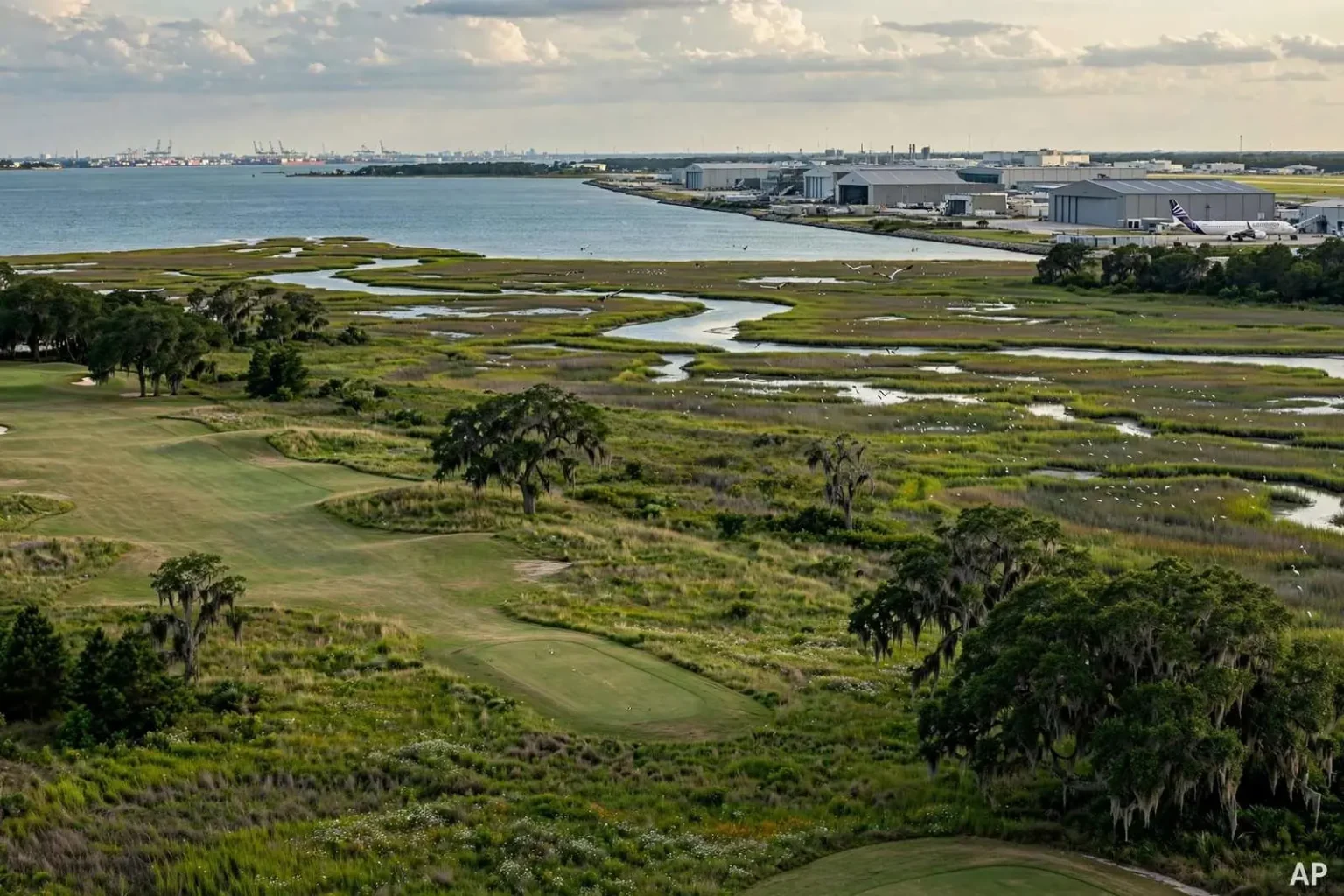
A deal that long seemed like a fairy tale came true for the city of Mobile: the former USA golf course property at Brookley — some 300 acres of mostly undeveloped land along Mobile Bay — has been sold to the city, with roughly half of it slated to become public space and a major bayside park. Mayor Sandy Stimpson announced the agreement at a press conference attended by Gov. Kay Ivey, who described the state’s role in assembling the deal. Mobile Airport Authority Chairman Elliot Maisel, who had once likened the park dream to a fairy tale, called the turnaround hard to dispute.
The announcement capped years of negotiation over a tract that has been one of the most coveted pieces of undeveloped waterfront on the entire Gulf Coast — a quarter-mile-wide stretch of bayfront land inside the city limits that had never been opened to the public. For a city whose downtown sits within sight of the water yet offers surprisingly few places to reach it, the purchase represents the largest single addition of public shoreline in Mobile’s modern history.
How the Land Breaks Down
Under the purchase, state and federal money covers roughly 250 acres of the property. About 100 acres will be set aside for public access and a new waterfront park, another 50 acres of wetlands go into preservation, and 100 acres remain earmarked for development tied to the push to make Brookley one of the world’s largest commercial aircraft construction sites. The city also holds a five-year option to spend $9 million on the final 50 acres, bringing the total purchase price to about $42 million — the vast majority of it state and federal funding rather than Mobile’s own treasury.
The structure of the deal means the city acquires the land without competing with the industrial expansion underway at the Mobile Aeroplex at Brookley, the former Air Force base that now hosts the Airbus final assembly line and a growing cluster of aviation suppliers. The 100 acres reserved for development will extend that industrial campus, while the parkland and preserved wetlands give the public its stake in the shoreline. Planners describe the split as a rare alignment of working waterfront economics and public access, rather than a choice between the two.
The property traces back to the old Gulf Pines Golf Course, once owned by the University of South Alabama and later transferred to the USA Foundation in exchange for money that helped build Children’s & Women’s Hospital. The foundation long sought to sell the tract for development, at one point reportedly asking as much as $60 million, and in March 2019 a $45 million option was placed on the land by 24/7 Development Partners before that deal collapsed just before Christmas. The failed option left the foundation with an asset it could not monetize and the city with an opening it had been pursuing for years.
A Long Campaign for Bay Access
The park push began in earnest seven years earlier, when retired insurance adjuster Clarence Carrio began arguing that the tract represented Mobile’s last real chance to create a large bayside park with easy public access to the water. Carrio’s advocacy — persistent, data-backed and aimed at anyone who would listen at city hall — turned the golf course land from a private real estate story into a public cause, and eventually into a mayoral priority.
Stimpson embraced the idea after taking office, and city leaders kept working on it even as BP restoration dollars flowed to other projects, such as the port’s roll-on, roll-off auto facility. That patience proved essential: while the most visible restoration money went to economic development elsewhere on the waterfront, the negotiations over the golf course tract continued through changing market conditions, the collapse of the 2019 option and the eventual assembly of state and federal funding.
Supporters note that Mobile is a city surrounded by water its residents have rarely been able to reach, unlike neighboring Fairhope’s celebrated pier-front park. The Eastern Shore city’s park and pier have become the region’s signature public waterfront — the place families drive to on summer evenings — while Mobile’s own bayfront has remained largely in private industrial and institutional hands. The new plan promises wetland trails, places to launch boats, room to play near the bay — and, backers hope, someday a long fishing pier of its own.
What the Park Could Become
The 100 acres designated for public access amount to one of the largest park sites created on the Gulf Coast in decades, and the land’s condition — former golf course fairways meeting natural bay shoreline — gives planners a head start most urban parks never get. Open turf that once served golfers can be repurposed for fields and gathering lawns, while the untouched shoreline edge becomes the natural spine for trails, launches and waterfront overlooks that need only be connected rather than constructed from scratch.
The 50 acres of wetlands entering preservation carry their own value beyond scenery. The marshes fringing Mobile Bay filter stormwater, buffer the shoreline against storm surge and serve as nurseries for the fish and shellfish that support the bay’s ecosystem and its fishing traditions. Permanent protection for that habitat means the park’s users will experience a working stretch of the bay’s natural systems, not just a manicured lawn at the water’s edge — and the preserved wetlands will do quiet infrastructure work, absorbing floodwater that would otherwise push inland.
The long-discussed fishing pier remains a future ambition rather than a funded feature, but its place in the vision signals what supporters believe the park can mean: a Fairhope-style destination on Mobile’s side of the bay, where the public’s relationship with the water changes from passing view to daily use. Birders, kayakers, anglers and families would all gain access to a shoreline that has been off-limits within living memory.
The Deal’s Wider Significance
For a mayor who has often spoken about legacy projects, advocates call the acquisition the most lasting one yet: the last large piece of Mobile Bay waterfront saved from development and handed to the public. Street resurfacing and drainage projects are renewed on budget cycles; a bayfront park, once created, belongs to the city permanently. The comparison to Fairhope — a town of a fraction of Mobile’s size with a waterfront that defines it — has become the shorthand backers use to explain the stakes.
The financing structure is equally significant for what it demonstrates. By combining state investment championed at the highest levels with federal dollars and a modest city commitment, Mobile assembled $42 million for a property once marketed at $60 million, while preserving 100 acres for the industrial expansion that drives the region’s aviation economy. The governor’s presence at the announcement underscored that the state treated the purchase as more than a municipal amenity — it was a piece of the Brookley growth story and a public asset rolled into one transaction.
The five-year option on the final 50 acres keeps the door open for the full vision while leaving room for negotiation. City leaders have not detailed a construction timeline for the park itself, and major waterfront parks typically unfold in phases as funding allows — trails and access first, signature features like a pier later. What is settled is ownership: the land that golfers once walked and developers once optioned now belongs to the people of Mobile, and the city’s long exclusion from its own shoreline has an endpoint.
From the air, the tract reads as the missing link in Mobile’s waterfront — undeveloped bayfront wedged between the Aeroplex’s runways and hangars and the neighborhoods to its north. From the ground, once the gates open, it will read as something simpler: the place Mobile went to reach the water it had always lived beside.
From Fairway to Front Lawn
The tract’s history gave the campaign its memorable arc. Generations of Mobilians played rounds at Gulf Pines without thinking much about the shoreline beyond the final holes, and the university’s transfer of the land to its foundation — a swap that helped build one of the region’s premier women’s and children’s hospitals — tied the property’s story to institutions the city takes pride in. The failed development option of 2019 then became the hinge point: when the $45 million deal fell apart, the conversation shifted from “who will buy it” to “what should it become.”
That shift is where the advocacy of a retired insurance adjuster proved decisive. Clarence Carrio’s years of argument — that Mobile’s last big piece of accessible bayfront should not slip away parcel by parcel — supplied the political framing that city leaders eventually adopted as their own. The park’s champions now include mayors, a governor and an airport authority chairman who once used the word “fairy tale” to describe the dream; the idea outlasted the skepticism directed at it.
For residents, the practical changes will arrive in sequence: planning and design, then access improvements, then the park’s public features as construction phases are funded. The development acres at Brookley will continue growing on their own schedule, with the aviation campus’s expansion running alongside — and ultimately paying for much of the public side through the assembled state and federal investment.
Mobile has spent decades reconnecting with its waterfront one project at a time — a riverfront jump-started downtown, greenways appearing in fits and starts, festival piers to the south. The Brookley purchase is the largest single step in that long return: 300 acres, half of them promised to the public, on the bay that gave the city its name and its reason for being where it is.