Mobile Launches $20,000 Down Payment Program to Put First Responders in Homes
Mobile's new HUD-funded program gives qualifying police officers and firefighters up to $30,000 for down payments and closing costs.
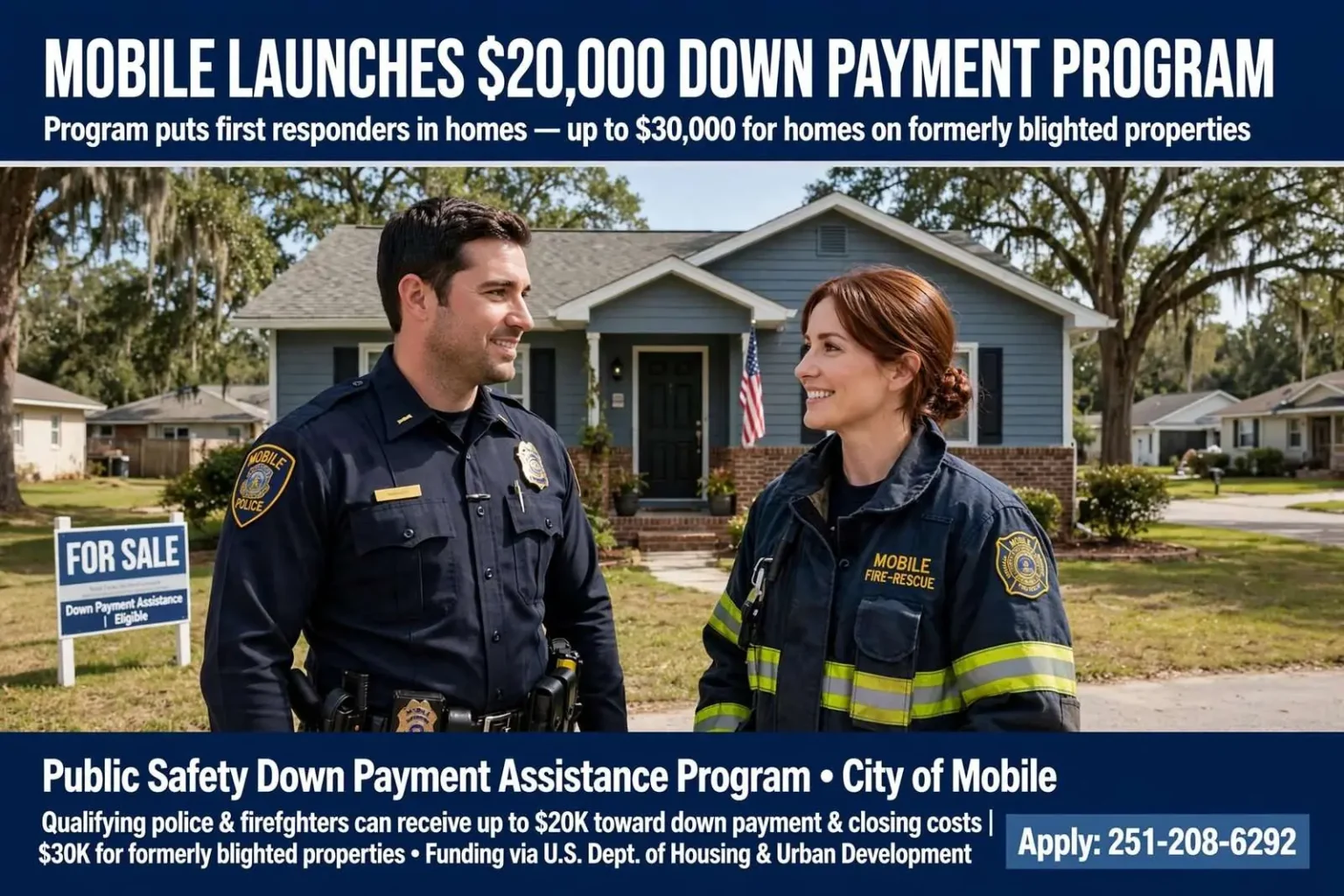
The City of Mobile is giving police officers and firefighters a leg up on buying their first home through a new Public Safety Down Payment Assistance Program.
Qualifying first responders can receive up to $20,000 toward a down payment and closing costs. If the home they purchase sits on a formerly blighted property, the assistance rises to as much as $30,000.
Funding comes from the U.S. Department of Housing and Urban Development, the federal agency whose community development block grants flow through city housing departments across the country to support homeownership, blight removal and neighborhood reinvestment.
How the program works
The Public Safety Down Payment Assistance Program is aimed squarely at the employees the city struggles hardest to recruit and retain: police officers and firefighters. Under the program’s structure, a qualifying first responder purchasing a home in Mobile can apply for up to $20,000 in assistance to cover the down payment and closing costs that stand between many working families and their first mortgage. That assistance is not a loan repayment schedule in the traditional sense of home lending; it is support layered onto the purchase to make the transaction possible in the first place.
The higher tier of assistance — as much as $30,000 — applies when the home being purchased sits on a formerly blighted property. That design ties the employee benefit directly to the city’s broader campaign against blight, directing program dollars toward lots and structures that have been a drain on their neighborhoods. A blighted property that returns to productive use as a first responder’s home removes a liability from the tax rolls, ends the cycle of vacancy and deterioration, and puts a stakeholder in the neighborhood who is on the city’s payroll and accountable to its residents.
The program’s design reflects a practical reading of what holds back homeownership for young officers and firefighters. Entry-level salaries in both professions are modest relative to Mobile’s median home prices, and the up-front cost of a purchase — typically thousands of dollars in down payment and closing costs — is the obstacle that keeps otherwise creditworthy buyers renting. By targeting that specific obstacle, the city aims to convert public safety employees into homeowners within the city limits rather than in the surrounding suburbs.
Why the city sees it as a neighborhood tool
Mayor Sandy Stimpson framed the program as a neighborhood-strengthening tool as much as an employee benefit. “Not only does home ownership improve these first responders’ quality of life, but it improves their neighbors’ quality of life too,” Stimpson said in a news release. “When a police officer or firefighter lives in your neighborhood, it reduces crime, improves property values and creates a more vibrant neighborhood.”
The reasoning the mayor described has a long pedigree in municipal policy. Cities across the country have experimented with residency incentives for public safety employees, operating on the theory that homeowners who work in the community they live in are invested twice over — as property owners with a financial stake and as the police officers and firefighters already familiar with the streets they patrol and protect. A neighborhood with a resident officer or firefighter benefits from that presence in ways that go beyond emergency response times.
For Mobile, the program also fits into a decade of effort under the Stimpson administration to confront blighted properties, which numbered in the thousands when the city began surveying them. Each formerly blighted lot converted into a homestead represents a permanent change in a neighborhood’s trajectory, and tying the first responder incentive to those properties means the housing program and the blight program reinforce each other.
The federal funding behind it
Funding for the program comes from the U.S. Department of Housing and Urban Development, which channels housing and community development money to cities through formula grants administered locally. Mobile, like cities of its size across the country, receives annual federal allocations that its housing officials program into homeownership assistance, rehabilitation loans, blight removal and neighborhood services.
Using federal housing money for first responder down payment assistance is a recognized approach among cities pursuing residency goals, provided the program meets the eligibility and income requirements attached to the funding. Those requirements shape who qualifies, what properties are eligible and how the assistance is documented — details the city handles through its application process rather than leaving to individual buyers.
The commitment of federal dollars to the program also reflects the economics of Mobile’s housing market. Home prices across the city have risen along with demand in recent years, and the gap between what an entry-level officer or firefighter can save and what a starter home requires has widened. Assistance at the $20,000 to $30,000 level is substantial relative to that gap, capable of covering the down payment and closing costs on many of the mid-range homes in Mobile’s older neighborhoods — precisely the neighborhoods where blighted properties have been concentrated.
Who qualifies and how to apply
The program is open to qualifying first responders employed by the City of Mobile, with eligibility requirements administered through the city’s application process. Interested applicants can learn more by calling 251-208-6292, the number the city designated for program inquiries.
For officers and firefighters weighing a purchase, the assistance changes the arithmetic of buying in Mobile in concrete terms. A buyer who has been renting while saving for a down payment can move years ahead of that timeline with $20,000 applied at closing, and a buyer willing to purchase on a formerly blighted property gains another $10,000 toward the same end. Those numbers do more than offset costs; they expand the pool of homes a first responder can realistically consider within the city.
City officials have long cited residency among first responders as a priority, and the program gives that priority a funding mechanism. The expectation behind it is straightforward: if the city helps its officers and firefighters buy homes in Mobile, the city gains residents with stable stakes in its neighborhoods, and its neighborhoods gain the presence the mayor described.
What it means for Mobile’s neighborhoods
The program’s ultimate measure will be visible street by street: homes purchased, blighted lots reoccupied and neighborhoods where first responders now live among the people they serve. Those outcomes accumulate slowly, but each purchase under the program represents a family planted in a neighborhood and a property returned to the tax rolls.
For Mobile’s older neighborhoods — the historic districts east of Broad Street, the mid-century subdivisions of the central city and the corridors where blight has been most persistent — the prospect of public safety employees as neighbors carries both practical and symbolic weight. Practically, it adds engaged homeowners to streets that need them. Symbolically, it signals that the people Mobile entrusts with its safety are choosing to build their lives in the same community.
The city has made program information available through the 251-208-6292 line, and interested first responders are encouraged to inquire about eligibility and the properties that qualify for the enhanced assistance tier. As the program moves from launch to operation, its take-up among officers and firefighters will determine how broadly its effects spread across the city’s neighborhoods.
In the meantime, the program stands as one of the more concrete ways Mobile has linked its public safety strategy to its housing strategy: a $20,000 bridge to homeownership for the people who answer the city’s emergencies, rising to $30,000 where a blighted property becomes someone’s home.
The recruitment problem the program addresses
Behind the program is a competition for personnel that has defined policing and fire services across the country for years. Departments large and small have struggled to fill academy classes and keep experienced personnel, as private-sector wages, remote work options and the demands of the professions themselves have thinned applicant pools. Mobile is no exception, and city leadership has treated recruitment and retention of police officers and firefighters as a budget and policy priority.
Down payment assistance addresses the retention side of that problem in a way that pay raises alone do not. An officer or firefighter who purchases a home in the city has made a long-term commitment that is expensive and inconvenient to undo, which makes homeownership assistance a retention tool as much as a recruitment one. Cities that have run similar programs treat the assistance as a mutual investment: the employee puts down roots, and the department gains stability in its roster.
The structure of the benefit also reflects an understanding of where first responders typically live. Like most American cities, Mobile draws many of its public safety employees from outside the city limits, with commutes in from the suburbs and unincorporated areas of Mobile County. Each of those employees represents both a resident the city would like to have and a taxpayer whose support currently flows to another municipality. Moving even a portion of that population inside the city limits changes the equation for the city’s budget, its school system and its civic life.
Blight and its costs
The enhanced assistance for formerly blighted properties ties the program to one of the most persistent challenges in Mobile’s older neighborhoods. Blighted structures and vacant lots impose real costs on the blocks around them: they suppress nearby property values, attract dumping and vandalism, and consume city resources through code enforcement, mowing and, in the worst cases, demolition.
The city has spent years cataloguing and confronting its blighted inventory, using condemnation proceedings, demolition contracts and land sales to return properties to productive use. What happens to a cleared lot is the next question in that process, and homeownership is the answer that brings the most lasting benefit. A new home on a formerly blighted lot replaces a liability with a homestead, and the $30,000 assistance tier is designed to make that outcome attractive to first responders specifically.
For the neighborhoods where those properties cluster, the difference between a vacant, overgrown lot and a maintained home with a family in it is not subtle. It changes how a street looks, how it is used and how it is valued. Anchoring that change with residents whose profession is protecting the community adds a dimension that market-rate buyers alone do not provide.
Looking ahead
Programs of this kind succeed or fail on participation, and the city’s outreach through the 251-208-6292 line is the entry point for measuring it. The application process will determine how quickly officers and firefighters move from interest to purchase, and the first closings under the program will provide the first real evidence of its effect.
The program also joins a set of housing tools the city has deployed alongside its blight campaign, including incentives aimed at other segments of the market. Each tool addresses a different gap, and the first responder program’s niche is clear: the city’s own employees, buying their first homes, in the neighborhoods that need them most.
For Mobile’s police officers and firefighters, the program converts a career in public service into a path toward homeownership that might otherwise take years to travel. For the city’s neighborhoods, it puts the people who answer 911 calls into the houses down the block. Both outcomes are the point, and the program’s design — from the $20,000 base assistance to the $30,000 blighted-property tier — is built to deliver them together.