Mobile Leaders Eye $168 Million Renovation Concepts for Aging Civic Center
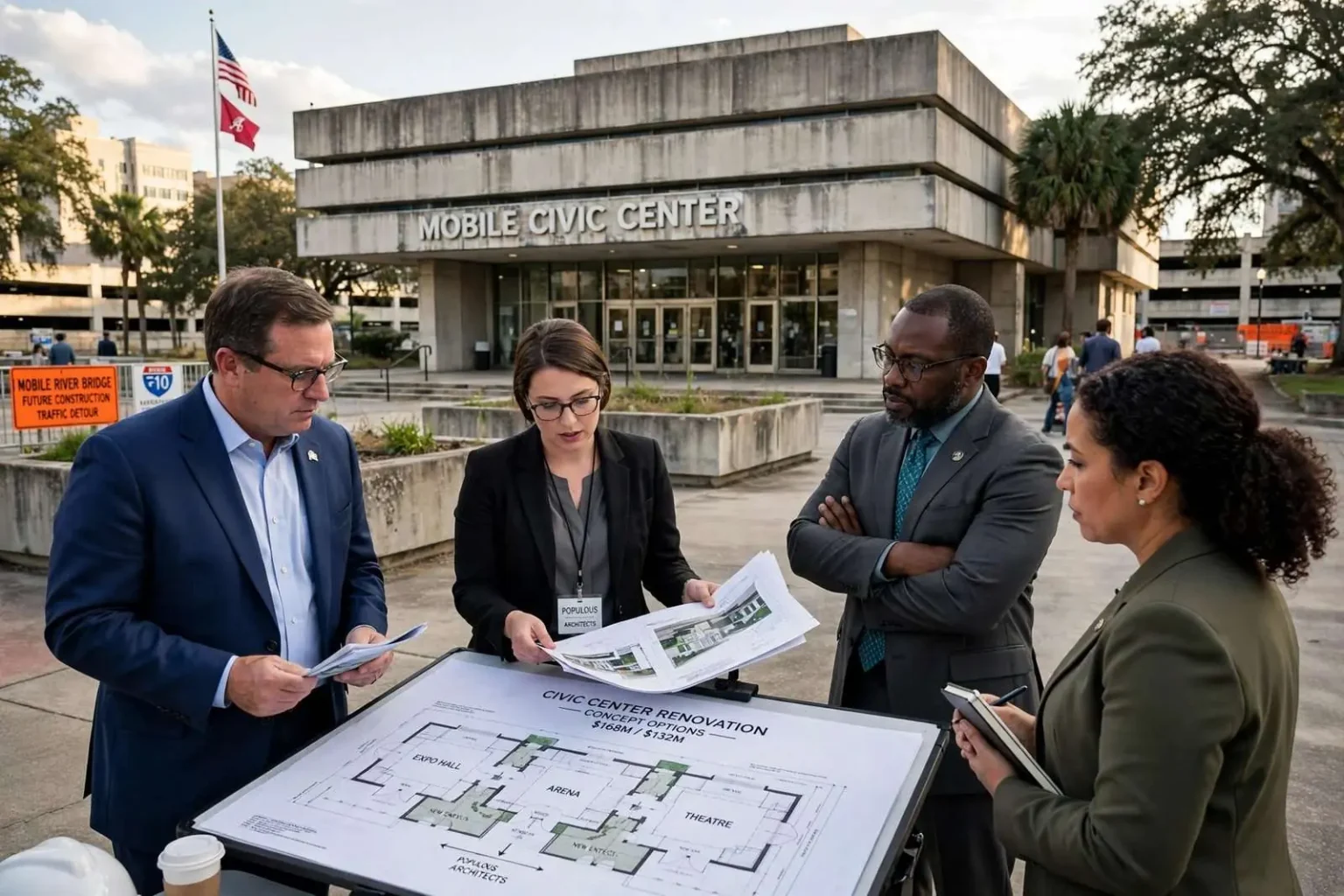
Mobile's City Council reviewed Populous Architects' concepts to renovate the Civic Center arena, expo hall and theatre at costs up to $168 million.
A Landmark Under the Microscope
The future of the Mobile Civic Center took center stage at a City Council work session with designers, where renovation concepts carrying price tags of roughly $168 million and about $132 million were laid out. The council met with Populous Architects to talk through the potential layout of the downtown facility, an aging complex that has anchored Mobile’s public events for generations and now faces decisions about how much of it to rebuild and how quickly.
Under consideration were updates spanning all three of its main venues — the expo hall, the arena and the theatre. Each component serves a different slice of the region’s civic life. The expo hall hosts trade shows, consumer expositions and community events; the arena carries concerts, sporting events and large gatherings; the theatre presents performances in a more intimate setting. Renovating all three at once is what pushes the concept costs into nine figures, while a narrower scope comes in around the lower estimate presented to the council.
Designers walked council members through the possibilities floor by floor, describing how circulation, seating and support space could be reconfigured without tearing the complex down. The exercise was conceptual rather than final — no vote was taken, no contractor selected and no funding committed — but it marked the most detailed public discussion of the building’s future in some time.
What the Concepts Would Change
District 2 Councilman William Carroll said funding discussions would come later, but framed the project as a chance to make better use of an aging landmark. The elements he cited read like a checklist of what patrons and performers have complained about for years: rearranged seating, a renovated interior, added private spaces, new bathrooms, fixes for ADA issues, mechanical and air-conditioning repairs, more green space — and a plan for how visitors will get in and out once a new bridge arrives nearby.
The accessibility items carry weight beyond compliance. Bathrooms, seating and entrances that meet modern standards determine whether older residents, families with strollers and patrons with disabilities can attend events comfortably at all. Mechanical and air-conditioning repairs address a system that has strained through Gulf Coast summers, when large crowds and heavy humidity test equipment sized for a different era.
The transportation question is increasingly urgent. Planning for the new I-10 Mobile River Bridge and its approach has been reshaping downtown traffic patterns, and the Civic Center sits in the middle of that changing landscape. Designers and council members agreed that ingress and egress plans drawn now will determine how easily thousands of event-goers reach the complex once the new highway connections open.
More green space, meanwhile, reflects a broader shift in how cities use convention and civic campuses. Surface parking and hard edges between the building and surrounding streets are giving way in many cities to plazas and landscaped areas that host festivals, markets and everyday gathering between ticketed events.
Why the Civic Center Matters
The Civic Center complex opened in the mid-1960s and has hosted everything from touring concerts and circuses to graduations, high school championships and political events. It has been the site of moments that longtime Mobilians still recount decades later, and its arena and theatre gave local promoters venues to book national acts that might otherwise have skipped the Gulf Coast for larger cities.
Age has caught up with it. Mechanical systems installed decades ago cost more to keep running each year, interior finishes show wear that renovations cannot fully disguise, and the standards expected of modern event venues — loading capacity, technology infrastructure, premium and private spaces, concessions layouts — have moved far beyond what was built in the 1960s. Cities across the country have faced the same calculation: renovate a beloved civic anchor or replace it, and either path costs tens of millions.
That economic logic is what community leaders who attended the work session emphasized. Among them was Reggie Hill, founder of “Success 4 the Future,” who called the Civic Center a historic heirloom and argued renovating it would pay off in economic development. His argument follows the standard playbook for civic venues: every concert, exposition and tournament brings visitors who eat in downtown restaurants, park in downtown decks and stay in downtown hotels, multiplying the value of each event beyond ticket sales.
Downtown Mobile has invested heavily in recent decades — redevelopment along Dauphin Street, growth in the medical and aerospace employment base, and a rising number of residents living in the central business district. A renovated Civic Center would sit alongside those assets, and its condition directly affects how competitive Mobile remains for conventions, regional tournaments and touring shows against cities such as Pensacola and Biloxi.
Two Price Tags, One Decision
The difference between the roughly $168 million and $132 million concepts comes down to scope. A comprehensive renovation touching all three venues, their mechanical systems and the site around them occupies the higher tier. A more selective approach — prioritizing the most-used spaces and the most urgent repairs — lands near the lower one. Designers present both so elected officials can see the tradeoffs before choosing which direction to pursue.
No funding source was identified at the work session, and council members were clear that money conversations would follow, not precede, the design discussion. Options typically available to a city in this position include general obligation borrowing, dedicated tax revenues, hospitality taxes, state and federal grants, and public-private partnerships, each with its own approval path and political considerations.
Where the Public Fits In
Residents did not get a voice during Monday’s meeting itself, but Carroll stressed they would be included before final decisions — from what should be done and how money should be spent, to shaping the overall master plan so it fits what the community has been working toward. That commitment matters for a building whose users span high schools, churches, festival organizers, promoters and thousands of ordinary attendees each year.
Public input processes for civic projects usually run through community meetings, surveys and stakeholder sessions with the groups that actually use the venues. For the Civic Center, that would mean hearing from event promoters who know its loading docks, theater companies who know its stage, and families who know its parking lots. The council’s message was that those voices will shape the master plan rather than merely react to it once drawn.
The work session format itself was notable: no vote, no final design, just an extended conversation between elected officials and the architects studying the building. Sessions like this one are where the scope of a project is actually decided, before renderings go public and long before a construction contract is awarded.
What Comes Next
The immediate next steps are design refinement and, eventually, the funding conversation Carroll deferred. Council members will need to weigh renovation costs against the building’s operating deficits, compare the concepts with estimates for new construction, and decide what timeline the city can sustain. Each of those steps will come back before the council in public session.
For now, the Civic Center keeps operating as it has, hosting its calendar of shows and events while the debate over its future proceeds. What Monday’s meeting established is that the city is seriously entertaining a nine-figure investment in the complex rather than writing it off, and that both a full renovation and a scaled-down version are on the table. Which of them — if either — moves forward will be decided not at the drawing board but in the budget discussions and community conversations still to come.
Residents who want to follow the process can expect future council work sessions and public meetings as the master plan takes shape, with the stated goal that the community’s priorities — accessibility, usable public space, and a facility that works — drive the final design rather than trail it.
The stakes extend beyond one building’s walls. A civic complex of this size anchors the scheduling logic of downtown — hotels book group blocks around its conventions, restaurants staff up for its show nights, and parking decks plan for its peak hours. If the city under-invests, those businesses lose the traffic; if it invests well, the entire district shares the return. That shared stake is precisely why council members and community leaders alike keep returning to the same phrase: this is a decision about downtown’s future, not just its past.
Whatever the final number, the council’s review of the Populous concepts marks the point where the Civic Center conversation moved from aspiration to arithmetic. The arithmetic is now public: two scopes, two price tags, and a community that has been promised a seat at the table before either is chosen.
The clock matters too. Every season of deferred work adds maintenance costs and risks losing booked events to newer venues elsewhere on the Gulf Coast.