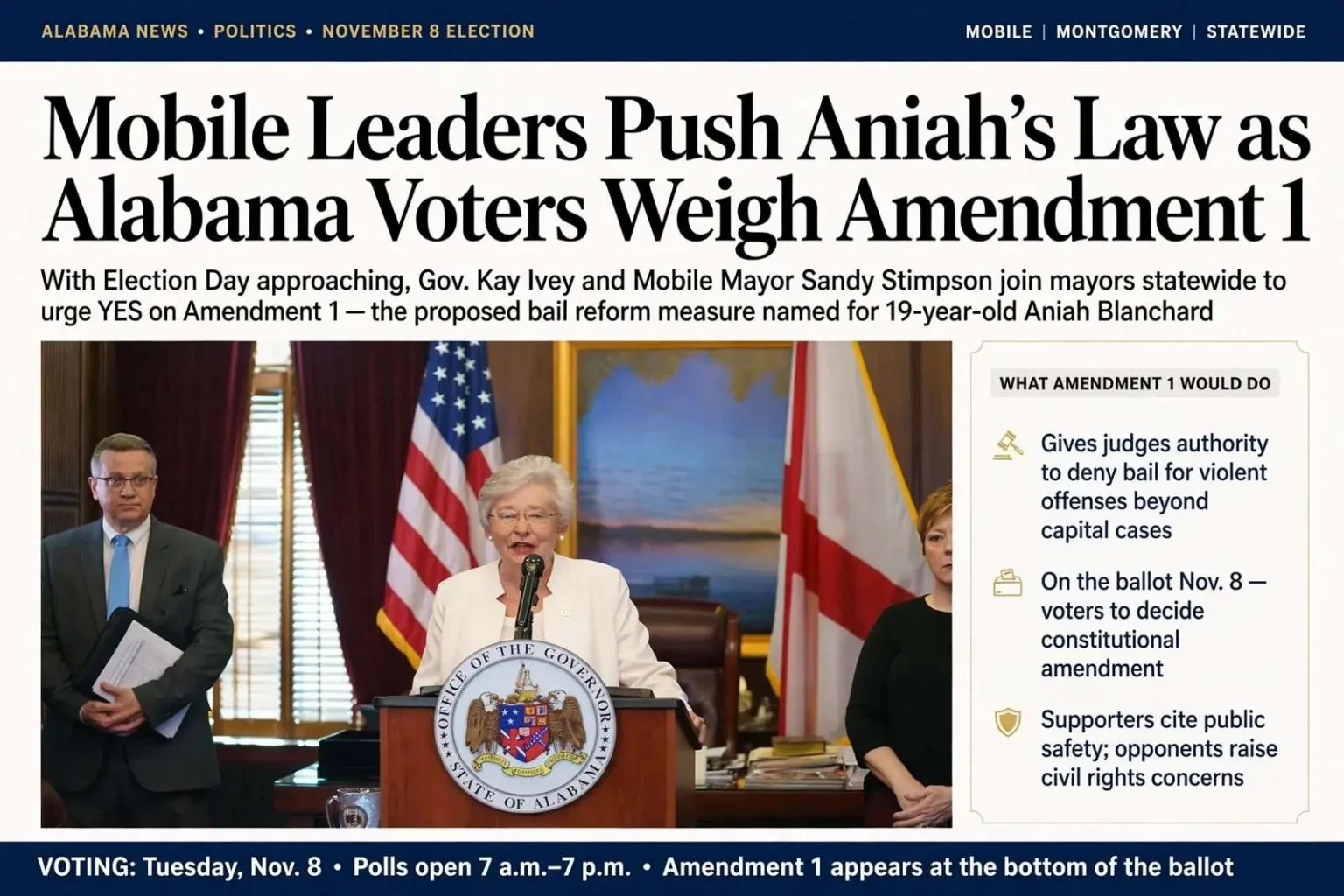
With Election Day approaching, Mobile Mayor Sandy Stimpson has joined Governor Kay Ivey and a group of mayors from across Alabama in urging voters to support Amendment 1, the proposed state constitutional amendment widely known as Aniah’s Law. The measure is named for Aniah Blanchard, the 19-year-old college student kidnapped and killed in 2019.
The amendment would rewrite a cornerstone of Alabama criminal procedure, giving judges the authority to deny bail to people accused of a broader list of violent offenses. Its supporters describe it as the most significant change to the state’s bail system in a generation, and its opponents call it a dangerous erosion of protections that date to the founding of the state.
How Aniah’s Law Got Its Name
Aniah Blanchard was a college student whose disappearance in 2019 gripped the state. The search for her ended with the discovery that she had been kidnapped and killed, and the arrests that followed raised the question that would become the amendment: why was one of the men charged in connection with her death out on bond, able to walk free while the case moved through the courts?
State legislators first floated similar legislation in 2018, but the effort gained momentum — and its name — after her death. What had been an abstract debate about bail doctrine became a personal cause carried by her family, and the proposal that reached the ballot carried her name as a permanent reminder of the case that made it political reality.
The proposal cleared both chambers of the Alabama Legislature without opposition before landing on the Nov. 8 ballot. Unanimous passage of a constitutional amendment touching bail — a subject that had divided legislatures elsewhere in the country — reflected how completely the case had reframed the debate in Alabama.
What the Amendment Would Change
Aniah’s Law would give judges broader authority to deny bond to people charged with violent offenses such as kidnapping and rape, aiming to keep accused violent offenders off the streets while they await trial. Under the existing Alabama Constitution, judges may deny bail only in capital cases — offenses punishable by death or life without parole — and even then, the state must prove the proof is evident and the presumption great.
The amendment widens that list. Judges would be able to consider denying bail for a catalogue of serious violent crimes that goes beyond the capital category, moving Alabama away from a bail system in which release before trial is the default for nearly every offense.
Under the current framework, a defendant accused of even a violent non-capital crime generally receives a bail amount, and detention before trial is the exception reached through a revocation or a high bond the defendant cannot pay. Aniah’s Law would allow a judge, after a hearing, to order that a defendant accused of a listed offense be held without any bond at all — a power that currently exists only at the capital end of the criminal code.
The Campaign for a Yes Vote
Supporters argue the change is a matter of public safety. “There’s nothing that I know that can be more impactful than passing Amendment 1 because you’re actually changing the State Constitution,” Stimpson said, adding that naming the amendment for Blanchard helps voters connect the issue to a preventable tragedy.
The coalition behind the amendment is broad. Mayors from across Alabama joined the campaign because city governments absorb the consequences of pretrial crime — the police calls, the victims, the community trust that erodes when a person accused of violence commits another offense while awaiting trial. Governors and district attorneys across the state have lined up behind the measure as well, making it one of the least contested political causes on the ballot.
Governor Ivey urged Alabamians to vote yes so that no family endures what she called a preventable tragedy. For the state’s chief executive, the amendment represented a direct response to a case that had become a symbol of a system that released people it perhaps should have held.
Aniah’s mother, Angela Harris, has said her daughter’s name on the amendment reflects lives it could save. Her advocacy has put a family’s grief at the center of a constitutional debate, and her argument — that the amendment’s name should remind voters of the stakes behind the legal language — has been the campaign’s most consistent theme.
The Case Against
Opponents, including several civil rights organizations, warn that the measure erodes long-standing bail protections. Their objection is not to holding dangerous defendants but to writing a broader detention power into a constitution that has, for two centuries, treated pretrial release as the rule and detention as the exception.
Jerome Dees, Alabama policy director for the Southern Poverty Law Center, called the amendment a dramatic departure from centuries of state constitutional law, noting that it sets no limit on how long someone could be held before trial despite speedy-trial guarantees under the Sixth and Fourteenth Amendments. The concern is practical as much as philosophical: a defendant held without bail has the strongest possible incentive to demand a trial, but courts with backlogged calendars cannot always deliver one quickly, and the speedy-trial rights that protect defendants are notoriously difficult to enforce against overcrowded systems.
Critics also point to the risk of error. A bail-denial hearing happens before a jury has heard any evidence, decided by a judge working from prosecutors’ filings. Every expansion of pretrial detention means more people held on accusations that may not survive trial — people who lose jobs, housing and family connections while they wait, and who cannot be given those back if they are acquitted.
Jail Overcrowding and the Cost Question
Advocates for fair bond practices also say broader detention will worsen jail overcrowding. County jails — including Mobile County Metro Jail — hold large populations of people who have not been convicted of anything, and every expansion of pretrial detention shifts more of them into beds that counties pay to operate, often at hundreds of millions of dollars in aggregate cost across Alabama’s counties over time.
Overcrowding carries consequences beyond budgets. Jails operating above capacity struggle with safety for both inmates and corrections officers, with medical and mental health care, and with the logistics of transporting defendants to court. Sheriffs, who in many counties run the jails that the amendment would fill further, have found themselves in an awkward position on the ballot measure — sympathetic to public safety arguments, wary of the operational and fiscal weight the change could add.
Reform advocates argue that Alabama has other tools that address the same problem without constitutional change: better risk-assessment practices, faster trials, and supervision programs that monitor defendants in the community instead of holding them at county expense. The amendment’s passage would not eliminate those options, but its opponents say it removes the pressure to use them.
The fiscal argument has a human counterpart. People held in jail before trial are disproportionately those who cannot afford to buy their way out, and the existing cash-bail system already draws criticism for jailing the poor while releasing wealthier defendants accused of the same conduct. Adding offenses to the detention list, opponents argue, extends that inequity into cases where money can no longer help at all — release would depend entirely on a judge’s discretion after a hearing rather than on a bond amount a family might scrape together.
How the Vote Will Work
Voting takes place Tuesday, Nov. 8 at Mobile County’s 80 precincts. Statewide constitutional amendments appear at the bottom of the ballot, and Amendment 1 will be presented to voters as a full statement of its text — language most voters will read for the first time in the booth. Campaigns on both sides have spent the weeks before the election explaining the measure in plain terms, with the yes side emphasizing the Blanchard family’s story and the no side emphasizing the constitutional stakes.
Local election officials across the county have prepared for turnout that includes the usual municipal and state races alongside the amendment questions. Voters will need to bring valid photo identification under Alabama law, and polls will be open from 7 a.m. to 7 p.m., with results certified by the probate office after the close of voting.
Whatever the outcome, the debate has already changed the conversation about bail in Alabama. The question the amendment poses — whether the state’s constitution should treat release before trial as a right or a privilege for the accused violent offender — has moved from courtrooms and law reviews to the front of a statewide campaign, with a family’s loss and a mayor’s signature attached to one side and two centuries of constitutional tradition attached to the other.
For Mobile voters, the decision will be made in the same precincts where they choose their local officials, on a measure whose name they will recognize long before they read its text. Amendment 1 asks a simple question with complicated consequences, and on Nov. 8, Alabamians will answer it at the ballot box.