Mobile Leaders to Host ‘Road to Unity’ Race Relations Town Hall
Mobile-area community leaders will answer residents' questions live during 'The Road to Unity,' a race relations town hall set for Thursday at 6:30 p.m.
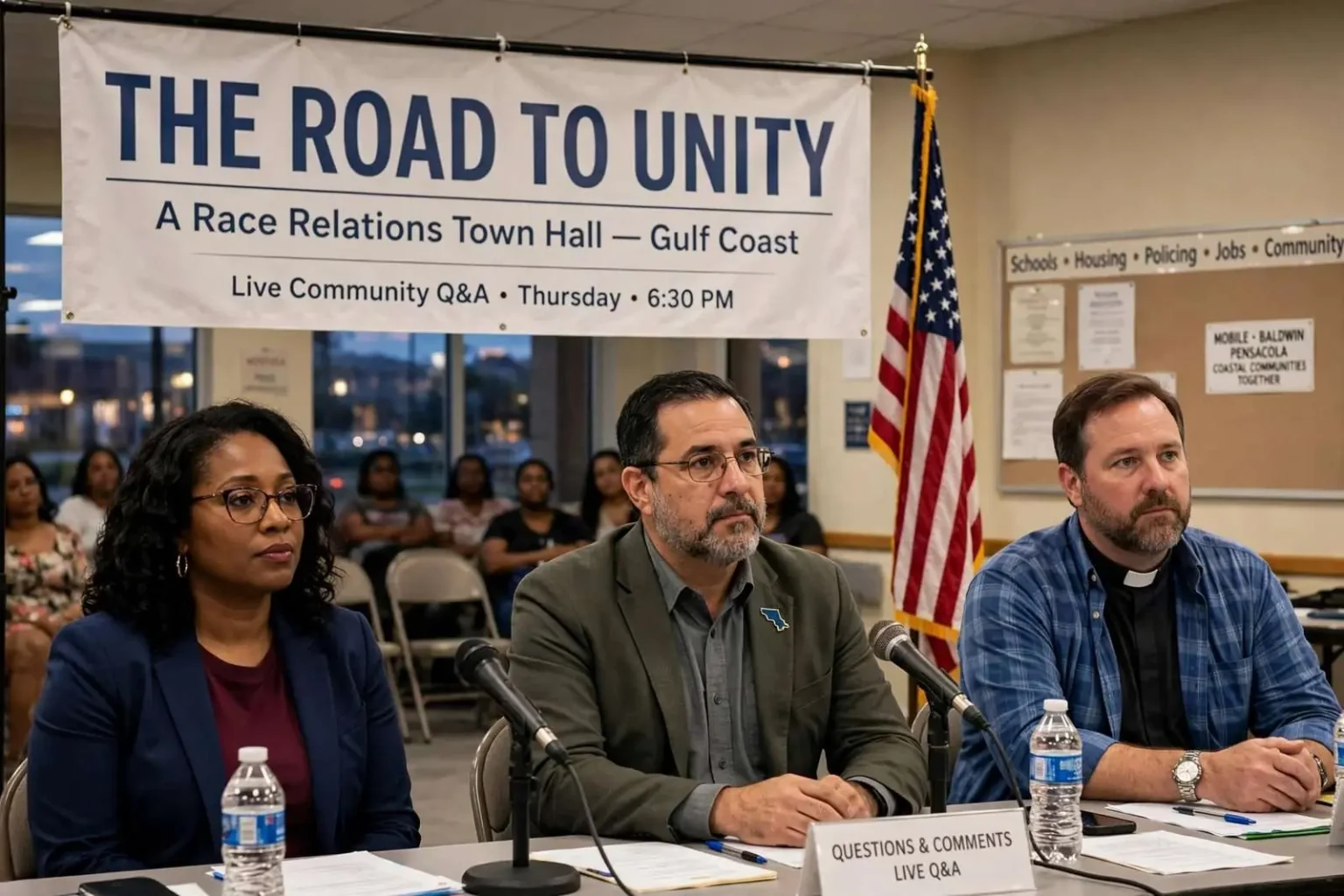
Community leaders across the Gulf Coast are coming together to address racism and build understanding during a live town hall event scheduled for this week. “The Road to Unity: A Race Relations Town Hall” is set for Thursday at 6:30 p.m., and organizers have designed the forum to give residents a direct line to the people leading local efforts for change.
The forum will bring community leaders together to take questions from residents live, a format that sets it apart from the panel discussions and prepared speeches that often characterize events on the subject of race. Rather than talking past the audience, the leaders on stage will answer what residents actually ask, in real time, on a topic that many communities find difficult to discuss openly at all.
The event is designed to open a frank conversation about race and unity on the Gulf Coast. Organizers say the goal is not a single evening of talk but a starting point — a public acknowledgment of the tensions and history that shape the region, and an honest exchange about what understanding between communities would actually require.
Why a town hall format
Live question-and-answer formats carry risks that scripted events do not, and that is precisely the point. A moderator or panel that controls every question can steer an evening toward comfortable ground, while an open forum invites the hard questions — about policing, schools, housing, economic opportunity, and the daily experiences of residents who feel the effects of racial division most directly. The leaders participating have chosen that exposure deliberately.
Town halls on race relations have a long history along the Gulf Coast and across the South. In moments of tension, communities have repeatedly turned to public forums as a way to move conversation out of private frustration and into shared space, where neighbors hear one another speak and public officials and civic leaders respond in front of the community they serve. The record of such events is mixed — a single evening rarely resolves anything on its own — but the ones that matter tend to be those that lead to sustained follow-up.
Thursday’s 6:30 p.m. start puts the event in prime evening hours, making it accessible to working residents and families. The live format suggests organizers intend broad participation, whether in person or through broadcast and streaming channels that reach viewers across the coastal region.
The Gulf Coast context
The central Gulf Coast carries a long and complicated racial history. Mobile, Pensacola, and the smaller communities between them were shaped by the plantation economy, the shipping and shipbuilding industries, segregation, and the civil rights struggles that unfolded across the South in the middle of the twentieth century. African American communities in the region built churches, schools, and businesses through and beyond that history, and their contributions are woven into the culture of the coast.
Modern conversations about race in the region touch practical matters as much as historical ones: the quality and funding of public schools, the geography of housing and investment, the relationship between police departments and the neighborhoods they serve, and the economic gaps that persist between communities. Residents on all sides of those questions have stories to tell, and a forum that invites those stories publicly creates a record of what the community actually experiences.
Community leaders involved in racial reconciliation work along the coast often describe the region as possessing both deep divisions and real assets for overcoming them — long-standing institutions, active faith communities, and a civic culture in which neighbors of different backgrounds have lived alongside one another for generations. The task, as they frame it, is converting proximity into understanding.
Events of this kind also serve a function beyond the evening itself: they signal to residents that the subject can be discussed openly, in public, without the conversation collapsing. Communities that talk about race only in private settings or in moments of crisis tend to cycle through the same frustrations, while those that build regular public forums create a habit of dialogue that persists between incidents.
Attendance and participation are the variables that will determine the evening’s value. A forum with a sparse audience produces a narrow record, while one that draws residents from across the community captures the range of experiences and concerns that actually exist on the coast. Organizers have emphasized that the live question format exists precisely to reward participation, and every question asked in the room shapes what the evening covers.
The leaders taking questions Thursday come from the network of clergy, civic organizations, elected officials, and advocates who work on community issues across the Gulf Coast. Their participation reflects the shared judgment that the moment calls for direct engagement with residents rather than statements issued from a distance.
For residents planning to participate, the live format rewards preparation. Questions about specific local concerns — a school, a neighborhood, a public service, a pattern of treatment — give panelists something concrete to respond to, and specific questions tend to produce more useful answers than broad ones. Organizers have built the evening around exactly that exchange.
What a conversation like this can accomplish
Civic experts who study public dialogue on divisive subjects generally find that the value of a single event lies in what it sets in motion. A town hall can surface concerns that officials had not fully understood, identify residents willing to work on solutions, and create public commitments that participants can be held to afterward. The frankness that organizers are seeking is the ingredient that makes those outcomes possible.
The phrase at the center of the evening — the road to unity — frames unity as a journey rather than a destination, an honest acknowledgment that understanding between communities is built through accumulated effort rather than declared in an evening. That framing sets expectations appropriately: Thursday’s forum is a step, not a conclusion.
The event is scheduled for Thursday at 6:30 p.m., with community leaders from across the Gulf Coast taking live questions from residents. The conversation about race and unity that organizers hope to open is designed to continue well beyond the evening itself, and the residents who show up to ask their questions are the ones who will determine whether it does.
Mobile and the surrounding coastal communities have hosted race relations forums repeatedly over the decades, often in moments that demanded them — after incidents that strained trust, or at milestones that invited reflection. The Gulf Coast’s civic history includes the work of interfaith councils, human relations commissions, and neighborhood associations that kept conversations going between crises, and Thursday’s forum joins that tradition.
The region’s demographic makeup makes the conversation practical rather than abstract. Mobile County’s population includes large Black and white communities alongside growing Hispanic and Asian populations, and the city of Mobile itself has been shaped by the contributions and tensions of all of them. Baldwin County to the east and the Florida Panhandle communities across the state line share the same coastal economy and many of the same historical patterns, which is why the forum’s organizers describe it as a Gulf Coast event rather than a single-city affair.
The churches of the region have historically anchored this work. Black congregations across the coast have long served as organizing centers for community advocacy, and predominantly white congregations have at times joined in formal and informal partnerships. Faith leaders participating in events like Thursday’s forum carry both that history and the convening power that religious institutions still hold in Gulf Coast communities.
Race and the institutions of daily life
Residents who attend forums on race relations most often raise the institutions they encounter daily. Schools are a recurring subject — the demographics of enrollment, the fairness of discipline, the resources available to different campuses — and the questions residents ask on those subjects tend to be specific to their own children’s schools rather than theoretical.
Policing is another consistent subject, and the relationship between law enforcement and minority communities on the Gulf Coast has been the focus of reform efforts in recent years, including body camera adoption, community policing initiatives, and citizen review structures in some jurisdictions. A live forum gives residents the chance to raise those efforts directly with the leaders involved in them.
Economic questions complete the trio of concerns that dominate these conversations: access to jobs, the condition of neighborhoods that saw disinvestment decades ago, and the distribution of public infrastructure spending. The Gulf Coast’s economy — anchored by the Port of Mobile, shipbuilding, tourism, aerospace, and healthcare — has grown substantially, and the question of who shares in that growth is a fair one that residents are entitled to ask their leaders in public.
Thursday’s town hall will not settle any of those subjects definitively, and its organizers do not claim otherwise. What it offers is the opening the title describes: a road, a direction of travel, and an invitation to residents across the Gulf Coast to join the conversation at 6:30 p.m. and ask the leaders of local change efforts what they are doing, and what comes next.