Mobile Library Hosts Free Seminar Series on Natural Approaches to Preventative Health
The Ben May Main Library in Mobile is hosting an ongoing, free health education seminar on herbs and natural approaches to disease prevention, led by health advocate Elder Makinde Gbolahan on the first and third Tuesday of each month.
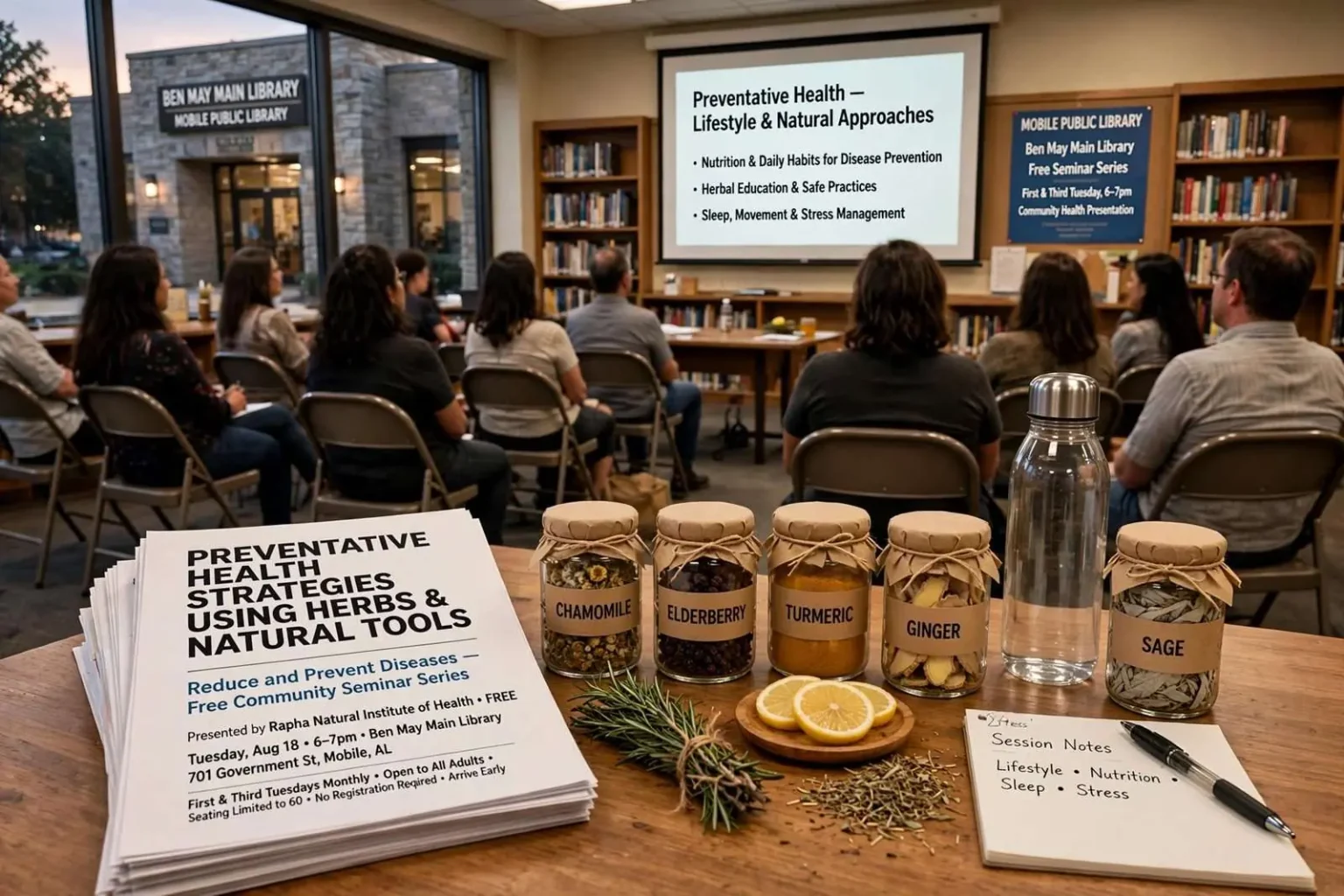
Mobile residents looking to learn more about natural approaches to wellness have a free, recurring opportunity to do so at the Ben May Main Library. The library is hosting “Preventative Health Strategies Using Herbs and Natural Tools to Reduce and Prevent Diseases,” an ongoing health education seminar series that continues Tuesday, Aug. 18, from 6 to 7 p.m. The evening session fits neatly into the library’s after-work hours, making it accessible to residents who cannot attend daytime programming.
The series is presented by Elder Makinde Gbolahan, a health advocate, educator and researcher with the Rapha Natural Institute of Health. Sessions are held on the first and third Tuesday of each month at the library, located at 701 Government St. in downtown Mobile. The twice-monthly cadence gives attendees a chance to build on earlier sessions rather than treating each talk as a standalone event, and Gbolahan structures the material so newcomers can join at any point in the schedule.
What to Expect
The seminar is designed for adults and community members interested in practical, natural approaches to wellness, healthy living and disease prevention. Each session explores a different aspect of preventative health, including lifestyle habits, nutrition, herbal education and other natural practices that may help support overall well-being. Rather than pitching a single remedy or product, the sessions walk through the reasoning behind everyday choices — diet, movement, sleep and stress management — and how those factors interact over time.
Admission is free, and no registration cost is required to attend. Seating, however, is limited to 60 participants, so community members interested in attending are encouraged to arrive early. The capped capacity reflects the size of the library’s meeting space, and past public programming at the branch has occasionally filled seats well before the scheduled start time, particularly for health-focused topics.
Attendees are welcome to bring questions, and the sessions typically allow time for discussion after the main presentation. Because the material is educational rather than clinical, participants are encouraged to treat what they learn as a starting point for conversations with their own health care providers, especially if they take prescription medications or manage chronic conditions.
Why Libraries Host Health Education
Public libraries have increasingly become venues for community health programming, and Mobile is no exception. Health educators and nonprofit organizations value library meeting rooms because they are free to use, centrally located and perceived as neutral, trusted spaces. For residents who lack a regular primary care provider or who are hesitant to navigate the medical system, a library seminar offers a low-pressure entry point to reliable information.
The Ben May Main Library’s Government Street location places it within reach of neighborhoods throughout downtown and midtown Mobile, and the branch is served by the city’s public transit routes. Parking is available nearby, and the building’s meeting facilities are among the most-used in the Mobile Public Library system for evening programming.
National health agencies have noted for years that preventable chronic conditions — including type 2 diabetes, hypertension and heart disease — respond to lifestyle changes when they are adopted early and sustained. Community education series like this one aim to translate that guidance into practical terms: what to put in a shopping cart, how to build movement into a workday, and which everyday habits carry the greatest long-term payoff.
An Ongoing Series
Because the seminar runs on a recurring schedule — the first and third Tuesday of every month — residents who miss the Aug. 18 session will have additional opportunities to attend future installments covering different preventative health topics. The rotating subject matter means a resident who attends regularly can move through a broad curriculum over the course of several months, from nutrition fundamentals to herbal education to stress and lifestyle management.
The series is part of a broader push by community health educators to make information about nutrition, herbal remedies and everyday wellness practices more accessible to the public at no cost. Organizers of similar programs across the Gulf Coast point to rising interest in natural and integrative approaches to health, alongside a recognition that traditional health education often reaches audiences only after a diagnosis has already been made. Preventative programming flips that sequence, meeting people before problems develop.
For attendees considering herbal approaches specifically, the sessions cover practical questions: how herbs are prepared, what the research says about common preparations, and how natural supplements can interact with prescription medications. Gbolahan’s background as a researcher with the Rapha Natural Institute of Health informs the presentations, which blend traditional herbal knowledge with an emphasis on informed, cautious use.
The Ben May Main Library’s Role
The Ben May Main Library, part of the Mobile Public Library system, regularly hosts educational programming for adults in addition to its traditional library services. The main branch anchors a system that serves residents across the city, and its calendar mixes author talks, job assistance sessions, technology classes and community meetings alongside the health series. Library programming of this kind is typically offered at no charge as part of the system’s public mission.
Government Street has long been one of Mobile’s central east-west corridors, and the library’s position on it makes the branch a familiar landmark for residents across the metro area. Evening events like the Aug. 18 session draw attendees who work downtown as well as neighbors who walk or drive in from surrounding blocks, giving the room a mix of regulars and first-time visitors.
Library staff recommend checking the branch’s posted schedule or calling ahead to confirm session topics and times, since dates occasionally shift around holidays. Those interested in attending the Aug. 18 session or a future date in the series can visit the library at 701 Government St., Mobile, AL 36602.
A Broader Wellness Movement on the Gulf Coast
Interest in preventative and natural health has grown across South Alabama in recent years, reflected in farmers markets that feature local herbal vendors, community gardens, and fitness and nutrition programs offered through churches and community centers. Health educators say the region’s climate and agricultural traditions — from satsuma orchards to backyard gardens — give residents practical opportunities to connect dietary advice with food they can actually source locally.
Community series like the one at Ben May Main also serve a social function. Attendees return month after month, exchange tips and build informal support networks that help sustain lifestyle changes long after any single lecture ends. Public health researchers have long observed that knowledge alone rarely changes behavior; peer reinforcement and repeated exposure do. A twice-monthly seminar designed around exactly that rhythm is, in that sense, structured to give participants their best chance of turning information into habit.
For Mobile residents weighing whether to attend, the barriers are minimal: no cost, no registration fee and a one-hour commitment on a weeknight. With seating limited to 60, arriving early remains the only requirement — a small step for anyone interested in taking a more active role in their long-term health.
Practical Takeaways for Attendees
Sessions in a series like this one tend to be most useful when attendees arrive with specific goals in mind. Health educators commonly suggest that participants pick one or two manageable changes — adding vegetables to a daily meal, walking a set number of minutes each day, improving sleep routines — rather than attempting a wholesale lifestyle overhaul. The seminar format, with its recurring schedule, is built to support that approach: each session can reinforce progress made since the last one and troubleshoot what is not working.
On the herbal side, presenters typically stress the importance of sourcing and quality. Herbal preparations are not standardized in the way prescription medications are, so differences in growing conditions, harvesting and processing can affect potency. Attendees are generally advised to buy from reputable suppliers, to introduce one preparation at a time, and to keep a written record of what they take so that potential interactions or side effects can be identified quickly. Anyone managing a chronic condition or taking daily medication is encouraged to review herbal use with a pharmacist or physician before starting.
Nutrition guidance in community settings also tends to emphasize affordability and local availability. The Gulf Coast’s growing season supports leafy greens, sweet potatoes, peas and citrus for much of the year, and mobile-area farmers markets make seasonal produce accessible in neighborhoods across the city. Educators often point out that preventative nutrition does not require exotic ingredients — the same produce aisles and market stalls that supply everyday cooking also supply the foundation of most dietary recommendations for disease prevention.
Getting There and Getting the Most From It
For first-time attendees, a few practical notes can make the evening smoother. The Ben May Main Library’s main entrance faces Government Street, and the meeting room used for adult programming is signed from the lobby. Arriving 15 to 20 minutes early leaves time to find seating, pick up any handouts and settle in before the 6 p.m. start. Sessions end at 7 p.m., leaving the remainder of the evening free.
Residents who want to follow the full arc of the series can mark the first and third Tuesdays on their calendars and attend as many sessions as their schedules allow. Because topics rotate, missing a session does not leave anyone behind — each installment stands on its own while still contributing to the larger picture of preventative health. Handouts and notes from earlier sessions can usually be discussed with the presenter before or after a talk for those who join mid-series.
The series’ presence on the library calendar also reflects the breadth of what the Mobile Public Library system offers beyond books. From tax season assistance to computer classes to health seminars like this one, the system’s branches function as community classrooms open to all — and on the first and third Tuesday of each month, that classroom covers one of the subjects residents ask about most: how to stay well.