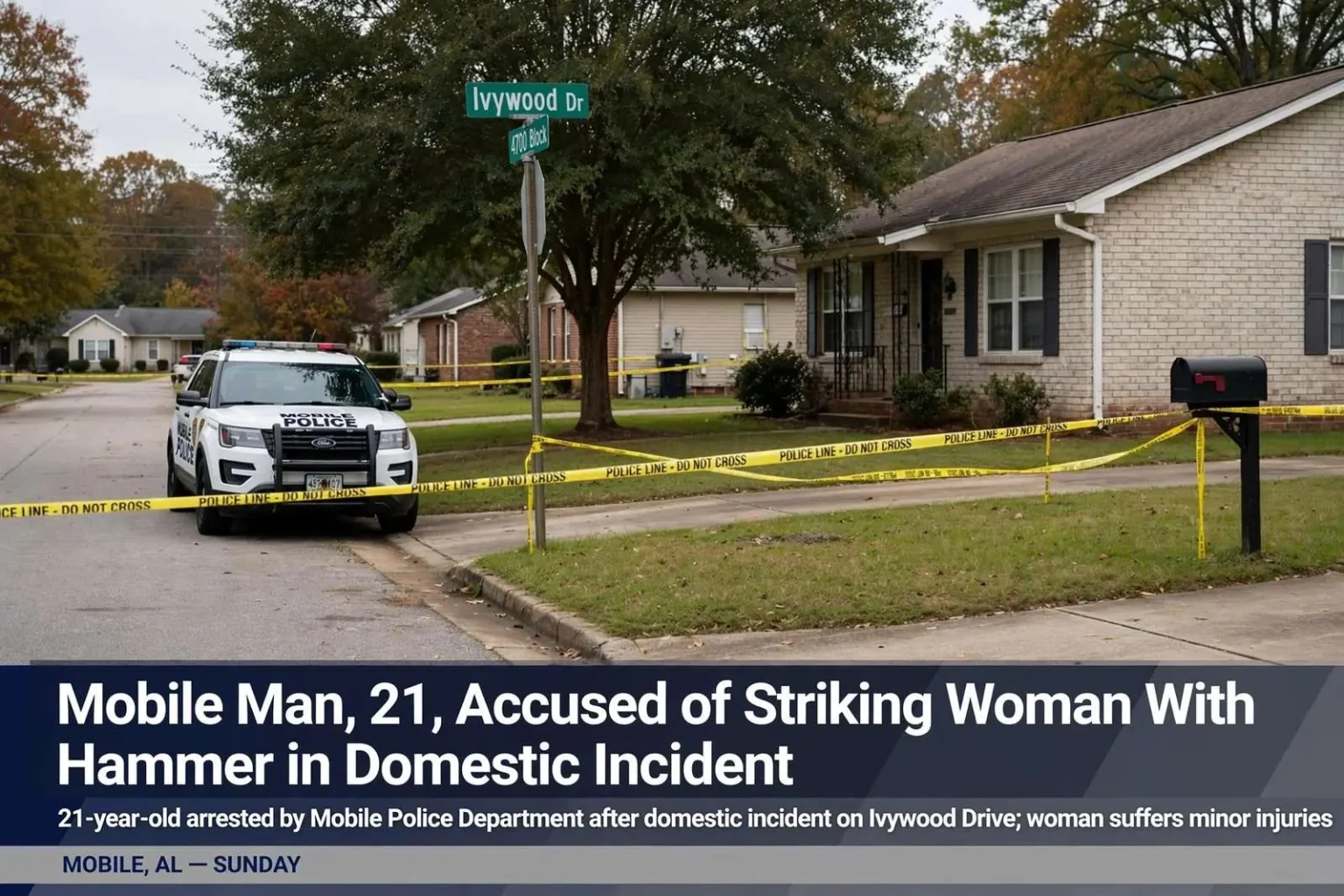
A Mobile man is facing charges after police say he struck a woman with a hammer during a domestic incident over the weekend. According to the Mobile Police Department, officers responded Sunday afternoon to a report of a domestic incident in the area of the 4700 block of Ivywood Drive, a residential street in the city’s western reaches where the afternoon quiet was broken by an emergency call that would end with a young man in jail and a woman injured.
Upon arrival, officers said they discovered that a male subject had struck a known female victim with a hammer, causing her minor injuries. The victim’s injuries, while described as minor, marked the end of a violent encounter between people who knew each other, the kind of episode that domestic violence units and advocates across the country identify as both common and dangerous: assaults involving weapons and household members rarely occur in isolation, and the response to them sets the tone for whatever follows. Police took Aaron Oliver, 21, into custody at the scene and transported him to the Mobile County Metro Jail.
Oliver has been charged with second-degree domestic violence and second-degree assault, the two charges that Alabama law pairs when an alleged attack between people in a domestic relationship involves serious physical injury or a dangerous weapon. The charges together carry the weight of felony prosecution, and the double filing reflects how the state’s domestic violence statutes work: the domestic violence designation attaches to the underlying assault when the relationship between suspect and victim fits the legal definition, adding both a sentencing enhancement and a distinct count to the indictment.
How Alabama’s domestic violence statutes work
Alabama’s domestic violence laws, enacted in the 2000s, restructured how the state charges violence within families and households. Rather than treating an assault between family members as an ordinary assault with a domestic component, the statutes created standalone domestic violence offenses graded by severity, from third-degree up to first-degree. Second-degree domestic violence typically applies when the underlying conduct would constitute a serious assault, such as one involving serious physical injury, and it is charged as a felony. The framework’s purpose is to ensure that violence inside a home or relationship is prosecuted with the same seriousness as violence between strangers, and to give courts tools, including protective orders and specialized handling, tailored to domestic cases.
Second-degree assault, the companion charge in this case, covers conduct that causes serious physical injury to another person or that is committed with a deadly weapon or dangerous instrument. A hammer, an ordinary household tool, becomes legally relevant when prosecutors allege it was used as a weapon, and the presence of a weapon in an alleged attack raises both the severity of the charge and the risk assessment that police and courts apply when deciding on custody and conditions of release. The minor-injuries description in this case suggests the outcome could have been far worse, which is precisely the kind of fact investigators and prosecutors weigh when weapons are involved in domestic calls.
The arrest process Oliver went through is standard for the city. Following a Sunday afternoon arrest, he was booked into Mobile County Metro Jail, the downtown facility where people arrested by MPD are processed, held, and brought before a judge for initial proceedings. Felony charges like his are reviewed by prosecutors and presented to a court for the next steps in the criminal process.
MPD said the arrest was one of two assault cases the department announced Monday morning, a detail that illustrates the routine volume of violent-crime work handled by the city’s police force. When the department announces multiple arrests at once, it is typically summarizing a weekend’s bookings for the public, a practice that keeps residents informed about what happened in their neighborhoods and how the department responded. For the Ivywood Drive area, the announcement put on record that a report from Sunday afternoon led to a same-day arrest and felony charges by Monday.
The speed of the sequence, from a Sunday afternoon emergency call to arrest and charges within roughly a day, reflects how seriously Alabama’s system treats domestic violence. Officers responding to a domestic call are trained to assess the scene, identify the dominant aggressor, document injuries and evidence, and make an arrest when the facts support it, rather than leaving resolution to the parties themselves. That approach, embedded in state law and department policy, exists because domestic incidents are statistically among the most dangerous calls officers make and because unaddressed violence inside a relationship tends to escalate rather than resolve.
The Ivywood Drive neighborhood and the response
The 4700 block of Ivywood Drive sits in west Mobile, part of the grid of residential streets west of the city’s core where homes, schools, and neighborhood parks sit along arterial roads like Old Shell Road and Airport Boulevard. It is the kind of neighborhood where a police presence on a Sunday afternoon draws curtains and questions, and where residents rely on the department’s announcements to understand what happened on their street. The department’s account, that officers arrived to find a woman with minor injuries after being struck with a hammer, and that a suspect was taken into custody, provides the outline of the incident without identifying the victim, consistent with standard practice in domestic cases.
Protecting victims’ identities is one of several ways the system is structured around domestic violence specifically. Cases are often handled by specialized prosecutors, victims are offered advocates and protective orders, and court procedures include safeguards designed to keep victims safe through the process. The felony charges filed against Oliver mean the case will move through the court system with all of those mechanisms available, and the presumption that applies in every criminal case will govern how it proceeds.
As with any pending case, the charges against Oliver are accusations, and he is presumed innocent unless and until proven guilty in court. Prosecutors must prove each element of the charged offenses beyond a reasonable doubt, and Oliver will have the full opportunity to contest the evidence through his defense, at hearings and, if the case proceeds that far, at trial in Mobile County’s courts.
For residents of Mobile, the case is a reminder of the resources that exist around domestic violence, both for victims and for the community members who may become aware of it. Advocates consistently emphasize that domestic violence thrives in silence and isolation, and that intervention, whether by police, family members, or neighbors who call for help, is often the turning point. The National Domestic Violence Hotline, reachable around the clock, connects victims and concerned others with trained advocates who can discuss safety planning, shelters, and legal options, and local victim service organizations in the Mobile area perform the same work on the ground, accompanying victims through protective order hearings and the criminal process.
The charges Oliver faces, second-degree domestic violence and second-degree assault, will be adjudicated in the months ahead, and the facts that emerge in court will determine the outcome. What is already on the public record is the sequence police described: a Sunday afternoon report of a domestic incident on the 4700 block of Ivywood Drive, the discovery that a woman had been struck with a hammer and suffered minor injuries, the arrest of a 21-year-old man at the scene, and his transport to the Mobile County Metro Jail to await the court process on two felony counts.
What the charges mean going forward
If the case proceeds to prosecution, the domestic violence designation on the charge will shape how it moves through the system. Felony domestic violence cases in Alabama are prosecuted by the district attorney’s office, often with input from victim-witness officers who keep victims informed and supported through each stage. Convictions on the charges Oliver faces could carry significant prison time, and the domestic violence framework allows courts to consider the relationship between the parties in sentencing, along with protective orders that can extend beyond any sentence imposed.
The case also lands amid broader attention to violence in Mobile, where the police department regularly announces arrests in assault, robbery, and shooting cases as part of its public-facing work. Monday morning’s announcement of two assault cases, including the Ivywood Drive incident, gave residents a window into both the weekend’s events and the department’s response. For the woman police say was attacked, the system’s machinery now takes over: felony charges, court dates, and the protections that Alabama law extends to victims of domestic violence as their cases move forward.
What remains clear in the meantime is the limit of what any announcement can establish. An arrest and charging documents describe accusations, not findings, and the presumption of innocence will attach to Oliver’s case through every proceeding that follows. The courts will determine what the evidence supports, and the outcome will be decided, as the law requires, in the open process of Mobile County’s criminal courts rather than in the initial account of a Sunday afternoon on Ivywood Drive.