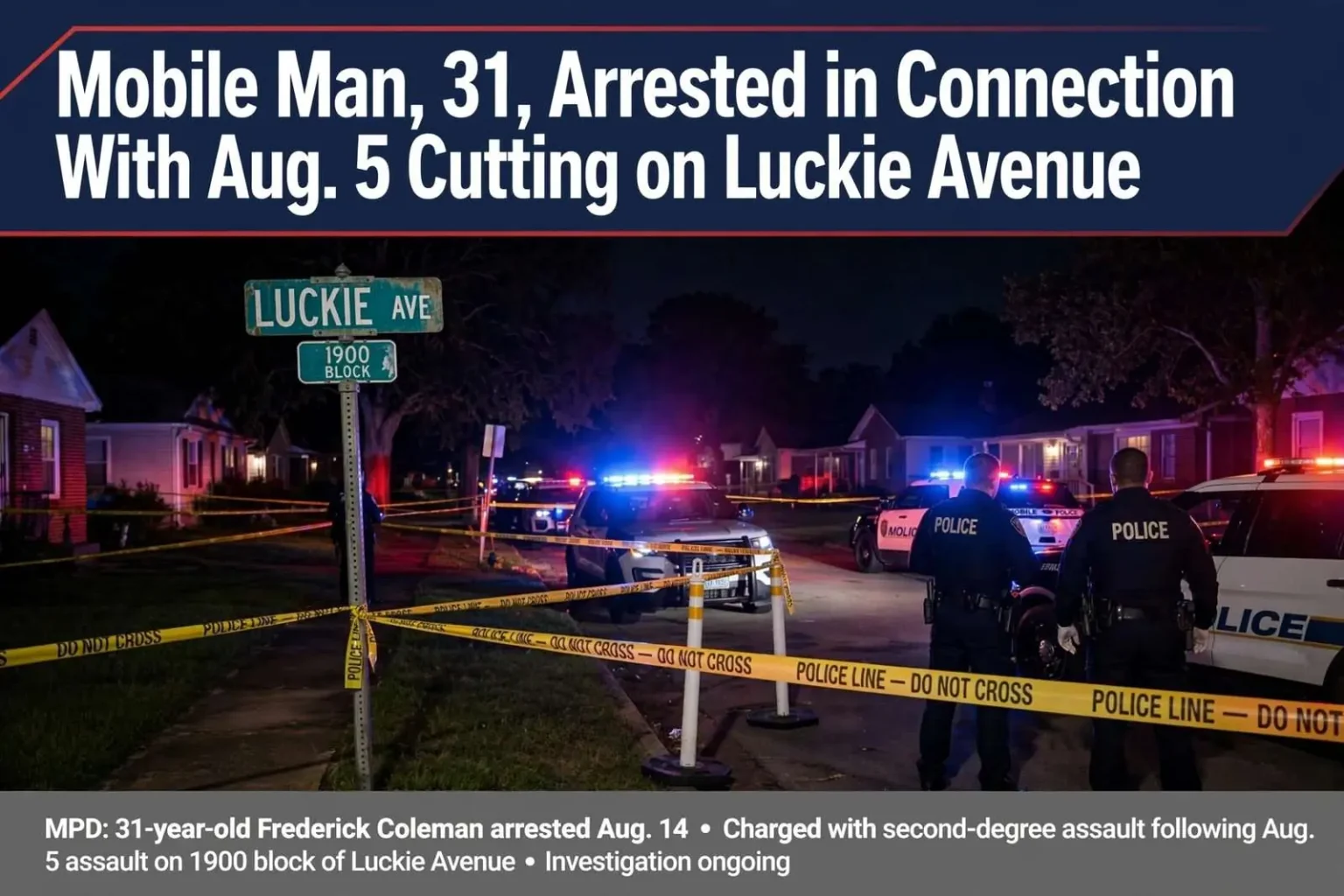
Mobile Police Department officers have arrested a man in connection with an assault that happened earlier this month in west Mobile.
According to an MPD news release, 31-year-old Frederick Coleman was arrested Friday, Aug. 14, in connection with a cutting that occurred Aug. 5. Officers were called to the 1900 block of Luckie Avenue around 11:30 p.m. that night for a report of an assault. When they arrived, they found a man with minor lacerations, according to officials. The victim was taken to a local hospital for treatment.
“Upon further investigation, officers discovered a known male subject cut the victim during an altercation,” the release stated.
Coleman has been charged with second-degree assault. The arrest came more than a week after the incident itself, a span detectives used to identify the suspect, locate him and develop the case needed for a warrant.
What the charges mean under Alabama law
Under Alabama law, second-degree assault is a Class C felony that can apply when a person causes serious physical injury to another, or injures someone with a weapon, during an altercation. The statute covers a range of conduct beyond the circumstances alleged in this case, including assaults committed with a deadly or dangerous weapon and injuries caused during certain other specified acts.
A Class C felony is the least severe felony classification in Alabama’s criminal code, but it still carries serious consequences. Upon conviction, the range of punishment runs from one year and one day to ten years in prison, along with fines that can reach $15,000. Because the charge is a felony rather than a misdemeanor, the case will be handled at the circuit court level, with a preliminary proceeding first to determine whether probable cause supports the charge.
Prosecutors weigh several factors in assault cases involving a weapon, including the severity of the victim’s injuries, whether the weapon was recovered, the relationship between the parties and any prior record. The specific facts developed during the investigation determine how the case is ultimately charged or resolved.
The initial response
The late-night hour of the original call is typical of assault reports in residential neighborhoods. Officers responding to a report of an assault around 11:30 p.m. found the victim injured but conscious enough to be transported, and medics took him to a local hospital for treatment of lacerations described as minor.
Police did not release the victim’s name or condition beyond noting the treatment, which is standard practice in assault investigations. Nor did officials describe what led to the altercation or what weapon was involved, details that generally emerge only in court documents as a case proceeds.
The department’s release confirming the arrest was brief, following the format MPD uses for most assault cases: the date and location of the incident, the nature of the injuries, the identity of the person charged and the charge itself.
How the investigation unfolded
In the days after the initial report, detectives continued working the case — interviewing witnesses, following up on leads in the neighborhood and working to confirm the identity of the person believed responsible. The news release language indicates that investigators fairly quickly developed a suspect who was already known to the victim or to the investigation, which is common in assault cases involving a single altercation between people acquainted with one another.
The gap between the incident and the arrest reflects the normal rhythm of such investigations. Detectives must gather enough evidence to establish probable cause before a warrant can be issued, and locating a suspect can take additional time. Coleman’s arrest on Aug. 14, nine days after the cutting, put the case on a formal footing: booking, an initial appearance before a judge, and the setting of bond conditions.
The Mobile Police Department has not announced additional arrests in connection with the incident, and the department’s release did not indicate whether more charges are possible.
The case remains under investigation
The case remains under investigation by the Mobile Police Department. That designation means detectives are still gathering evidence and following leads, and it leaves open the possibility of additional charges or amendments to the current ones as the file moves toward prosecutors.
Once the investigation is complete, the case file will be presented to the Mobile County District Attorney’s Office, which decides whether to take the charge to a grand jury or resolve it through other means. Victims in assault cases are frequently consulted during that process, and their injuries, medical records and statements become central evidence.
For the neighborhood where the incident occurred, the arrest closes one chapter of the case but not all of it. Court proceedings can stretch over months, and outcomes depend on evidence, testimony and negotiations that have not yet taken place.
Assault investigations in Mobile
Cutting and stabbing incidents make up a portion of the violent crime the Mobile Police Department investigates each year, and the department’s practice in such cases follows a consistent pattern: secure the scene and the victim’s medical treatment, canvass for witnesses, identify a suspect, and seek a warrant. The department typically announces arrests through news releases distributed to local media, as it did in this case.
Second-degree assault arrests in Mobile cover a wide range of circumstances — fights that turn serious, disputes involving weapons, and incidents in which a victim suffers significant injury. The charge’s flexibility is one reason it appears frequently in local arrest reports: it fits situations where the harm is serious but does not meet the threshold for attempted murder or first-degree assault.
West Mobile, where the 1900 block of Luckie Avenue sits, is a mix of established residential neighborhoods, and incidents there are handled by the precinct officers and detectives who cover that part of the city. Residents who noticed a heavy police presence the night of Aug. 5 would have seen the first stage of that response; the arrest announced Aug. 14 was the product of the quieter work that followed.
Second-degree assault and the sentencing framework
Alabama’s sentencing framework treats felony classes as the starting point for punishment, with judges operating inside statutory ranges that depend on the classification and the defendant’s history. For a Class C felony, a first-time offender may be eligible for probation or a suspended sentence, while a defendant with prior felony convictions faces a much narrower range of options and potentially enhanced punishment under the state’s habitual offender provisions.
Restitution is also a factor in assault cases. Victims’ medical expenses, lost wages and related costs can be ordered repaid as part of a sentence, and prosecutors routinely include restitution requests when presenting assault cases for resolution. The victim’s hospital treatment in this case would be documented as part of that record.
What residents can do
Police departments across the Gulf Coast consistently stress the same points when it comes to assault cases: report incidents promptly, preserve evidence and provide statements while memories are fresh. Delays between an incident and a report — or between a report and the identification of a suspect — make investigations harder, even when the eventual arrest comes quickly. Anonymous tip lines exist precisely for residents who may have information but are reluctant to become directly involved, and detectives regularly credit such tips with moving cases forward.
In cases like this one, where the altercation occurred in a residential block late at night, neighbors who heard or saw anything are often the key witnesses. Detectives typically return to the area after an arrest as well, to confirm accounts and locate any additional evidence.
The Mobile Police Department encourages anyone with information about the incident, or about any violent crime, to contact its investigators or leave an anonymous tip through the department’s tip lines. Information that reaches investigators after an arrest can still matter, both to the prosecution of the case and to the resolution of related questions that remain open.
What happens next in the case
Coleman’s case will now move through the court system. Following his arrest and booking, he was entitled to an initial appearance, where a judge informed him of the charge and addressed bond. From there, the case proceeds to a preliminary hearing or grand jury review, and then to arraignment in circuit court if the charge is upheld.
Class C felony cases in Alabama can be resolved by trial, plea agreement or dismissal, and the timeline from arrest to resolution commonly runs from several months to more than a year. Factors that influence the pace include the complexity of the evidence, the availability of witnesses and the volume of cases already moving through the docket.
As of the department’s announcement, the investigation remained open. Any updates — additional charges, additional arrests, or new details about the altercation — would come through further releases from the Mobile Police Department or through filings in Mobile County circuit court as the case advances.