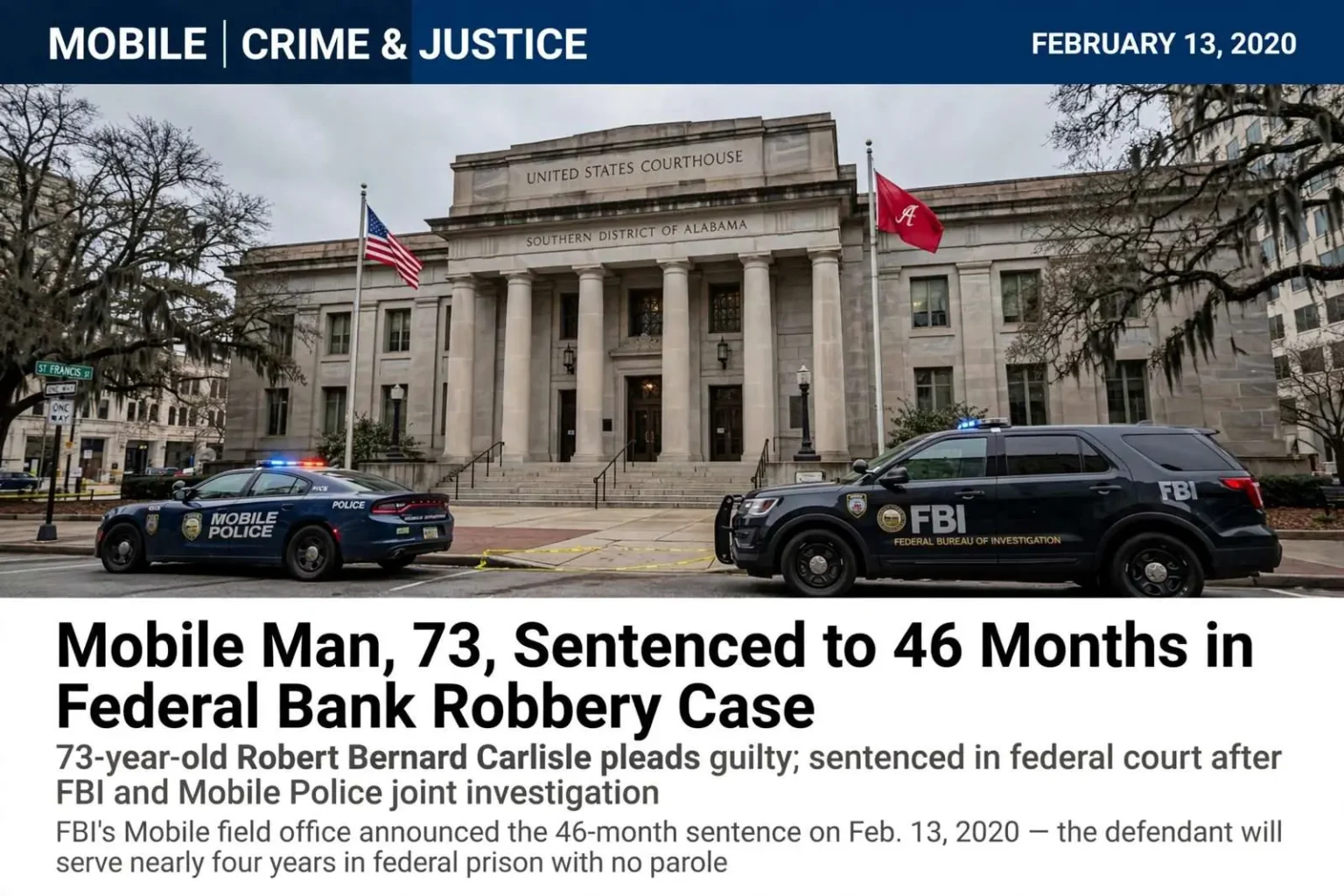
A 73-year-old Mobile man will spend nearly four years in federal prison after admitting to robbing a Mobile bank, the FBI’s Mobile field office announced in February 2020. Robert Bernard Carlisle pleaded guilty to one count of bank robbery and was sentenced to 46 months in federal imprisonment, closing out a case that moved from a local police referral to a guilty plea in less than a year.
Agents credited the Mobile Police Department with referring the case to the FBI for federal prosecution, a handoff that illustrates how bank robbery investigations work in Alabama’s port city. When a holdup is reported inside Mobile city limits, the first officers on the scene are Mobile’s own — securing the bank, interviewing tellers and witnesses, and collecting the initial evidence. But because the victim is a federally insured institution, the case quickly becomes a federal matter, and the FBI’s Mobile field office takes the investigative lead.
The 46-month sentence falls within the range typically produced by federal sentencing guidelines for bank robbery where no one was physically harmed. Federal judges weigh the statutory maximum against the guidelines’ recommended range, adjusting for factors such as the defendant’s criminal history, whether a weapon was displayed, the amount taken, and any threats made during the offense.
Why Bank Robbery Is a Federal Crime
Bank robbery is a federal offense under U.S. law because banks are federally insured institutions — deposits are backed by the Federal Deposit Insurance Corporation, so Congress has long treated crimes against banks as crimes against the federal insurance system itself. The relevant statute makes it a felony to take or attempt to take money by force or intimidation from a bank whose deposits are federally insured, and the vast majority of banks in operation today fall under that umbrella.
That means a bank robber faces a different legal pipeline than someone who robs a convenience store or a street-corner pedestrian. Those crimes are prosecuted in state court under Alabama law by the county District Attorney’s Office. A bank robbery, by contrast, is investigated by the FBI and prosecuted in U.S. District Court by the United States Attorney’s Office for the Southern District of Alabama, whose jurisdiction covers Mobile and the state’s southern counties.
From Local Arrest to Federal Court
Cases originating inside Mobile city limits are typically worked jointly: local officers make contact and gather evidence first, then the FBI takes over prosecution through the U.S. Attorney’s Office for the Southern District of Alabama. The arrangement is efficient by design. Mobile officers can respond within minutes to a bank’s alarm call, lock down the block, and start canvassing for witnesses while the trail is fresh; FBI agents then bring specialized resources — federal case agents, forensic support, and access to national databases that can connect a suspect to similar crimes in other cities.
The referral process also spares duplication. Rather than running parallel investigations, the two agencies document the handoff, and the evidence gathered by Mobile police becomes the foundation of the federal case file. Defendants in these cases typically face an initial appearance before a federal magistrate judge in Mobile, followed by an indictment or information, and then either a plea or trial in U.S. District Court.
The Sentence and What It Reflects
A term of 46 months — just under four years — is a substantial sentence for any defendant, but it is notable that the guidelines still call for significant prison time even for older, first-time offenders in bank robbery cases. Federal sentences must be served almost entirely; unlike many state systems, there is no parole in the federal system, with only limited good-conduct credit that can shave modest time off the tail of a term.
For a 73-year-old defendant, a sentence of that length carries its own weight. Federal Bureau of Prisons facilities must accommodate elderly inmates, and medical care within the system becomes a central issue as inmates age. The sentence nevertheless reflects the judiciary’s consistent position that holding up a bank is a violent crime in law even when no shots are fired, because tellers and customers are placed in fear for their lives regardless of what the robber intends.
The plea itself also matters in the federal system. Defendants who plead guilty generally receive a reduction in their guideline range for accepting responsibility, which often avoids a trial and shortens the path from arrest to sentencing. Carlisle’s guilty plea to a single count fits that pattern, resolving the case without the time and expense of a jury trial in the Southern District of Alabama.
FBI Mobile and the Region’s Bank Robbery Cases
The sentence was announced by FBI Mobile via social media on February 13, 2020, a channel the field office uses regularly to close the loop with the public on resolved cases. The Mobile field office covers the southern district’s territory and works bank robbery cases across the Gulf Coast region, where the frequency of holdups has made them a staple of the office’s docket.
Bank robbery investigations in the region often move quickly once suspects are identified, partly because banks’ own security measures — cameras at every teller window and entrance, dye packs, and silent alarms — generate strong evidence early. Investigators also coordinate across jurisdictions when a serial robber strikes in multiple cities, a pattern that has recurred along the Gulf Coast over the years and that federal charges are particularly well suited to address, since a single federal case can consolidate conduct that crosses city and even state lines.
Mobile’s Banking Heart and the Risk It Carries
Mobile’s downtown and its sprawling commercial corridors hold a dense concentration of bank branches, from the towers of the central business district to drive-through branches along Government Street, Airport Boulevard, and Cottage Hill Road. That density makes the city a consistent target for bank robbery, and it also means a single holdup can rattle employees and customers at institutions scattered across the metro area within minutes of the report.
Bank employees in Alabama train for exactly these situations. Teller procedures emphasize compliance during a robbery — handing over the money, activating silent alarms when it is safe, and memorizing details that will matter later: height, clothing, direction of travel, anything said aloud. Those details, combined with branch surveillance footage, form the backbone of the identification process that follows. Federal prosecutors have repeatedly noted that the quality of that frontline evidence is often the difference between a case that resolves in a plea and one that must go to trial.
The public’s role matters as well. FBI Mobile routinely asks residents to report anything suspicious near a bank before or after a holdup, and several Gulf Coast robberies have been solved in part because witnesses noted a getaway vehicle or a direction of flight that investigators could match to other footage along the route.
The Southern District’s Court Process
Once a bank robbery case reaches the U.S. Attorney’s Office for the Southern District of Alabama, the machinery of federal justice moves on its own calendar. An assistant U.S. attorney presents the case to a federal grand jury, which returns an indictment; the defendant then appears before a district judge, and pretrial proceedings address bail, discovery, and motions before either a plea hearing or trial. Sentencing follows a presentence investigation by federal probation officers, who prepare a report the judge uses in setting the final term.
That process is what carried Carlisle’s case from referral to resolution in under a year — a comparatively brisk pace that reflects both the strength of the evidence typical in bank robbery cases and the efficiency of the plea process. Federal dockets in Mobile handle everything from white-collar fraud to violent crime, but bank robbery prosecutions remain among the most straightforward: the statute is clear, the institutions are diligent about evidence, and the sentencing guidelines leave judges with a well-defined range.
What the Case Means Locally
For Mobile residents, the case is a reminder of how the layers of law enforcement fit together in practice. The Mobile Police Department handles the overwhelming majority of the city’s crime, but when a federal element is present — a federally insured bank, a fugitive who crosses state lines, a crime with an interstate dimension — the referral to the FBI and federal prosecutors adds tools that local agencies cannot access on their own, including federal sentencing structures that tend to produce longer, more certain prison terms.
The partnership runs in both directions. FBI agents in Mobile regularly coordinate with the Mobile Police Department, the Mobile County Sheriff’s Office, and neighboring agencies in Baldwin County and Mississippi on violent crime and fugitive matters. Task force arrangements allow officers from multiple departments to work under federal supervision, and those relationships are precisely what makes a smooth referral like this one possible.
For the banking community, the resolution closes an incident that, whatever its specifics, underscores the stakes employees face at the teller window. The American Bankers Association and local banks alike continue to emphasize training and quick reporting as the most effective responses to robberies — comply, stay safe, remember details, and let investigators do the rest.
A Case Closed, a Sentence Served Slowly
With the guilty plea entered and the 46-month term imposed, Carlisle will serve his sentence in a federal facility designated by the Bureau of Prisons, with supervised release to follow — a standard component of federal sentences that keeps former inmates under reporting requirements and conduct conditions after their release. At his age, the supervised release period is likely to extend well into his late seventies.
The announcement by FBI Mobile on February 13, 2020 was brief, but it marked the end of a chain that began with a Mobile bank’s alarm call and a patrol response, passed through a local referral to federal agents, and concluded with a plea in the U.S. District Court for the Southern District of Alabama. It is, in miniature, the story of how justice is administered along the Gulf Coast: local officers first on the scene, federal investigators and prosecutors carrying the case to its conclusion, and a community left with a clear account of both the crime and its consequence.