A Mobile man accused of leading Mobile County sheriff’s deputies on a high-speed chase that ended in a crash on Dauphin Island Parkway is now facing a federal firearms charge, on top of the state case stemming from the pursuit. Roderiquez Quinterrion Henderson, 22, is scheduled to make his initial appearance in U.S. District Court on a charge of being a convicted felon in possession of a firearm, an offense that carries a maximum penalty of ten years in prison if it results in a conviction. The federal filing adds a second, separate track to a case that until now has lived almost entirely in the state court system, and it signals that federal prosecutors see the allegations as serious enough to justify taking them on directly.
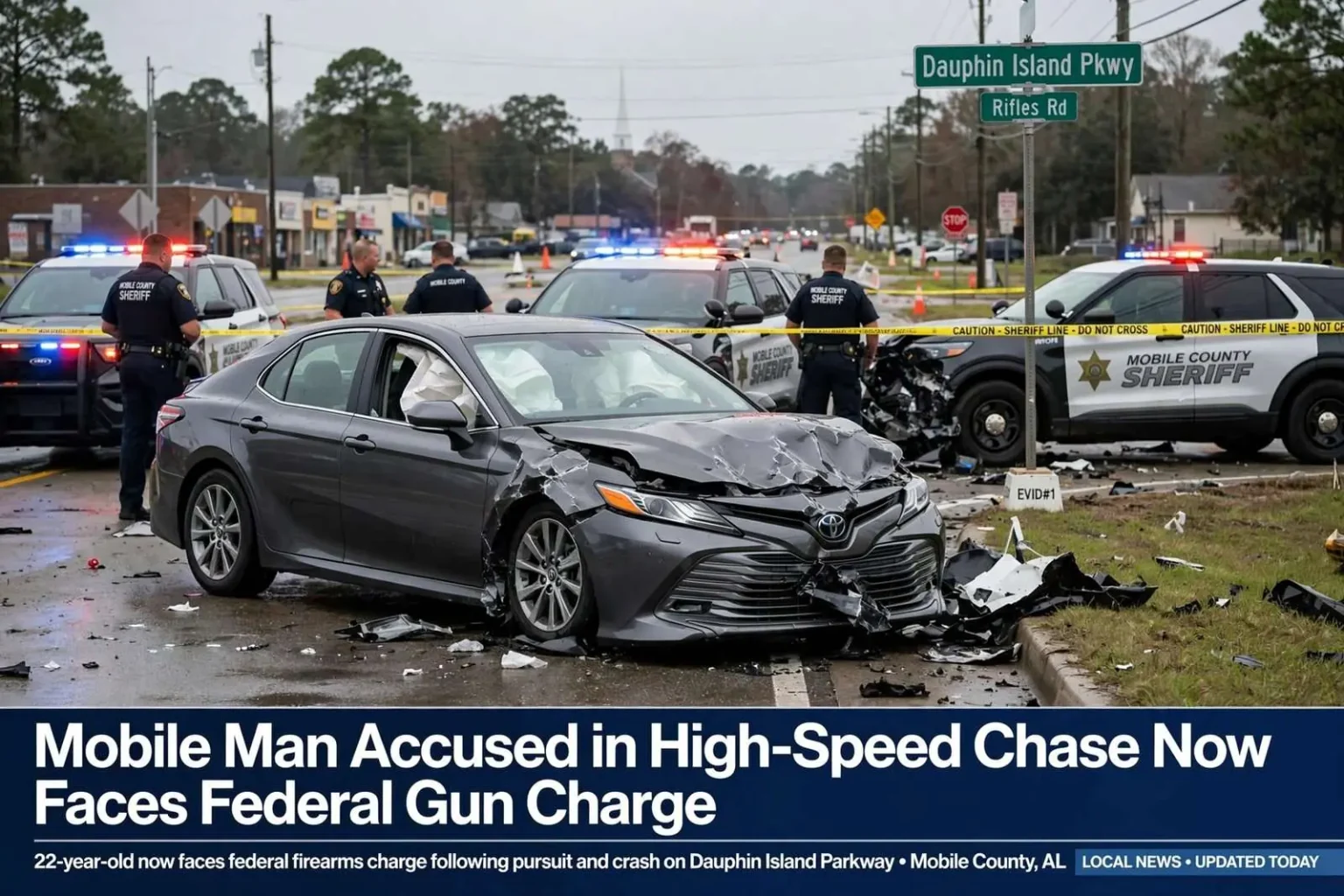
According to law enforcement, the pursuit began when Henderson refused to stop for deputies near the intersection of Rangeline and Halls Mill roads in south Mobile. From there, authorities say, the chase continued down Rangeline Road and Hamilton Boulevard before ending on Dauphin Island Parkway, where Henderson’s 2021 Toyota Camry collided with another vehicle near Rifles Road. The route carried the pursuit through a busy stretch of south Mobile County, across corridors lined with homes, churches and small businesses where deputies had to weigh the risks of continuing the chase against the danger of letting a fleeing driver go.
Sheriff’s investigators say Henderson is a member of a street gang active in south Mobile, a detail that helped move the case into the federal system. Cases involving suspected gang members and firearms are frequently referred to federal prosecutors, who can pursue penalties and supervision terms that are not always available in state court for weapons offenses of this kind.
How the gun entered the case
According to a federal affidavit filed by a member of the FBI’s Safe Streets Task Force, the firearm at the center of the case is a loaded Glock handgun that deputies say they watched Henderson throw out of his vehicle’s window during the chase. The affidavit, a sworn written statement that lays out the government’s evidence in support of the charge, describes what deputies observed from the moment the pursuit began until the moment it ended in a collision near Rifles Road. A loaded weapon tossed from a moving car during a pursuit is more than a discarded piece of evidence; investigators treat it as a public safety hazard, because it can end up in a ditch, a yard or a roadway where anyone might find it.
Henderson has denied to investigators that the gun belonged to him. However, the federal affidavit states that a passenger in the vehicle told authorities she saw him toss the weapon from the car during the pursuit. That account, if a judge or jury finds it credible, would directly contradict Henderson’s own denial and give prosecutors a second eyewitness to the moment the Glock left the moving vehicle, in addition to the observations of the deputies who were behind it.
Why the case went federal
The charge Henderson now faces — being a convicted felon in possession of a firearm — is one of the most frequently brought weapons offenses in federal court. Under federal law, a person with a qualifying felony conviction is generally prohibited from possessing a firearm or ammunition, and violations are prosecuted by the U.S. Attorney’s Office for the district where the offense occurred. Local agencies routinely partner with federal counterparts on these cases when the defendant’s history, the circumstances of the arrest or suspected gang involvement make the case a priority for federal attention.
The FBI’s Safe Streets Task Force, which filed the affidavit in this case, is a long-running partnership that pairs FBI agents with officers and deputies from local and state agencies to target violent gangs, armed offenders and the networks that support them. Task force members work cases across jurisdictional lines, which allows evidence gathered by sheriff’s deputies during a traffic pursuit to be folded into a federal prosecution when the underlying facts support it. The involvement of the task force here suggests the case was flagged as part of that ongoing effort rather than treated as an isolated traffic incident.
The pursuit through south Mobile
The corridors involved in the chase are among the busiest in the southern part of the county. Rangeline Road runs through a commercial and residential stretch of south Mobile, while Halls Mill Road and Hamilton Boulevard carry steady local traffic through neighborhoods that sit between Airport Boulevard and the Dauphin Island Parkway corridor. Dauphin Island Parkway itself serves as one of the main southern gateways toward the bay communities and the island it is named for, which means it sees a constant mix of commuters, families and commercial vehicles throughout the day. A pursuit that ends in a collision on a road like that carries obvious risks not just for the people in the vehicles involved, but for every driver nearby.
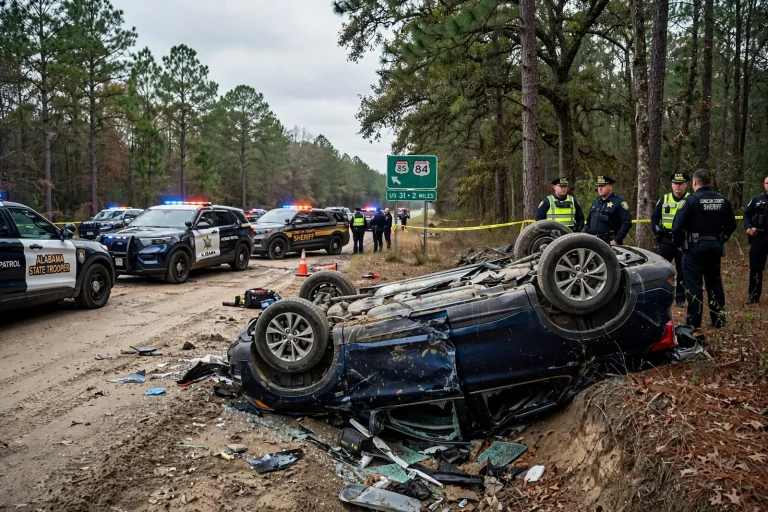
According to law enforcement, the chase ended when Henderson’s 2021 Toyota Camry collided with another vehicle near Rifles Road. Deputies say the crash brought the pursuit to a close and gave them the opportunity to take Henderson into custody. The occupants of the other vehicle were part of the scene deputies had to sort through, along with the search for the discarded Glock and the interviews that followed with both Henderson and his passenger.
High-speed pursuits are among the most unpredictable events law enforcement handles. Deputies making the decision to continue a chase have to balance the seriousness of why a driver is fleeing against what could happen at 60 miles an hour through intersections with cross traffic. In this case, investigators say, the deputies’ observations of the firearm being thrown from the window during the pursuit became the central evidence in the federal case, which is one reason the government’s interest in the matter outlasted the crash itself.
A record that barred him from having a gun
Court records show Henderson was on probation at the time of the chase for prior convictions on charges of shooting into an occupied building and shooting into an occupied vehicle — convictions that legally barred him from possessing a firearm long before deputies say they saw him toss one from a car window. Those offenses, under Alabama law, involve firing at structures or vehicles where people were present, and they carry the kind of felony record that triggers the federal prohibition at the heart of the new charge. The fact that the prior convictions involved gunfire aimed at occupied places is also likely to shape how seriously the new case is treated.
Probation in Alabama is a court-ordered alternative to incarceration that comes with strict conditions, including regular check-ins with a supervising officer, staying employed or in school, remaining law-abiding and avoiding firearms. A new felony arrest while on probation can set off a separate revocation proceeding, where a judge decides whether the probationer violated conditions and what the consequence should be — anything from tightened supervision to serving the original suspended sentence. For Henderson, that means the chase and the federal charge do not just create one new case; they put his existing sentence back on the table as well.
The passenger’s account also matters in a practical sense. In cases built on what officers saw during a chaotic, fast-moving pursuit, a second witness inside the vehicle can resolve questions that surveillance video or testimony from deputies following behind cannot. Prosecutors will treat her statement, and any statements Henderson made to investigators denying ownership of the gun, as key pieces of the record as the case moves forward.
The penalty and the process ahead
If convicted on the federal charge, Henderson faces a maximum penalty of 10 years in prison. Federal sentencing, however, is shaped by more than the statutory maximum. Judges weigh advisory sentencing guidelines, a defendant’s criminal history, whether the firearm was loaded, and whether the offense was connected to other criminal conduct. Henderson’s prior felony convictions will factor into that calculation, and prosecutors may point to the circumstances of the chase — the speed, the crash and the alleged gang affiliation — as they argue for a sentence at the higher end of the available range.
The process begins with the initial appearance in U.S. District Court, where a magistrate judge will inform Henderson of the charge, address the question of pretrial detention and, if necessary, appoint counsel to represent him. From there, federal felony cases typically move to a grand jury for an indictment, followed by arraignment, discovery and a series of pretrial hearings. Depending on how the evidence is contested, the case could end in a plea agreement or proceed to trial before a jury. Each of those steps takes place on a separate clock from the state proceedings connected to the same night.
The case adds to a growing list of legal troubles for Henderson, whose probation status stemming from earlier gun-related convictions could also factor into how prosecutors and a judge handle the new charge. In practical terms, that means three distinct things could happen in parallel: the federal weapons case, any state consequences tied to the pursuit and crash, and a possible probation revocation hearing on the original convictions. Each track has its own schedule, its own standard of proof and its own potential consequences, and outcomes on one track can influence the others.
A familiar pattern on the Gulf Coast
The way this case moved from a county pursuit to a federal indictment reflects a broader pattern along the Gulf Coast, where local sheriffs, city police and federal agencies have spent years building joint operations aimed at gun violence. Mobile-area task forces have long combined the street-level reach of deputies and patrol officers with the sentencing leverage and investigative resources of the federal system. For local agencies, the appeal is straightforward: a felon caught with a gun can face federal charges even when a state court docket is crowded, and the message to armed offenders is that the jurisdiction where they are caught matters less than the fact that they were caught.
For residents of south Mobile, the case touches on issues that shape daily life along the Rangeline, Halls Mill and Dauphin Island Parkway corridors. Neighborhood associations and community groups in the area have repeatedly called for attention to illegal guns and gang activity, and each high-profile arrest tends to renew the conversation about how the balance should be struck between aggressive enforcement and the safety risks that pursuits themselves create on residential streets.
What happens next will depend on the court process. Henderson’s initial appearance will set the early tone for the federal case, while the state matters and his probation status continue to move on their own schedules. For now, the case stands as an example of how a single night — a refusal to stop, a route across south Mobile, a crash on Dauphin Island Parkway and a Glock thrown from a car window — can generate consequences that reach well beyond the road where it all ended.