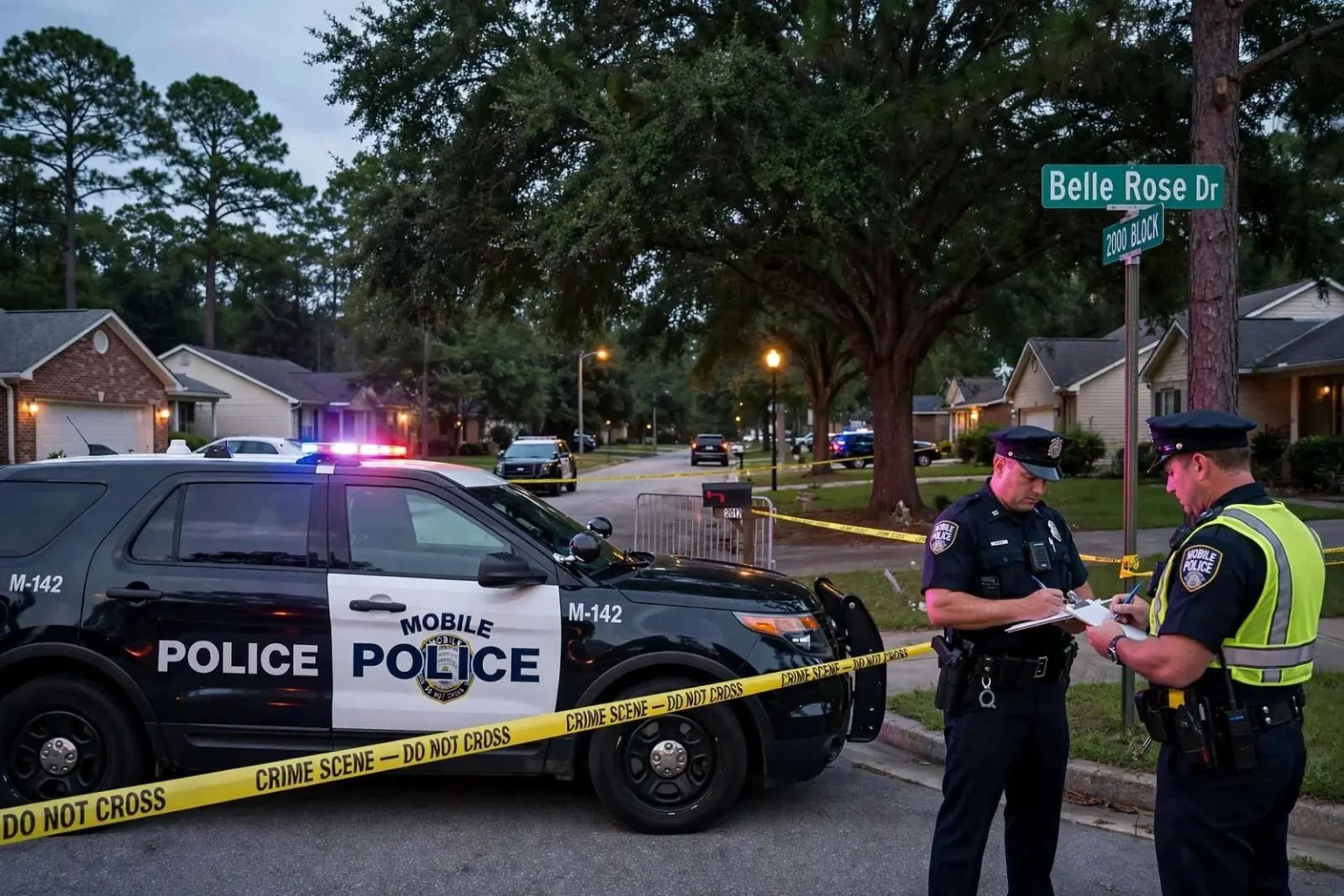
A Mobile man is facing multiple charges after he allegedly assaulted two police officers while resisting arrest over the weekend, according to the Mobile Police Department. Officers were called to the 2000 block of Belle Rose Drive just before 6:30 p.m. Saturday, Aug. 15, in reference to a disorderly complaint, a call that began as a routine disturbance response and ended with two officers injured.
When officers arrived and attempted to make contact, the person they encountered allegedly resisted arrest and physically assaulted two officers, causing them minor injuries, according to MPD. Mario Smith, 21, was arrested and charged with two counts of second-degree assault, along with disorderly conduct and resisting arrest. He was booked into the Mobile County Metro Jail.
The arrest was one of two assault cases Mobile police announced over the weekend, a span in which the department’s patrol divisions handled the ordinary volume of disturbance calls, assaults, and arrests that a city of Mobile’s size produces in any three-day period. As with any pending case, the charges against Smith are accusations, and he is presumed innocent unless and until proven guilty in court.
From Disturbance Call to Arrest
The sequence alleged in the case traces a pattern that police departments across the country identify as among the most dangerous parts of routine patrol work: the disturbance call that escalates on arrival. Officers responding to a disorderly complaint are dispatched to mediate — to determine what happened, separate the parties if necessary, and either resolve the matter with a warning or make an arrest if the law requires it. The call itself carries no information suggesting violence against police; the danger emerges at the point of contact, when the officer encounters the person involved and that person decides to resist.
Under Alabama law, resisting arrest is its own misdemeanor, but the alleged physical assault on the officers elevated the encounter into felony territory. Second-degree assault — a Class C felony in Alabama — covers assaults that cause physical injury with a deadly or dangerous instrument, or physical injury caused by other means under the statute’s definitions, and two counts meant the law alleged injury to each officer separately. The felony charges, stacked with disorderly conduct and resisting arrest, reflected the full arc of the encounter rather than its beginning.
The 6:30 p.m. timing on a Saturday evening placed the call in the middle of the weekend’s peak demand. Saturday evenings concentrate the week’s disturbance calls — parties, disputes, crowds — and police departments staff for that surge. An arrest that requires two officer injuries also generates the follow-on workload every use-of-force case does: injured officers evaluated and treated, reports documented, evidence collected, and the department’s review processes set in motion to examine how the arrest unfolded.
Assaults on Officers in Context
Assaults on police officers during arrests are among the most common circumstances in which law enforcement officers are injured on the job, and the statistics that national agencies keep on officer assaults show a steady pattern: a large share of the officers injured in the line of duty are hurt in disturbance-response and arrest situations, not in the high-profile confrontations that dominate coverage. Minor injuries — the classification reported in this case — include the sprains, lacerations, and contusions that result from physical struggles on the ground, in doorways, and in the close quarters where arrests happen.
The charges in a case like this also serve the function of marking the line the law draws around police contact. A person who argues with police, or who refuses to comply verbally, commits at most the misdemeanor of resisting; a person who physically attacks an officer commits a felony against the officer as a victim, and Alabama’s courts treat those cases as they treat any assault — with the officer’s injuries documented, medically verified, and presented as evidence.
The Charges and What They Carry
Second-degree assault in Alabama carries a penalty range of up to ten years in prison per count for a defendant without prior felony convictions, and the sentencing exposure multiplies with the counts. Alongside the two assault charges, the misdemeanor counts of disorderly conduct and resisting arrest document the conduct that began and sustained the encounter. In practice, cases with this profile — a young defendant, multiple charges arising from a single incident, and injured parties whose medical records form the evidence — are resolved in Mobile County’s courts through plea negotiations in the substantial majority of instances, with trial reserved for cases where the facts or the law are genuinely disputed.
The booking into Mobile County Metro Jail placed Smith in the county’s intake system, where he would have appeared before a district court judge for an initial appearance within days, as Alabama procedure requires for arrested defendants. Bail in assault cases involving police officers is set with the case’s circumstances in view, and the conditions of release — or continued detention — depend on the defendant’s record and the judge’s assessment. None of those later steps are described in the announcement of the arrest itself, which records the charges and the booking and nothing more.
The presumption-of-innocence language that accompanies reports of this kind is not boilerplate without meaning. An arrest announcement describes what police allege and what the charging documents claim; it does not establish that the events occurred as described. The evidence will be tested in court — through the defense available to the accused, the prosecution’s burden of proof, and the jury’s or judge’s verdict — and the distinction between an allegation and a conviction is the foundation of the criminal process that the case was about to enter.
Belle Rose Drive and the Neighborhood
The 2000 block of Belle Rose Drive sits in west Mobile, in the residential grid between the major commercial corridors, where the city’s neighborhoods of single-family homes and small apartment complexes run west toward the university area. Calls for service in such neighborhoods follow the rhythm of any residential district: alarms, traffic stops that pass through, domestic and neighbor disputes, and the disorderly complaints that bring patrol officers onto a street at 6:30 on a Saturday evening.
A disorderly complaint itself covers a spectrum. Alabama’s disorderly conduct statute addresses fighting, violent or threatening behavior, and unreasonable noise — the range of conduct by which one household’s Saturday evening becomes a neighbor’s reason to call the police. The officers dispatched to Belle Rose Drive were, in the ordinary course, responding to determine which of those behaviors was occurring and whether the situation required an arrest. The alleged assault changed the encounter’s character, but the call’s origin remained the same kind of report that patrol officers handle dozens of times in a weekend.
For the neighborhood, an arrest of this kind passes as a marked police presence, a short period of activity, and then the ordinary return of quiet — with the case itself moving to the courthouse, out of the street’s view. The two injured officers, meanwhile, followed the path every injured officer takes: medical evaluation, documentation of their injuries, and their account of the arrest entered into the record that the prosecution would carry forward.
The weekend’s second assault case, announced alongside this one, served as a reminder of the volume behind any single arrest report. Mobile Police handle thousands of calls in the course of a summer weekend, and the department’s announcements distill that activity into the cases that involve injuries or notable charges. Smith’s case, beginning with a disorderly complaint and ending in felony charges, joined that record — pending, as every announcement notes, the outcome in court.
How Resistance Escalates an Encounter
The mechanics of how a routine arrest becomes a felony case are worth understanding, because the escalation usually happens in seconds. When officers place someone under arrest, the encounter becomes physical by definition — handcuffing requires control of a person’s hands — and a subject who pulls away, braces, or fights turns a controlled procedure into a struggle. Officers are trained to escalate their own force only in response, which means the struggle continues until the subject is secured or the officers are hurt. The two minor injuries alleged in this case fit the most common outcome of that kind of struggle: musculoskeletal and contact injuries sustained while taking a resisting person to the ground and holding them there.
Police departments review these encounters internally regardless of how they end, because force used during an arrest is always examined against policy. The review runs in parallel with the criminal case against the resisting subject, and in cases where officers are injured, the documentation of the struggle — the officers’ reports, witness accounts, and any camera footage — becomes the record on which both the review and the prosecution rest. A defendant charged with assaulting officers faces that evidence in court, alongside whatever account the defense presents.
The weekend timing also means the case entered the system alongside the ordinary weekend flow of arrests. Mobile County Metro Jail’s intake processes every arrest the city and county produce, and a Saturday-night booking joins the queue of cases that district court magistrates address in the days that follow. The initial appearance, the bond setting, and the assignment of the case through the circuit court system all happen on the timetable that thousands of cases a year move through in Mobile County — faster for defendants who remain in custody, slower for those released on bond.
Officer Assaults and the Courts
Prosecutors treat assaults on officers as a category demanding firm handling, and the reasoning is institutional as well as individual: officers cannot perform arrests at all if resistance carries no consequence beyond the misdemeanor it would otherwise be. The two counts of second-degree assault in this case reflected two injured officers, and the felony classification meant the case would be handled in circuit court rather than staying in the district court where misdemeanors are resolved. For a 21-year-old defendant, a felony record of this kind carries consequences that extend well past any sentence — employment screening, firearms rights, and the sentencing enhancements that apply to repeat offenders.
The announcement of the arrest also served the department’s public-facing function. Police departments announce assault arrests to inform the neighborhoods where the incidents occurred, to document the cases for the public record, and to make clear that injuries to officers are charged and pursued. The practice of noting the presumption of innocence in the same announcement reflects the balance the department maintains between reporting an arrest and adjudicating it in the press.
What remains unknown from the announcement is everything the courts will decide: the facts of the struggle, the evidence for and against the charges, and the outcome for the 21-year-old now facing them. The case record — from the 6:30 p.m. disorderly call on Belle Rose Drive to the booking at Metro Jail — now belongs to the process that decides such questions, and the announcement’s own closing line is the accurate summary of where it stands: the charges are accusations, and the presumption of innocence holds until a court says otherwise.