Mobile man accused of setting car on fire after domestic dispute
Mobile man Trayon Montgomery is accused of setting a Toyota Corolla on fire after a domestic dispute, damaging a nearby apartment building.
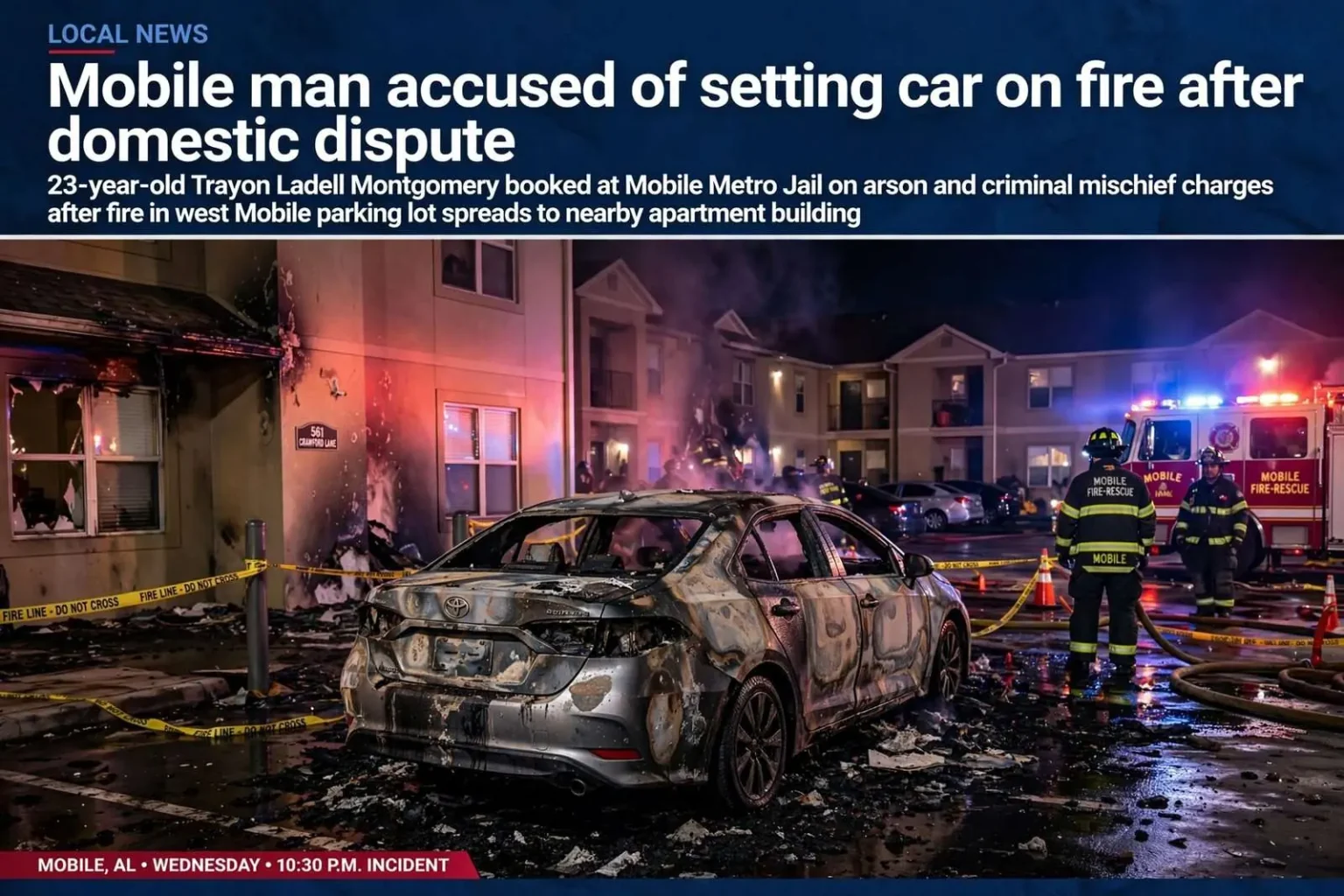
A Mobile man is expected to face arson and criminal mischief charges after authorities say he intentionally set a car on fire following a domestic dispute. According to the Mobile Fire-Rescue Department, 23-year-old Trayon Ladell Montgomery was booked into Mobile Metro Jail on Wednesday on several unrelated outstanding warrants, including disorderly conduct and no insurance. Arson and criminal mischief charges are expected to be added, officials said. Montgomery is accused of setting a Toyota Corolla on fire in a parking lot at 561 Crawford Lane just before 10:30 p.m. Tuesday, authorities said. The fire spread to an adjacent apartment building, causing moderate damage.
The case began as a domestic dispute that escalated until it left a car burning in a parking lot and a nearby apartment building damaged. Fires set intentionally during moments of personal conflict are among the most dangerous calls fire crews respond to, because they rarely stay contained to the property targeted. In this case, flames from the Toyota Corolla spread to the adjacent structure, turning what might have been a single-vehicle loss into a threat to an occupied building and everyone living in it.
How the Fire Unfolded
The blaze was reported shortly before 10:30 p.m. Tuesday in the parking lot at 561 Crawford Lane, an address in west Mobile near the shift from residential streets to apartment complexes that marks much of the city’s western growth corridor. When Mobile Fire-Rescue crews arrived, they confronted a burning sedan in a lot surrounded by apartment buildings, a configuration that gives vehicle fires in such complexes little room to burn without threatening nearby units.
Crews worked to knock down the vehicle fire and protect the adjacent building, and while the flames reached the structure and caused moderate damage, the response kept the incident from becoming a full structure fire. No widespread injuries were reported in connection with the blaze. Investigators with the fire department’s team examined the scene, and the circumstances — a car set on fire in connection with a domestic dispute — pointed to arson rather than a mechanical failure or accidental ignition.
The Arrest and the Charges
Montgomery did not face the arson allegation alone when he was booked Wednesday. He arrived at Mobile Metro Jail already carrying several unrelated outstanding warrants, including charges of disorderly conduct and no insurance, and the expected arson and criminal mischief counts will be added to that ledger as the case moves forward. Criminal mischief, under Alabama law, covers the intentional damage of another person’s property, and it pairs with arson in cases where a fire is set deliberately and causes damage beyond the property of the person responsible.
Domestic disputes that turn into property crimes follow a pattern that investigators and victim advocates know well. When a disagreement between people who live together or share a family tie escalates beyond words, vehicles left in shared driveways and parking lots are frequent targets, and the fire set in anger does not respect property lines. Alabama’s arson statutes treat fires that endanger occupied buildings more severely than those that damage only property, which means the spread from the Corolla to the apartment building matters legally as well as practically.
Mobile Metro Jail and the Booking Process
Mobile Metro Jail, the holding facility where Montgomery was booked Wednesday, serves as the intake point for arrests made by Mobile police, Mobile Fire-Rescue investigators and other agencies across the county. Arrestees booked there are photographed, fingerprinted and held while the charges against them are formally logged, and the jail’s roster of outstanding warrants often surfaces additional counts when a person is brought in on a new offense, as happened here.
The presence of outstanding warrants for disorderly conduct and no insurance suggests Montgomery was already known to law enforcement before the fire. When officers book a suspect and discover unresolved warrants, the jail holds the person until those matters can be addressed by a judge, and the combined charges are sorted out as the case moves into the court system.
The Danger of Vehicle Fires Near Apartments
Fires in apartment parking lots pose risks that go well beyond the vehicle itself. Modern cars carry plastics, fuels and synthetic materials that burn hot and fast, and the heat from a fully involved sedan can ignite nearby vehicles, awnings, soffits and exterior walls within minutes. In complexes where buildings stand close to their parking lots, the difference between a car fire and a structure fire is often just a few minutes of response time and the direction of the wind.
That math played out at Crawford Lane. The Toyota Corolla burned in a lot adjacent to an apartment building, and the fire spread to the structure before crews could contain it, causing moderate damage. Moderate damage in fire department terms can still displace residents, require repairs to exterior walls and interiors, and leave a building offline for weeks. The occupants of the threatened units escaped the worst of the outcome because of where the fire was attacked and how quickly crews arrived.
Mobile Fire-Rescue, the department that responded and investigated, handles fire suppression and emergency medical calls across the city from its network of stations, and its investigators are trained to distinguish accidental vehicle fires from deliberately set ones. Fires connected to domestic disputes, insurance claims and personal conflicts form a distinct category of casework, and the expected charges in this case reflect that determination. The department’s ability to move from suppression to cause determination within a single day is what allowed the expected charges to surface so quickly after the blaze.
What Happens Next in the Case
With the booking complete and the arson and criminal mischief charges expected to be added, the case moves toward an initial court appearance, where the combined charges — the new arson counts and the older warrants — will be laid out. Prosecutors will weigh the evidence gathered at the scene, witness accounts of the dispute and the fire department’s investigation as they decide how to proceed.
Arson cases carry timelines of their own. Investigators must document the scene before it is disturbed, collect samples for laboratory analysis and match the physical evidence to the accounts of the people involved, and each of those steps takes time even when the circumstances are as clear as they appear here. The addition of charges after an initial booking is common in fire cases, because the arson determination often comes from the fire investigator’s report rather than from the arrest itself, and prosecutors file the count once that report is in hand.
For the woman or man whose car burned, the case will also move through insurance channels, where an arson finding determines whether a claim pays out and against whom the loss is assigned. Criminal mischief counts cover the property damage beyond the vehicle, including the repairs to the apartment building next door, and restitution can be ordered alongside any sentence if there is a conviction.
For the residents of the apartment building next to the parking lot, the episode ended without serious injury but with repairs to absorb and a reminder of how quickly a dispute next door can become a fire at their own front door. Vehicle fires in residential complexes are a recurring concern for fire departments across the Gulf Coast, where apartment construction has expanded rapidly along the region’s growth corridors, packing more units and more parked cars into the same footprints.
The case also illustrates how domestic disputes reach beyond the people involved. What began as a conflict between individuals damaged shared property, endangered neighbors and consumed the resources of a fire department, a police investigation and a jail intake process. Community advocates in Mobile regularly point to that pattern when urging people in escalating relationships to seek help before a dispute turns destructive, noting that the services exist across the city for exactly those moments.
Montgomery’s case now sits with the court system, where the arson and criminal mischief charges will be added to the warrants he was already facing. The outcome will be decided in the courts, but the facts as authorities describe them — a car set on fire in a parking lot at 561 Crawford Lane, flames spreading to an adjacent apartment building, and a 23-year-old booked at Mobile Metro Jail the next day — sketch the arc of a domestic dispute that escalated until it endangered far more than the two people at its center.
As of the booking, officials had not released additional details about the relationship between Montgomery and the car’s owner or the residents of the damaged building. What the record shows is the sequence: a fire reported just before 10:30 p.m. Tuesday, a fire department investigation pointing to arson, and a Wednesday booking that added a new set of serious charges to an existing one.