Mobile man arrested for allegedly setting church bus on fire
Randy Lee Hale, 29, was arrested and charged with arson and criminal mischief after a church bus was set on fire in Mobile.
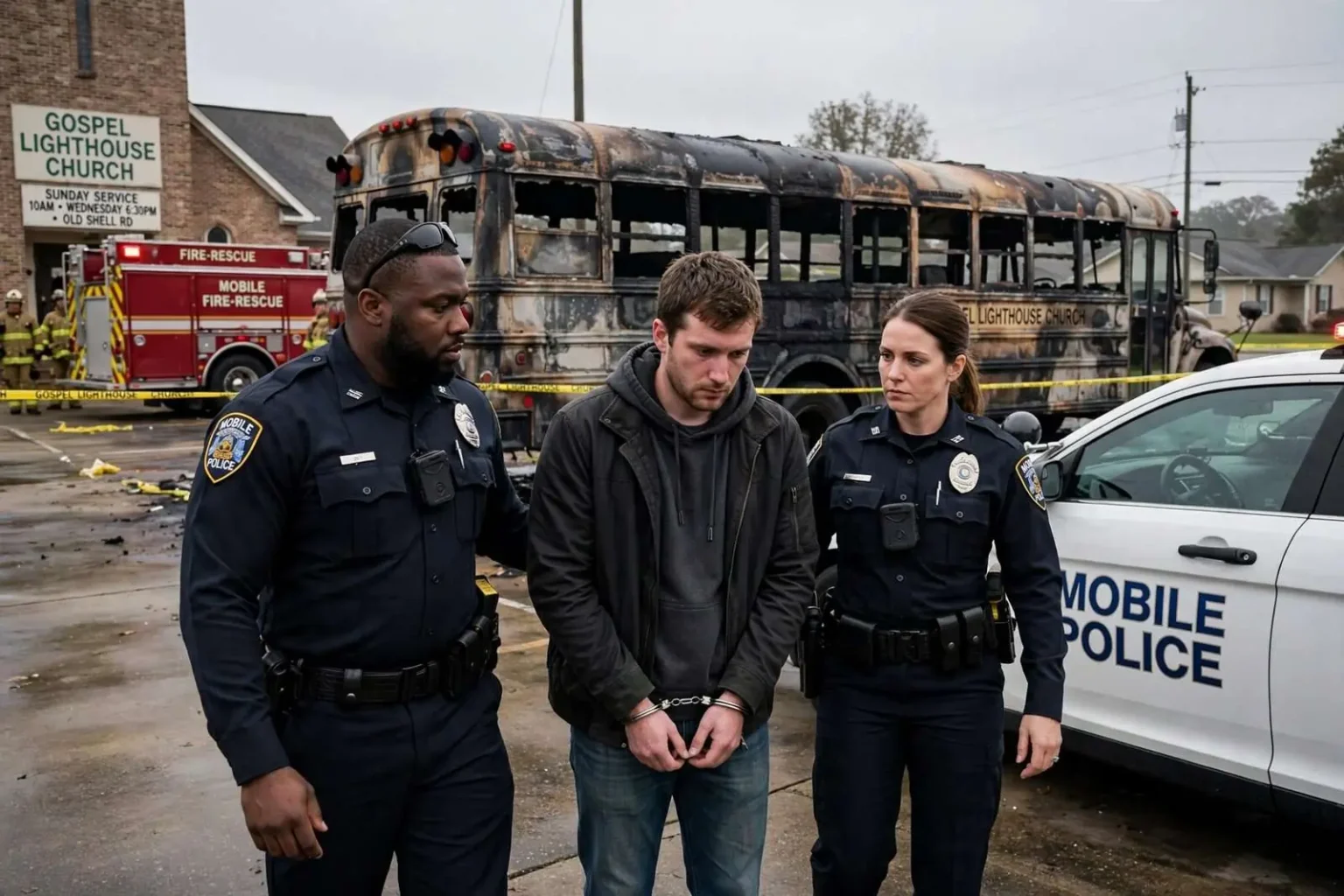
Arrest Made in Church Bus Fire
MOBILE, Ala. — A man has been arrested for allegedly setting fire to a church bus in Mobile about a week ago, according to Mobile Fire-Rescue. Randy Lee Hale, 29, is charged with arson and criminal mischief. Fire officials said Hale went to Gospel Lighthouse Church on Old Shell Road and set the bus ablaze around 6:50 a.m. on April 4.
The arrest closed out an investigation that began on an early spring morning when firefighters were called to the church property and found the bus burning. No injuries were reported in the blaze, but the vehicle — a visible piece of the church’s ministry, used for services and outreach — was the target of what investigators concluded was a deliberately set fire. A week later, Mobile Fire-Rescue investigators announced the arrest, crediting the work of their arson team and tips that flowed in after the fire was made public.
The charges Hale faces reflect the two halves of the offense. Arson covers the deliberate burning of property, and in Alabama it is a felony whose severity rises with the circumstances of the fire and the risk created for people nearby. Criminal mischief covers the destruction of or damage to another person’s property. Together they give prosecutors the tools to pursue a case built on a fire set in the early morning at a house of worship.
The Fire on Old Shell Road
Old Shell Road is one of Mobile’s oldest and longest corridors, running west from the heart of the city through neighborhoods of modest homes, storefront churches and long-established congregations. Gospel Lighthouse Church sits along that corridor, the kind of neighborhood congregation where a church bus is not a luxury but a working tool — hauling children to services, seniors to appointments, and members to events across the city. When the bus caught fire shortly before 7 a.m. on April 4, the damage was measured in more than dollars.
Fire officials said the sequence of events was straightforward: Hale went to the church and set the bus ablaze around 6:50 a.m. A fire at that hour, in a parking area next to a building used by congregants, carries obvious risk even when no one is hurt. Mobile Fire-Rescue’s investigators treat fires at houses of worship with particular care, both because of the community’s investment in the property and because any deliberately set fire in a populated corridor threatens lives beyond the target itself.
Mobile Fire-Rescue is the agency responsible for fire suppression and fire investigation across the city, and its arson investigators handle the slow, methodical work that follows a suspicious blaze. Investigators examine burn patterns on and around the vehicle, look for accelerants and ignition devices, canvass the neighborhood for anyone who saw a person or vehicle near the church in the minutes before the fire, and pull footage from any cameras in the area. In a case like this one, the announcement of an arrest about a week later signals that the team assembled a case it believed it could prove.
How Arson Cases Are Built
Fires destroy evidence even as they create it, which is what makes arson among the most technically demanding crimes to investigate. Investigators work from the outside in, documenting the scene before anything is moved, and a burned vehicle is examined much like a crime scene — sealed, photographed and picked apart for signs of how the fire started and spread. Accelerant detection, witness statements and surveillance video typically converge before an arrest is made, and prosecutors will later need to establish both that the fire was intentionally set and that the person charged set it.
The criminal mischief charge alongside the arson count reflects the damage done to the church’s property. In practice, the two charges also give a court flexibility in resolving the case, whether through conviction, plea or a resolution that includes restitution to the congregation. For a small church, the loss of a bus is a practical blow — transportation for members and ministries is disrupted until the vehicle is repaired or replaced — and restitution is often among the most meaningful outcomes for the victim institution.
Fires at churches occupy a distinct place in Alabama law enforcement practice. State investigators from the Alabama Fire Marshal’s office have historically coordinated with local departments on fires at houses of worship, and federal partners become involved when the circumstances suggest motives such as hate or insurance fraud. In this case, Mobile Fire-Rescue handled the investigation and announced the arrest directly, describing the events leading to it in plain terms: a man went to the church and set the bus on fire.
As the case moves forward, it will proceed through the county court system, where the arson and criminal mischief charges will be weighed. The congregation at Gospel Lighthouse, meanwhile, is left to do what neighborhood churches across Mobile have always done after a loss — repair, replace, and carry on. The arrest announced by Mobile Fire-Rescue a week after the April 4 fire is the first step in holding accountable the person officials say is responsible, and it returns the focus to the community along Old Shell Road that the church serves.
What the Charges Mean
Arson under Alabama law is graded by the circumstances of the fire, with the most serious degrees reserved for fires that endanger human life. Setting a vehicle on fire is charged as arson when it is done willfully, and the addition of a criminal mischief count addresses the property destruction itself. A person convicted of arson in Alabama faces years in prison, and the felony record that follows affects employment, housing and civil rights long after any sentence is served. Criminal mischief, by contrast, is graded by the value of the property damaged, but when charged as a felony alongside arson it signals the seriousness with which prosecutors view the destruction of the church’s vehicle.
The timing of the fire — around 6:50 in the morning — mattered to the investigation in several ways. Early-morning fires in populated corridors draw fast responses, which limits damage but also means witnesses may be scarce: commuters pass in seconds, and residents may hear nothing over the sound of ordinary morning traffic. Conversely, the early hour means the fire was visible against a still-dark morning sky, and flash-points like a burning vehicle in a church lot attract immediate 911 calls. Firefighters arrived to find the bus burning and were able to keep the fire from spreading to structures or other vehicles.
Mobile Fire-Rescue’s announcement of the arrest emphasized the basic narrative rather than a motive. Fire officials said Hale went to Gospel Lighthouse Church on Old Shell Road and set the bus ablaze. Investigators did not describe in their public statements what connection, if any, the man charged had to the congregation, and authorities generally withhold motive details while a case is pending. What the public record shows is a fire set at a neighborhood church, a week of investigative work, and an arrest that produced two felony-level charges.
Churches and Community Response
Across Mobile, congregations of the kind found along Old Shell Road operate on tight budgets, and a church bus is often one of the most-used pieces of property a small church owns. It carries choirs to events, youth groups to camps, and members who can no longer drive to Sunday services. When such a vehicle is destroyed, the loss ripples through the congregation’s weekly life. Neighborhood response to fires at churches historically includes everything from donations to offers of loaned vehicles, and Mobile’s community has a long habit of rallying around congregations that suffer property crimes.
The arrest also serves the practical purpose every fire investigation is aimed at: making sure a person who sets fires is identified and stopped. Arson investigators note that fires deliberately set are rarely isolated events, and an arrest shortly after a blaze both answers the community’s questions and removes the risk of a repeat. In announcing the arrest of Randy Lee Hale, 29, and the charges of arson and criminal mischief, Mobile Fire-Rescue closed the investigative chapter of the April 4 fire at Gospel Lighthouse Church and opened the court chapter, which will determine the consequences he faces.
For residents along Old Shell Road, the case is a reminder of how quickly a neighborhood institution can be touched by a single act, and of how the system responds when it happens. Firefighters answered the call on an early April morning; investigators spent the following week building the case; and an arrest followed. The bus that burned belonged to a church that has served its stretch of Mobile for years, and the man accused of setting it ablaze will now answer for it in court.