Mobile man celebrates 82nd birthday by honoring World War II veterans
A Mobile man celebrated his 82nd birthday by inviting two World War II veterans to the lot where his family home once stood before Hurricane Frederick.
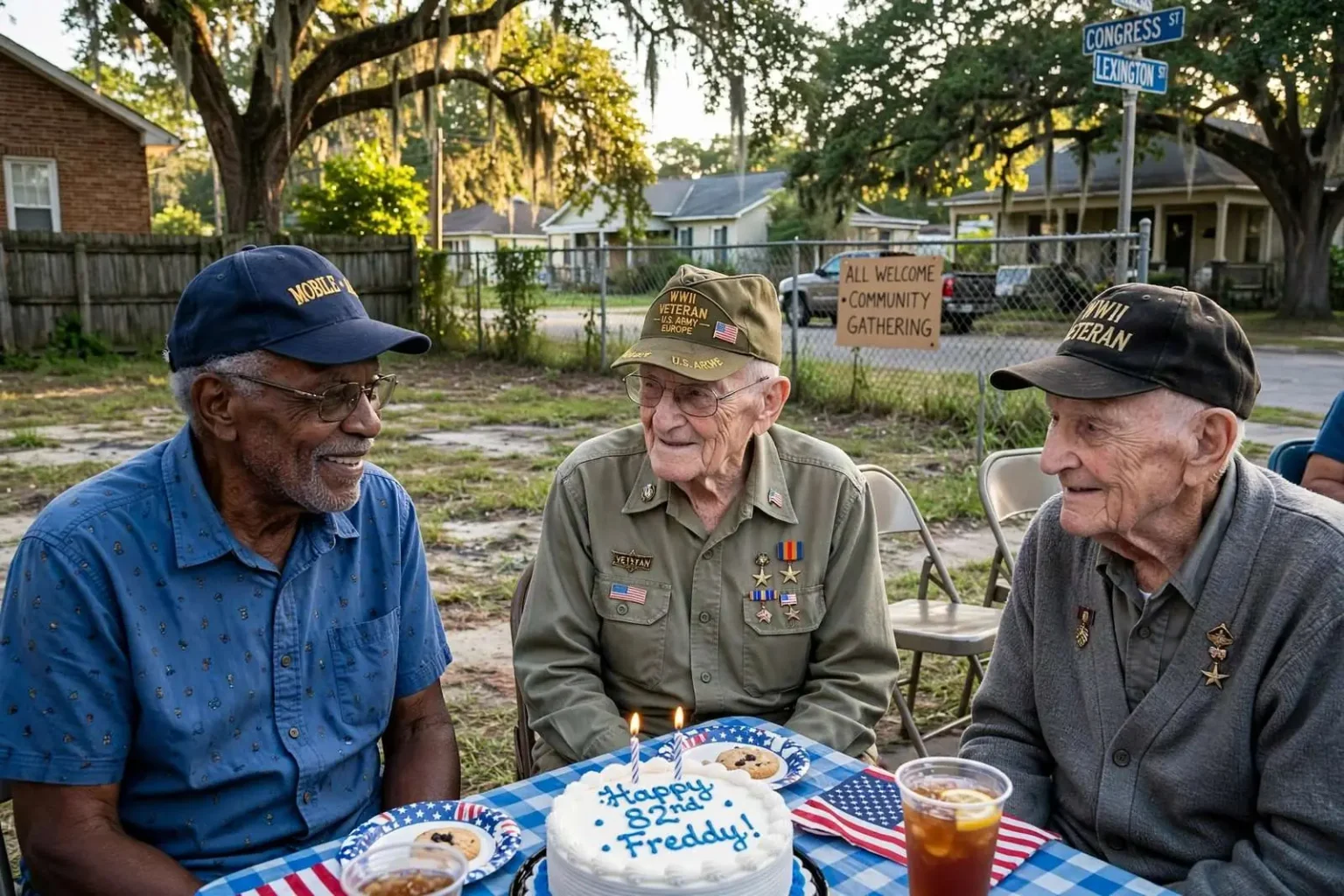
A Mobile man marked his 82nd birthday in a way few celebrations do — by inviting two World War II veterans to celebrate with him.
Freddy Sigler, a lifelong Mobile resident, hosted the honorees at the corner of Congress and Lexington streets, the spot where his family’s home once stood before Hurricane Frederick destroyed it. Rather than let the lot sit empty after the storm took the house, Sigler now uses it as a makeshift community gathering place, according to his son, Norman.
Among the veterans who joined him was John Guy, who served in the U.S. Army in Europe during the war.
The gathering joined two threads of Mobile history in one place: a hurricane that reshaped the city more than four decades ago, and the generation of Americans whose service in the Second World War is steadily passing into memory. For Sigler, celebrating a milestone birthday alongside men who fought that war turned an ordinary birthday into something closer to a community event.
A Birthday With Purpose
Turning 82 is an accomplishment in itself, but Sigler chose to center the day on guests of honor far older than he is. World War II veterans, men and women now in their 90s and beyond, represent a group that grows smaller every year. The Department of Veterans Affairs has estimated for years that the nation loses hundreds of these veterans each day, which is why opportunities to honor them locally have taken on new urgency.
Choosing to spend a birthday that way says something about how Sigler sees his place in the community. His son Norman described the Congress and Lexington lot as a makeshift gathering spot — a place where neighbors meet, talk and mark occasions together. In many Mobile neighborhoods, such informal common spaces have become as important as any park, especially in areas where the built landscape still carries scars from storms long past.
The presence of two World War II veterans gave the afternoon a living-history quality that no formal program could replicate. For neighbors who stopped by, the chance to sit with men who served in Europe during the war is increasingly rare, and it will not remain possible for many more years.
The Corner Where a Home Once Stood
Hurricane Frederick came ashore near Dauphin Island on September 12, 1979, and struck Mobile directly as a Category 3 storm with winds that peaked well above 100 mph. It remains one of the most destructive hurricanes ever to hit the city, damaging or destroying thousands of homes, toppling trees across the region and leaving much of Mobile without power for weeks. The damage ran into the billions of dollars, an enormous figure at the time, and the storm reshaped how the Gulf Coast thought about building codes, insurance and preparedness.
For individual families, the storm’s story is told in smaller units — a house lost, a lot cleared, a life redirected. The Sigler family home at Congress and Lexington streets was one of the casualties. Where a house once stood, the lot remained, and in time it took on a new role as a gathering place rather than sitting neglected.
That kind of transformation is more common in Mobile than outsiders might guess. Neighborhoods hit hard by Frederick rebuilt unevenly, and vacant corners became vacant lots, community gardens, extra parking or, as at Congress and Lexington, informal meeting spots. The street grid itself still shows the storm’s fingerprints, block by block, for those who know where to look.
Honoring the World War II Generation
John Guy’s service in the U.S. Army in Europe placed him in a theater that stretched from the beaches of Normandy to the heart of Germany. More than 16 million Americans served in World War II, and those who remain — now nearly 80 years after the war’s end — are generally in their late 90s. Every local gathering that includes them is, in a practical sense, one of the last of its kind.
Communities across Alabama have worked to keep that memory alive. The USS Alabama Battleship Memorial Park in Mobile stands as the city’s most visible monument to the war, drawing veterans and their families for decades. Schools and civic groups continue to invite aging veterans to share their stories, and local historians have pressed to record oral histories while the men and women of that generation can still give them.
What distinguishes gatherings like Sigler’s from museum ceremonies is their scale. There was no stage, no program and no admission — just a corner lot, a birthday, and neighbors sitting near men who helped defeat fascism on another continent. Sometimes the most meaningful memorials are the informal ones.
Midtown Mobile, Then and Now
The corner of Congress and Lexington streets sits in Mobile’s midtown area, a grid of residential streets laid out long before air conditioning made Gulf Coast summers comfortable. Homes in the surrounding blocks date from the early and middle 20th century, and the neighborhood has weathered every era the city has passed through — the war years, suburban flight, storms, and the gradual renewal that has brought families back toward the city’s core in recent years.
Midtown’s identity is built on exactly the kind of informal neighborliness that Sigler’s lot represents. Front porches, corner stores, church suppers and school car lines bind the blocks together, and longtime residents can usually trace their connections back through several generations. When a family has lived in Mobile as long as the Siglers have, the streets themselves become a kind of family album.
A gathering on a reclaimed lot also reflects how the neighborhood has handled loss. Rather than mourning the house Frederick destroyed, the family turned the ground it stood on into a place for living. Neighbors who gather there are, in a sense, standing on the storm’s history while quietly answering it.
The Meaning of an 82nd Birthday
An 82nd birthday places Sigler among Mobile’s own elder generation — men and women born in the early 1940s, during the years when the world was at war and Mobile itself was transformed by it. The city’s shipyards ran around the clock during World War II, swelling the population and pouring out vessels for the Navy, and children born in those years grew up in a town that understood service firsthand.
That background gives the birthday gathering a natural symmetry. Sigler grew up in the shadow of the war effort; his guests of honor fought it. Members of his own generation in Mobile were often children of veterans or knew them as fathers, uncles and neighbors. Honoring the two veterans on his birthday was less a staged tribute than a family conversation across generations.
Birthdays at that age also tend to draw family together, and Norman Sigler’s account of the event suggests that is exactly what happened — a son talking about his father’s tradition of opening the family’s old lot to the community. In an era when celebrations often move to restaurants or event halls, an afternoon on a corner lot in midtown Mobile carries its own kind of distinction.
Why These Gatherings Matter Now
The urgency behind honoring World War II veterans is arithmetic. The war ended in 1945; the men and women who served are now a century or more removed from their births, and the national roll of living WWII veterans shrinks constantly. Every local event that includes one is an opportunity for younger residents to hear living testimony that will not be available to the next generation.
Community gatherings like the one at Congress and Lexington streets also serve the veterans themselves. isolation is a real risk in advanced age, and occasions that put elders at the center of attention — rather than on the margins — are valuable beyond any ceremonial gesture. A birthday table on a familiar corner, surrounded by neighbors, is a better setting for an afternoon than most.
For Mobile, the event was a small example of what the city does best when it works: ordinary people turning the places they have into places worth gathering. A storm took a house. A family kept the lot. A birthday brought the neighbors out, and two men who served their country in Europe sat among friends in the city they helped shape from afar.
Hurricane Frederick’s Long Shadow
More than four decades after Frederick, its mark on Mobile remains easy to find for anyone who knows the history. The 1979 storm forced sweeping changes in how Mobile and Baldwin counties approach construction, drainage and emergency management. Modern hurricane preparedness on the Gulf Coast — from evacuation planning to stricter building standards — traces directly to the lessons of that September.
The storm also left a demographic imprint. Some families who lost homes rebuilt where they stood; others relocated and never returned, and some vacant lots never regained their buildings. Drives through older Mobile neighborhoods still pass empty corners where houses once stood, each one a quiet record of the storm. The lot at Congress and Lexington is unusual in having been given a new life rather than remaining bare.
For older Mobilians, mentioning Frederick still produces personal recollections — where they rode it out, how long the power stayed off, which trees fell across which streets. The storm killed people in the region and caused damage across a wide swath of the Gulf Coast, making it a defining local memory for everyone old enough to remember it. Sigler’s birthday gathering, held on ground the storm claimed, connected that memory to the present in the most direct way possible.
A Community Gathering Place, Made by Hand
There is a long tradition on the Gulf Coast of improvised common spaces — church parking lots that host fish fries, vacant corners that become parade viewing spots, front lawns that swell with folding chairs during Mardi Gras season. Mobile’s civic life has always spilled outdoors, helped by a climate that permits gatherings most of the year.
Sigler’s use of the family lot fits that pattern. A gathering place does not need benches, pavilions or landscaping to function; it needs a person who decides that people are welcome. Norman Sigler’s description of the lot as a makeshift community gathering place suggests that neighbors know they can stop by, and that the space has quietly become part of the neighborhood’s routine.
Urban planners spend considerable energy trying to design “third places” — spots between home and work where community life happens. Midtown Mobile’s version often grows from the ground up, out of habit and hospitality rather than planning documents. A corner lot where a family gathers for birthdays, and where neighbors are welcome, is exactly the sort of place no master plan can substitute for.
The Lasting Value of an Afternoon
When the celebration ended, the lot at Congress and Lexington streets went back to being simply a lot — but the afternoon had done its work. Two veterans spent time among people grateful for their service. A community marked the birthday of one of its own. And the story of a house lost to Frederick, and a corner reclaimed, reached a wider audience through the family that kept the place alive.
Gatherings like this one rarely make headlines, but they are the fabric of neighborhood life in Mobile. They require no budget, no committee and no ticket — only a host willing to open a space and guests willing to show up. That Freddy Sigler did it for his 82nd birthday, with World War II veterans at his side on the ground where his family’s home once stood, made the occasion worth remembering far beyond the corner of Congress and Lexington.
The honorees, as always in such gatherings, carried the deepest history with them. John Guy and his fellow veteran served in a war that most Americans know only from textbooks and films. For one birthday afternoon in midtown Mobile, that history came home — hosted on a storm-scarred lot by a man who has spent a lifetime in the city both events helped define.