Mobile Man Convicted of Murder in Death of Former Classmate Justin Hasty
A Mobile County jury convicted Brandon Estle of murdering former classmate Justin Hasty after a downtown Government Plaza trial that revealed a drug-fueled.
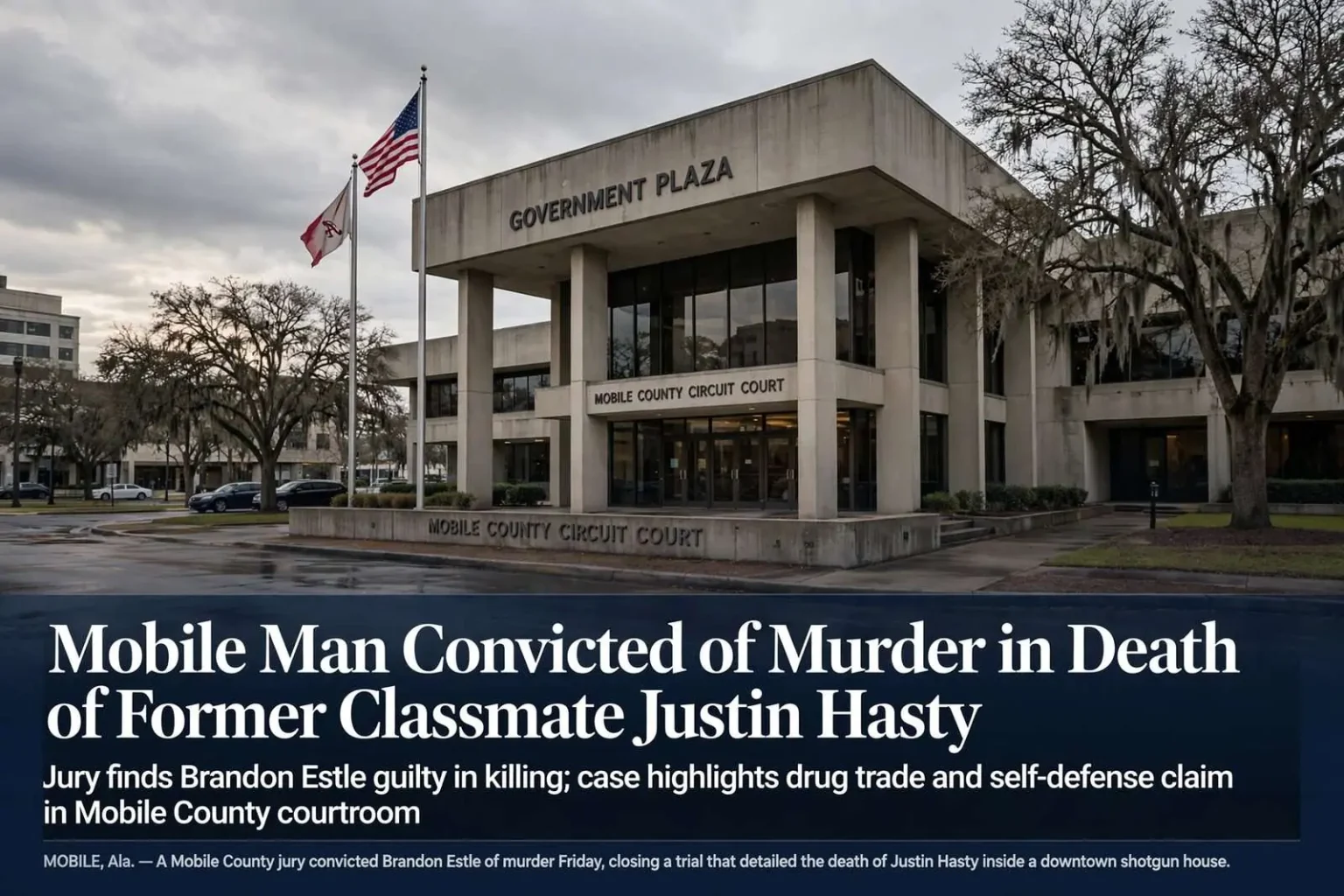
A Mobile County jury has found Brandon Estle guilty of murder in the death of Justin Hasty, a former high school classmate, capping a trial that laid bare a drug-fueled tragedy inside a downtown Government Plaza courtroom.
The verdict closed a case that had unsettled the Mobile area both for the brutality of the killing and for what it revealed about the reach of the local drug trade into the lives of two young men who had known each other since their school days. Prosecutors presented the death of Hasty not as a chance encounter but as the endpoint of a relationship built around marijuana and cocaine, and jurors agreed with the state’s account of what happened inside a small house where Hasty lived.
A Brutal Killing
Prosecutors said Estle, then 26, admitted he wielded an aluminum baseball bat that crushed Hasty’s skull. Estle acknowledged striking Hasty but claimed self-defense, telling jurors Hasty had hit him first and that he feared for his life when he saw a handgun.
The self-defense claim placed the defendant’s own admission at the center of the trial: Estle did not dispute that he delivered the blows that killed his former classmate. Instead, the case turned on whether the circumstances justified them, a question jurors answered when they returned the guilty verdict after weighing the state’s reconstruction of the encounter and the defense’s account of fear and provocation.
Investigators described a scene of extreme violence inside the small shotgun house where Hasty lived and died. Shotgun houses, with their narrow rooms aligned in a single line from front to back, are a familiar architectural feature of older Mobile neighborhoods, and the confined space left little room for the kind of struggle described in testimony.
What followed the beating formed the most disturbing portion of the state’s case. After the killing, Estle folded Hasty’s body into a plastic storage container, loaded it into his truck, and dumped it in a cotton field southwest of the city, firing rounds from Hasty’s own handgun into the box, according to testimony. The sequence — a killing inside the victim’s home, a body concealed in a common household container, and a disposal site in rural country outside the city — gave jurors a picture of an effort to erase what had happened rather than a fatal blow struck in the heat of a fight.
Drug Ties and a Guilty Verdict
Both men were entangled in the local drug trade. Hasty had been discharged from the Marine Corps over drug violations and was moving marijuana, while Estle supported a cocaine habit and traded with his old friend for the drug.
The military history added a layer to the case that resonated in a city with deep military ties. Hasty’s discharge from the Marine Corps over drug violations traced the arc of his decline — a veteran of the uniformed service so prominent in Mobile’s civic identity, returned to the city and drawn into small-scale drug dealing. Estle, by his own account at trial, was not a dealer in any entrepreneurial sense but an addict trading with a former classmate to feed a habit, a description that framed the encounter between the two men as one born of dependency rather than rivalry.
Mobile County District Attorney Ashley Rich urged jurors not to excuse the killing by blaming the substances, and the jury returned a guilty verdict. Her argument drew a line between explanation and excuse: the drugs in the case explained how two old friends came to be in that room, but they did not excuse what was done afterward — the beating, the concealment of the body and the disposal in a cotton field.
Presiding Circuit Judge Charles Graddick, addressing the courtroom after the verdict, pointed to drugs as the root of the case’s evil. The observation from the bench underscored what jurors had heard for the length of the trial — that beneath the questions of self-defense and intent lay a dependency that had consumed both men, one fatally.
A Charge That Might Have Been Greater
Rich later acknowledged that Estle’s retrieval of Hasty’s cash had gone undiscovered until he took the stand; had prosecutors known, the charge could have been capital murder with the death penalty on the table.
The admission mattered legally because robbery committed alongside a killing is what elevates a murder charge to capital murder under Alabama law, exposing a defendant to the death penalty or life without parole. Because the taking of Hasty’s money surfaced only when Estle testified, prosecutors had charged the case as ordinary murder — a conviction carrying a likely sentence of decades, rather than the death-penalty exposure that the additional fact would have brought.
The gap between what the state knew when it charged the case and what emerged at trial became one of the case’s lasting lessons for prosecutors. Evidence of financial gain is often the hinge between murder and capital murder, and in this case it arrived too late to change the charge — though not too late to change how the case was understood.
What Comes Next
Estle faces a likely sentence of life in prison when he is sentenced later this summer. Under Alabama law, a murder conviction carries a sentence of twenty years to life, and the circumstances of the killing — the weapon, the concealment of the body and the disposal site — left little room for a sentence at the low end of that range.
The sentencing will formally end a case that moved from a cotton field southwest of Mobile to a courtroom in Government Plaza, where Mobile County’s criminal trials play out in the same downtown complex that houses much of the city’s government. The courtroom proceedings drew attention throughout the trial, both for the graphic testimony and for the rare sight of a defendant whose own account supplied much of the evidence against him.
The case underscored the human cost of the drug trade that has touched families across the Mobile area. Two young men who had gone to high school together — one a Marine veteran drawn into dealing, the other an addict trading for his next supply — ended their story in a shotgun house, a storage container and a guilty verdict, while their families watched the details laid out in public testimony.
For prosecutors, the verdict affirmed the account they had assembled from investigators’ work at the house, the truck and the field. For the Hasty and Estle families alike, it closed a chapter on a case in which the drugs at its root — as the presiding judge put it — stood at the center of everything that went wrong.
How the Case Reached Trial
Murder prosecutions in Mobile County move through the circuit court system, where major felony cases are presented to juries drawn from the county’s residents. The path from arrest to trial typically spans months, during which investigators complete their work, forensic results come back and both sides prepare for the competing accounts that will be laid before jurors.
In this case, the investigation had to account for two crime scenes: the shotgun house where Hasty was killed and the cotton field southwest of the city where his body was found in the storage container. Evidence connecting the two — the truck used to transport the container, the handgun fired into the box, and the physical evidence gathered at each location — formed the backbone of the state’s reconstruction, while Estle’s own statements and testimony filled in the sequence of events from the defense table.
Trials held in the Government Plaza courtroom downtown place such cases before the public in the heart of Mobile, where news coverage of the testimony spread the details of the killing well beyond the families directly involved.
Self-Defense Claims in Alabama Courtrooms
Estle’s self-defense argument put a familiar legal question before the jury. Alabama law recognizes the right to use deadly physical force when a person reasonably believes it necessary to prevent death or serious physical injury, and defendants who admit to a killing sometimes rest their cases on that claim rather than on innocence.
But the defense faces a high bar in circumstances like those described in this trial. Jurors must weigh not only the moment of the fatal blows but everything surrounding them — who brought the weapon, what happened after the threat ended, and whether the defendant’s actions afterward were consistent with fear or with concealment. Prosecutors argued the aftermath told its own story: a body folded into a container, driven out of the city and shot from the victim’s own gun is not the conduct of a man who acted lawfully in self-defense.
The jury’s verdict indicated it accepted the state’s version of that sequence, finding the self-defense claim insufficient under the evidence presented.
Drugs and Violence in the Community
Cases of this kind recur in courts across Alabama, and law enforcement officials have long drawn the connection between the drug trade and violent crime in the Mobile area. Addiction-driven exchanges — not territorial disputes between organized dealers but small, desperate trades between acquaintances — form a recurring pattern in the cases that reach the circuit courts, and they often involve people who knew each other well before the crime.
Judge Graddick’s remarks after the verdict fit within that broader observation. When a presiding judge tells a courtroom that drugs were the root of a case’s evil, the statement carries weight beyond the individual defendant: it is an accounting, offered on the record, of how a cycle that begins with dependency ends in a courtroom with families on both sides of the gallery.
The sentence Estle receives later this summer will fix the legal consequences of the killing. What it cannot repair — the loss of Justin Hasty, the prison years ahead for his killer, and the toll on two Mobile families — is what the trial laid bare for the community to see.