
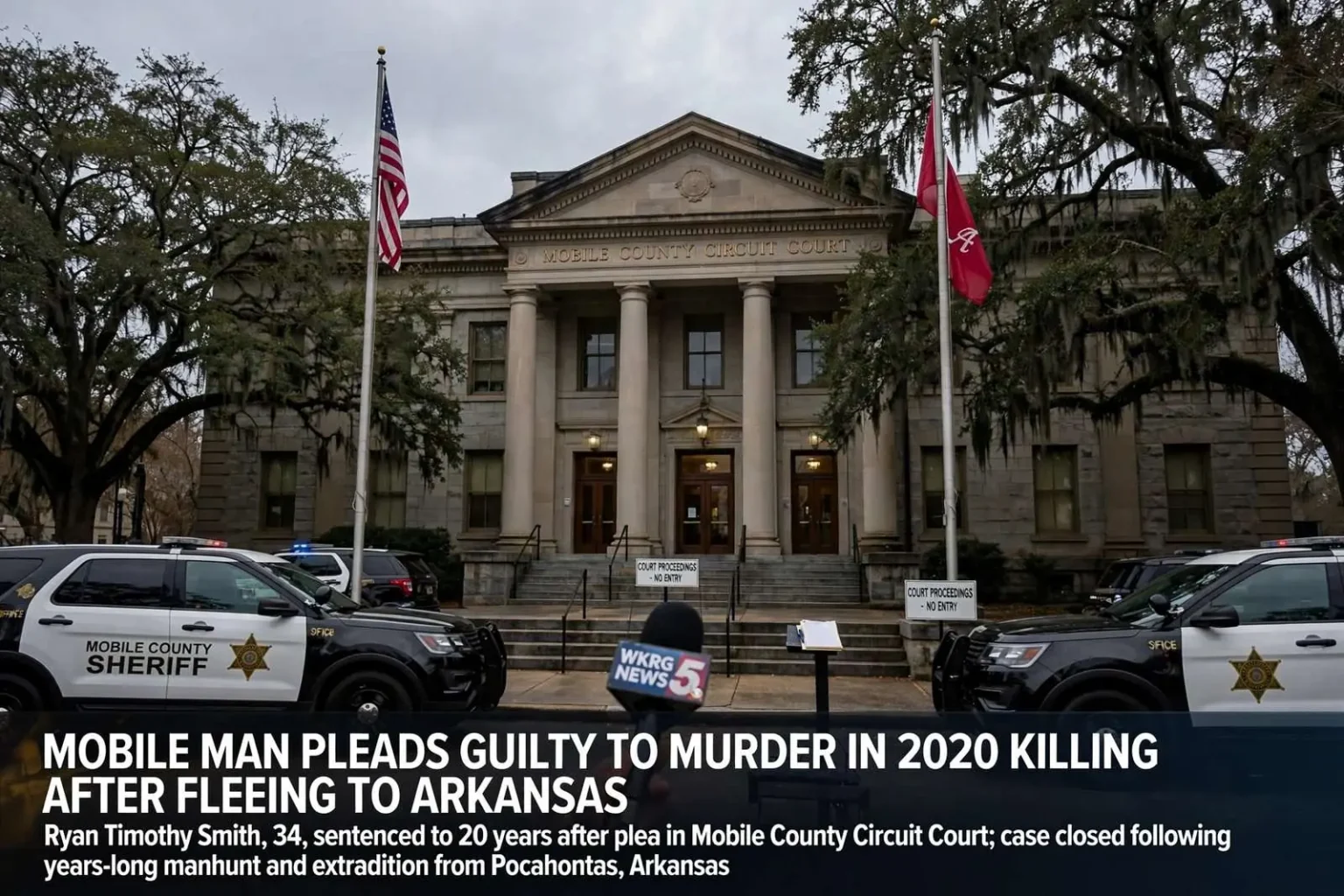
A Mobile man who spent nearly three years evading arrest before he was captured in Arkansas pleaded guilty to murder Monday in Mobile County Circuit Court, closing out a case that stretched back to a 2020 shooting and a body found buried near Dog River.
Ryan Timothy Smith, 34, of Mobile, entered the plea as part of an agreement with prosecutors. In exchange, Circuit Judge Jay York accepted the state’s recommendation to sentence Smith to 20 years in prison and agreed to dismiss separate charges of tampering with evidence and abuse of a corpse.
Smith said little during Monday’s hearing beyond acknowledging that he understood his rights. The brief proceeding stood in sharp contrast to the long and tangled path the case took through the justice system, from the initial missing person report in the fall of 2020, through an out-of-state manhunt and extradition, to years of delays before a resolution was finally reached.
How the case began
The case dates back to September 2020, when Derek Hase was reported missing. For weeks, there was no sign of what had happened to him, and the investigation gained little public traction until a tip came in toward the end of that October.
That tip led investigators with the Mobile County Sheriff’s Office to a spot in Theodore near Dog River, where they found Hase’s body buried along Rock Point Road. The discovery transformed a missing person case into a homicide investigation and sent detectives working to piece together the final days of Hase’s life and the circumstances that left him buried in a shallow grave in a quiet part of south Mobile County.
The Theodore area, a community of older neighborhoods, fishing camps and working-class subdivisions along the Dog River watershed, is not accustomed to cases of this kind, and the discovery of a buried body along Rock Point Road drew significant attention from residents in the surrounding area.
Flight to Arkansas and capture
Authorities said Smith had fled to Pocahontas, Arkansas, a small city in the northeastern part of that state, after the killing. According to investigators, Smith robbed the people he was staying with there after telling them he had shot a man in the face back in Mobile.
The robbery in Arkansas brought local police into contact with Smith, and he was arrested following a high-speed chase. Once his identity was confirmed and the Mobile County charges were matched to him, arrangements were made to return him to Alabama. He was booked into Mobile County Metro Jail in November 2020, little more than a month after Hase was first reported missing.
At the time, Smith maintained his innocence to reporters, saying, “I’m innocent,” and explaining that he had gone to Arkansas “to sober up.” Those early statements stood in contrast to the guilty plea he entered Monday, more than four years after the killing and nearly five years after Hase’s family first reported him missing.
Years of delays before a resolution
Defense attorney Christine Hernandez said outside the courtroom Monday that the lengthy delay in resolving the case stemmed partly from turnover among the prosecutors assigned to it over the years.
“We’ve been going back and forth with interviews for witnesses, evidence,” she said. “There’s been a lot of things that have come out about this case in the interim. … We have been able to go through a lot of the issues, and we were able to reach a resolution that my client felt was fair and appropriate.”
Delays of this length are not unusual in serious felony cases in Mobile County Circuit Court, where caseloads are heavy and complex murder prosecutions can pass through multiple hands. Witness interviews, laboratory work, and changes in prosecution staff can each add months, and cases that began years earlier often look very different by the time they reach a courtroom.
Hernandez’s comments suggested that the two sides had used those years to work through disputed evidence and witness accounts, eventually arriving at a plea agreement both sides could accept rather than risk the uncertainty of a trial.
The plea and sentence
Under the agreement, Smith’s 20-year sentence falls within the standard range for murder in Alabama, where the crime is classified as a Class A felony. By pleading guilty, Smith avoided a trial that could have produced a longer sentence, while prosecutors secured a conviction without putting witnesses through further testimony years after the events.
York agreed to dismiss the remaining charges of tampering with evidence and abuse of a corpse as part of the deal. Those charges, which stemmed from the disposal of Hase’s body along Rock Point Road, would have been presented to a jury alongside the murder count had the case gone to trial.
The Mobile County Sheriff’s Office took Smith into custody Monday immediately following his plea. York ruled that Smith will receive credit for the time he has already spent in custody, meaning the years he has been held since his return from Arkansas in 2020 will count toward his sentence.
What happens next
Smith will now be transferred into the custody of the Alabama Department of Corrections to begin serving his term. Under Alabama law, defendants sentenced to the Department of Corrections serve a portion of their sentence before becoming eligible for parole consideration, and a 20-year sentence with credit for time served could still mean a substantial period of incarceration ahead.
For Hase’s family, the plea brings a legal end to a case that began with a missing person report in September 2020 and ended in a courtroom more than four years later. Cases resolved by plea in this manner close the criminal proceedings, though the questions that lingered for years — about what happened in the final days of Hase’s life and why his body was buried near Dog River — may never be fully answered in public.
The resolution also marks the end of a long stretch of work for the Mobile County Sheriff’s Office, whose investigators developed the tip that broke the case open in October 2020 and coordinated with Arkansas authorities to bring Smith back to Mobile County to face the charges. Sheriff’s officials have not said whether additional charges or arrests related to the case are anticipated.
Context: violent crime cases in Mobile County
The case is one of many homicide prosecutions that move through Mobile County’s courts each year, and it illustrates how complicated cases can become when a suspect leaves the state before an arrest can be made. When a person wanted on Alabama charges is located in another state, local authorities must seek their return through the extradition process, coordinating with the governor’s offices of both states and with law enforcement agencies along the way. That process, combined with the pandemic-era court slowdowns that affected cases filed in 2020, helps explain how a case from the fall of that year was still being resolved in a courtroom years later.
The Mobile County Sheriff’s Office, which investigated the killing, covers the large unincorporated areas of the county outside the city limits of Mobile and Prichard, including the Theodore community where Hase’s body was found. Deputies and investigators there routinely work cases that stretch across multiple jurisdictions, since suspects and witnesses often move between Mobile’s city neighborhoods and the suburban and rural communities to the south.
The Mobile County Metro Jail, where Smith was held following his return from Arkansas, houses defendants awaiting trial on felony charges from across the county. Long pretrial detentions in murder cases are common, and the credit-for-time-served calculation that judges make at sentencing can significantly shape how much prison time a defendant actually remains subject to.
What the plea means for the record
A guilty plea carries the same legal weight as a conviction at trial, and Smith will now carry a felony murder conviction on his record for the killing of Derek Hase. The dismissed charges will not appear as convictions. Prosecutors did not comment publicly on the specifics of the negotiation, but the arrangement — a recommended 20-year term in exchange for pleas and the dismissal of ancillary counts — reflects a common resolution structure in Alabama circuit courts when the strength of evidence and the practicalities of trial are weighed on both sides.
For the neighborhood near Rock Point Road, where residents lived for weeks in 2020 with the knowledge that a body had been found buried nearby, the plea provides a measure of finality. So too for the community members in Pocahontas, Arkansas, whose report of being robbed by a houseguest claiming to have shot a man in Mobile set in motion the chase and arrest that ended Smith’s time on the run.
The case is now closed at the trial court level, with Smith’s sentence of 20 years formally entered and the defendant already in state custody pending his transfer into the prison system.
