
Mobile Man Wins New Hearing Aid From Beltone After Food Drive Victory
Beltone's Mobile location awarded local resident Greyland Peek a new Beltone Amaze hearing aid after excelling in a food drive with Feeding America.
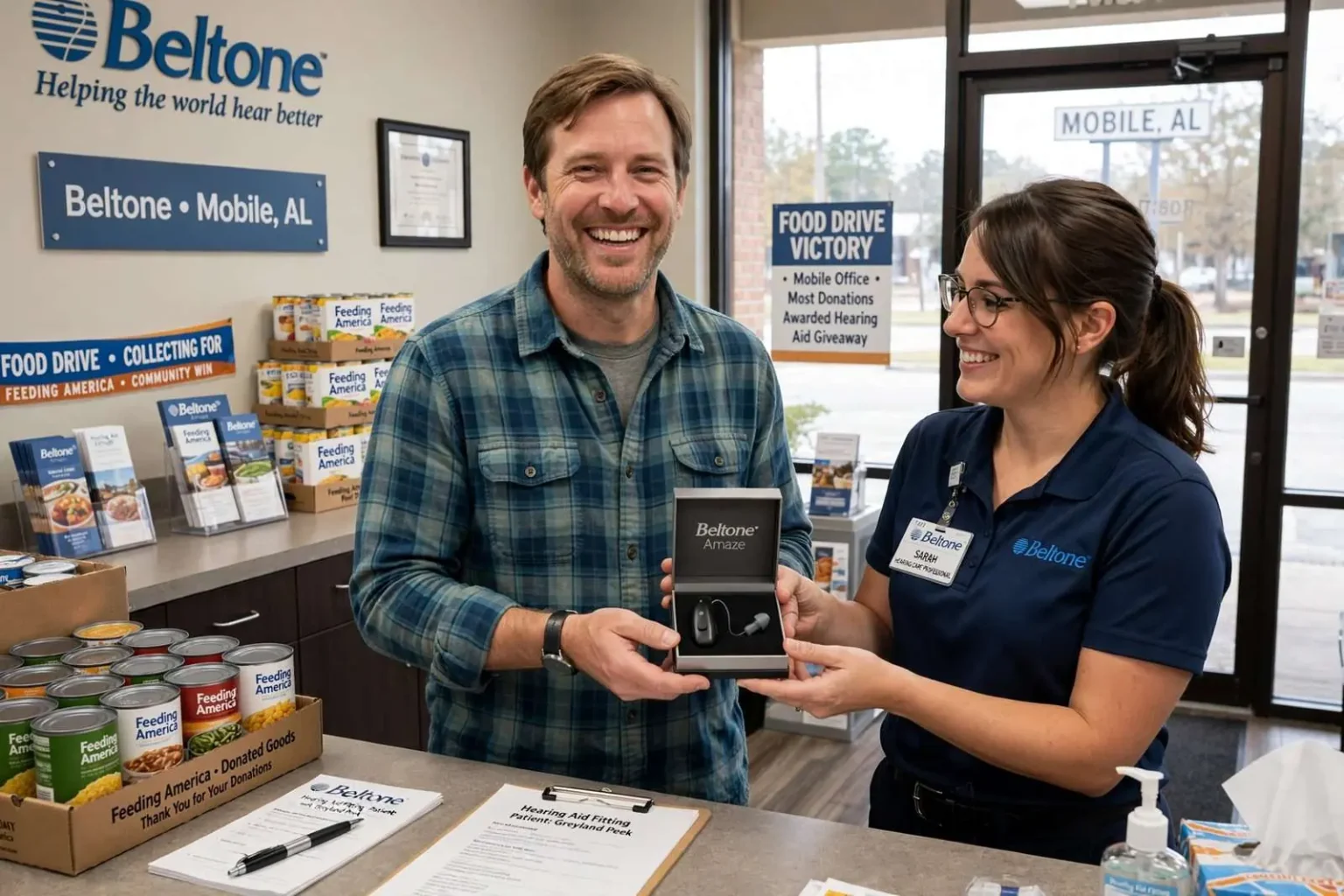
MOBILE, Ala. — A local man is hearing the world more clearly thanks to a giveaway from the Beltone hearing aid company’s Mobile location. Greyland Peek received a brand-new Beltone Amaze device after the company’s corporate headquarters awarded the Mobile office a free hearing aid to give away — a prize the location earned by performing well in a food drive held in partnership with Feeding America, the nationwide hunger-relief network.
The chain of events reads like a double act of generosity. Beltone’s corporate office created the incentive to reward franchise locations that went above and beyond in the food drive competition, and the Mobile office turned that reward around and gave it away to someone in the community who needed it. The result: shelves stocked for hungry families through the drive, and one unemployed Mobile man walking out of the Beltone office with a piece of technology worth thousands of dollars that he could not have purchased on his own.
A timely boost
For Peek, the timing could hardly have been better. Recently unemployed and unable to afford a hearing aid on his own, he said he hopes the new device will give him an edge as he searches for work. The arithmetic is stark: hearing aids commonly run into the thousands of dollars for a pair, they are not always covered by insurance, and someone who has lost a job and its health coverage is often in the worst possible position to pay for one out of pocket. A free, modern device removes both the financial barrier and the waiting period.
“I have never won anything in my life!” Peek said when he learned he had been chosen. The reaction captures how unlikely the moment felt — a man at a low point in his working life becoming the winner of a contest he did not even enter, because his local hearing aid office had spent the fall collecting canned goods for hungry families.
How hearing loss complicates a job search
Hearing loss can be a significant hurdle in any job search, affecting everything from phone screenings to face-to-face interviews. Phone conversations strip away the lip reading and visual context that many people with hearing loss rely on, and a missed word in a screening call can sound like inattention or confusion. In interviews, the stakes are higher still: candidates who ask strangers to repeat themselves risk being perceived — unfairly — as distracted or slow, while those who nod along risk missing the question entirely.
On the job itself, untreated hearing loss narrows the field of realistic positions. Noisy workplaces, phone-heavy roles and fast-paced team environments all become harder to navigate, and many applicants quietly rule themselves out of jobs they could otherwise do. Modern devices like the Beltone Amaze are designed to attack exactly those problems, amplifying speech while filtering background noise, making everyday conversations easier in workplaces and public settings.
What the Beltone Amaze offers
The Beltone Amaze sits in the upper tier of the company’s consumer hearing aids, built around the kind of features that matter in daily working life. Its processing emphasizes speech clarity — pulling voices out of the ambient noise of an office, a store or a job site — and many models in the Amaze line connect directly to smartphones, so calls and audio stream straight into the ear rather than through a distant speaker. For a job seeker like Peek, that difference is practical rather than cosmetic: a phone screening heard clearly, an interviewer’s questions caught the first time, a supervisor’s instructions understood on a noisy floor.
Fitting and adjusting such a device is not a one-time event, either. Hearing care professionals program the aids to the wearer’s specific audiogram and refine them over follow-up visits, which is part of what distinguishes a properly fitted hearing aid from an off-the-shelf amplifier. Peek’s prize includes the professional support of the Mobile Beltone office — the same team that earned the device in the first place.
Feeding America and the food drive behind the prize
The contest that made the giveaway possible ran through Feeding America, the largest domestic hunger-relief organization in the United States, a network of food banks that supplies pantries across the country, including in south Alabama. Beltone offices nationwide have used food drives as community-service campaigns, with corporate headquarters recognizing the locations that collect the most donations for local partners. The Mobile office’s strong performance in the drive earned it the reward — and the choice of what to do with it.
Giving the device away was the obvious call, but it is worth noting what the arrangement accomplished on both ends. Families facing food insecurity in the Mobile area received the goods collected during the drive, and a hearing-impaired job seeker received technology he could not afford. Neither would have happened without the office deciding to compete — and then to pass the prize through rather than keep it.
The wider problem of untreated hearing loss
Peek’s story sits inside a much larger national pattern. Millions of Americans who would benefit from hearing aids do not use them, and cost is among the most cited barriers — along with stigma, inconvenience and the misconception that hearing loss is simply something to put up with. The consequences of going untreated reach well beyond missed conversation: research has linked untreated hearing loss in adults to social isolation, strain in family relationships, and difficulties at work that compound over a career.
For someone between jobs, the effects are sharper. Job searches are communication-intensive by nature — cold calls, interviews, networking conversations — and every misheard word carries a cost. That is why a hearing aid can function as a piece of job-search equipment as much as a medical device, and why Peek framed his new Amaze in exactly those terms: as a tool for getting back into the workforce rather than simply a comfort item.
A quiet contest, a loud payoff
The giveaway was low-key by design. There was no public entry form and no ticket to buy — the Mobile office simply identified a deserving person in the community and made the award, which is why many residents first heard about the contest when its winner was announced. That approach reflects how hearing care practices often handle charitable fittings: discreetly, through screenings and community partnerships, rather than through a lottery that turns a medical need into a spectacle.
For the Beltone staff, the moment also closes a loop the food drive started. The employees who spent weeks collecting donations for Feeding America watched those same efforts return to the community as a working hearing aid on a neighbor’s ear. Few local promotions connect a cause to a payoff that directly, and it explains why offices continue competing for the prize year after year.
Local businesses and community causes
The giveaway also highlights the role local businesses play in community causes. A food drive organized out of a hearing care office is not a grand corporate campaign — it is a staff collecting canned goods from patients and neighbors, one donation at a time, with a local food bank benefiting directly. When corporate headquarters matched that effort with a reward, the Mobile office converted it into something with direct, measurable benefit to one local resident.
That model — national corporate programs filtered through local franchises with local knowledge — is one of the more effective forms of community giving. The corporate office knows the prize was earned; the local office knows who needs it. In this case, the local knowledge found Greyland Peek, a man who had never won anything in his life, at the exact moment a hearing aid could change the trajectory of his job search.
What happens next
Peek’s next steps are those of any job seeker in Mobile: applications, phone calls and interviews, now with a significant obstacle removed. Beltone’s Mobile office, meanwhile, continues its regular work of fittings and follow-up visits, and presumably another community campaign when the next food drive season arrives.
His advice to others in his position is implicit in the story itself: get hearing tested, ask about assistance programs, and do not assume the price tag on the counter is the final word. Devices, payment plans and community giveaways exist across the industry, and the first step is simply the screening.
The story offers a closing observation that applies well beyond one winner: the things that stand between an unemployed person and a job are rarely just applications. Sometimes it is transportation, sometimes it is child care, and sometimes — as in Peek’s case — it is a conversation missed because the world went quiet. Fixing that last one took a corporate incentive, a staff that competed hard for a good cause, and the decision to give the prize away. The food drive fed hungry families, and the prize fed a job search. Both were wins for Mobile.