Mobile Bowling Alley Offered Bead Exchange in 2018
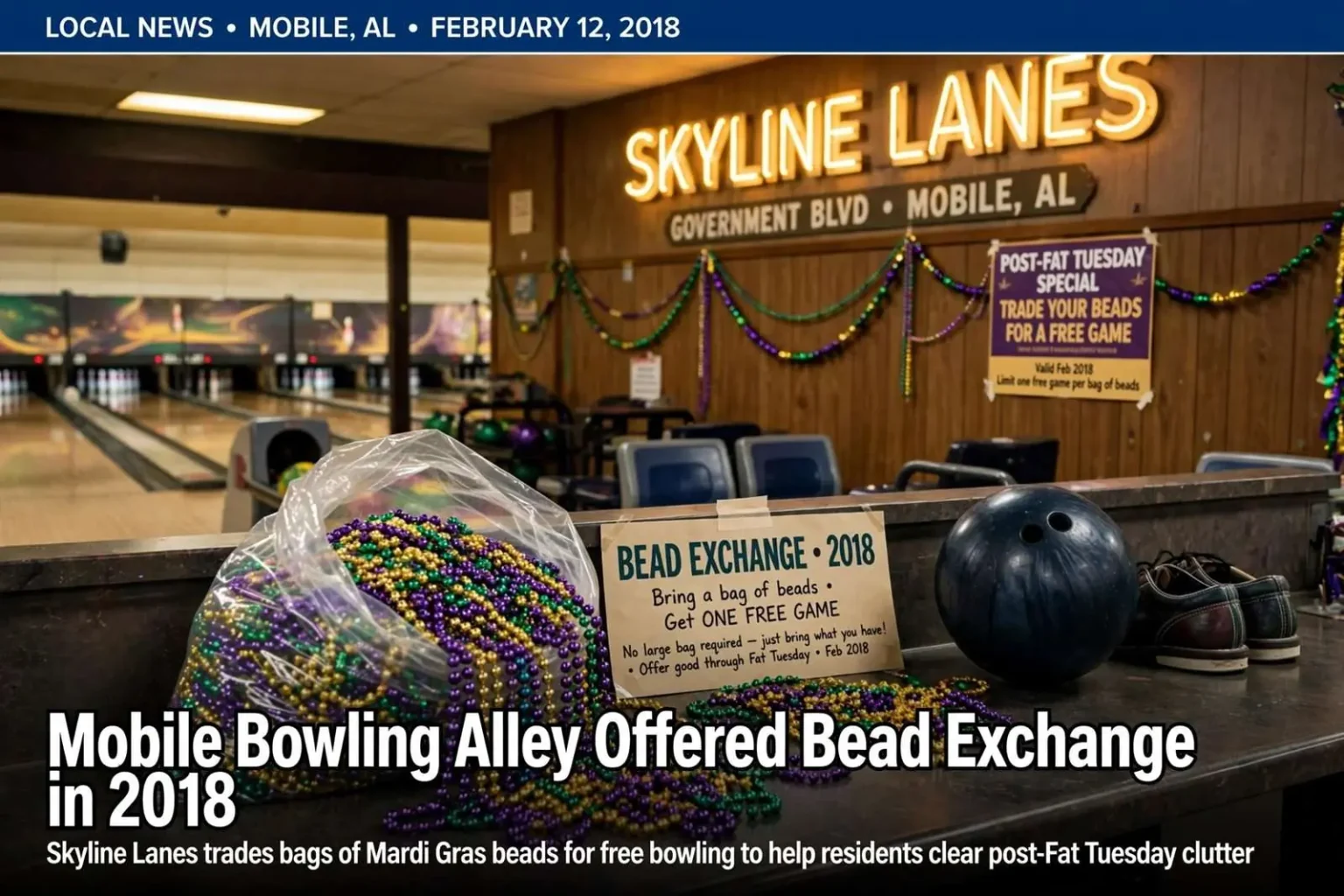
Skyline Lanes on Government Boulevard offered a free bowling game in 2018 to customers who brought in a bag of Mardi Gras beads.
Originally reported February 12, 2018.
Skyline Lanes on Government Boulevard offered a free game of bowling in 2018 to people who brought in a bag of Mardi Gras beads, according to a local news report — a promotion that turned the season’s most abundant souvenir into an afternoon of bowling.
General Manager Kevin Pocase said the idea recognized a familiar reality of Gulf Coast life: many residents would have piles of beads after Fat Tuesday, with nowhere in particular for them to go. The exchange gave those piles a destination.
He said customers did not need to bring a large bag for the exchange — the offer was designed to be easy to claim, not a test of how much loot a household had accumulated during carnival season.
This article preserves a local 2018 Mardi Gras promotion and does not describe a current offer. The promotion’s details, like the season it grew out of, belong to February 2018.
A Post-Fat Tuesday Problem, Solved Over Bowling
Anyone who has experienced a Gulf Coast Mardi Gras knows the aftermath: closets, attics and car trunks filling up with strings of beads, cups, MoonPies and doubloons collected over a season of parades. The throws accumulate faster than any household can reasonably use them, and by Ash Wednesday, many families are quietly deciding what to keep and what to toss.
Skyline Lanes’ promotion met that moment exactly. Rather than asking residents to buy anything or attend anything, the bowling alley simply invited them to bring what they already had too much of — a bag of beads — and traded it for a free game. The exchange required no collection quota, as Pocase’s comment about not needing a large bag made clear, which kept the barrier to participation as low as possible.
Promotions of this kind work because they convert the season’s leftover clutter into a reason to visit a local business during what is, for many establishments, a slow stretch of late winter. The customer gets value for something headed for the trash; the business gets a crowd and, likely, snack-bar and shoe-rental sales that a free game alone would not cover. Both sides walk away with more than they brought.
Skyline Lanes and Government Boulevard
Skyline Lanes operated along Government Boulevard, one of west Mobile’s principal commercial arteries. Government Boulevard runs west from the heart of the city through a corridor of family businesses, restaurants and recreation spots that generations of Mobilians have grown up with, and a bowling alley fits the corridor’s character precisely — a place built on leagues, birthday parties, family outings and school breaks.
Bowling alleys occupy a particular place in Southern community life. League nights give adults a weekly social fixture; youth leagues and birthday parties fill weekends; and between those anchors, the lanes function as an indoor escape from summer heat or winter rain. A promotion like the bead exchange builds directly on that role, giving families one more low-cost reason to come through the door.
For a business along Government Boulevard, February is an opportune month for such a draw. Carnival season itself brings crowds downtown and along the parade routes, but neighborhood businesses away from the routes benefit more from riding the season’s afterglow — when the beads pile up and the itch to get out of the house remains. The exchange timing, right around Fat Tuesday, sat exactly in that window.
Beads, Throws and the Economics of Carnival
The beads at the center of the promotion are the signature commodity of Mobile’s Mardi Gras, the oldest annual carnival celebration in the United States, with roots reaching back to the city’s colonial era. Parade societies — and Mobile has more than 60 of them — spend months acquiring throws, and riders on the floats distribute millions of beads over the course of each season, mostly to crowds packed along the downtown routes.
Those beads are made of plastic and strung by the ton, which makes the post-season surplus a genuine civic issue. Cities and community groups across the Gulf Coast have experimented over the years with bead recycling and collection drives — some programs have repurposed discarded beads for charity giveaways, art projects and even habitat restoration efforts — precisely because the volume of leftover plastic is too large to ignore.
A bowling alley’s bead-for-bowling trade belongs to that same family of ideas, arrived at from the business side. It acknowledges what every local household knows: the beads will accumulate, and someone might as well get something for them. Pocase’s framing of the idea — recognizing the piles residents would have after Fat Tuesday — captured the whole logic of the promotion in a sentence.
The promotion also fit the wider pattern of how Mobile businesses ride carnival season. Restaurants, retailers and service businesses across the city plan around the weeks of parades, from king cake sales to parade-route parking, and neighborhood establishments away from downtown participate by tying offers to the season’s themes. A bead exchange requires no parade float, no permit and no membership in a mystic society — just a counter, a sign and a willingness to take out the season’s most common souvenir as payment.
How the Promotion Worked
The mechanics were simple by design. A customer brought a bag of Mardi Gras beads to Skyline Lanes; the customer bowled a free game. No purchase was described as necessary beyond the exchange itself, and Pocase’s remark that customers did not need a large bag signaled that even a modest handful of strings would qualify. That simplicity is a feature of successful local promotions: complicated rules kill word of mouth, while easy ones spread it.
For families, the trade was especially easy math. A single evening of parade-going can easily fill a bag with beads, and a free game of bowling has real value for a household — shoe rentals and lane fees add up across a family of four. The promotion effectively converted one evening’s souvenir-hunting into another evening’s recreation, at no cost beyond the beads.
The promotion also benefited the lanes beyond the headline. A customer who comes in for a free game typically stays for an evening — snacks, drinks, additional games, friends who tag along and pay full price. Local businesses that run creative trades like this one are, in effect, buying foot traffic with inventory the customers were going to throw away anyway.
What Happens to Collected Beads
Whatever Skyline Lanes did with the bags it collected in 2018, the beads’ afterlife is a recurring question in Mobile every Ash Wednesday. The strings are durable plastic and do not biodegrade meaningfully, which is why discarding them wholesale is such a visible waste. Community reuse ideas over the years have ranged from re-stocking throws for future parades to donating beads for children’s events, church festivals and craft projects.
The exchange model — trading a free or discounted experience for collected items — has been used across the Gulf Coast for beads and for other parade leftovers, and it solves the collection problem at both ends. Residents get an incentive to bring the beads in rather than trash them; the collecting organization gets volume it can redirect or use. That a bowling alley ran one in 2018 says something about how local the idea has become: bead collections are no longer only the province of environmental groups.
Mobile’s Mardi Gras generates enthusiasm on a scale that few other cities experience — weeks of parades, dozens of societies, and a season that school calendars and local commerce bend around. The sheer abundance that makes the season joyful also produces the surplus that promotions like this one quietly address.
A Snapshot of February 2018
The details preserved here — the date of the original report, the offer of a free game for a bag of beads, the general manager’s comments — describe a specific promotion during a specific Mardi Gras season. The 2018 carnival season in Mobile ran through February 13 of that year, when Fat Tuesday fell, which placed the promotion in the season’s final week, exactly when the post-parade surplus Pocase described would be at its peak.
Readers should note that this article does not describe a current offer. Skyline Lanes’ bead exchange belongs to 2018, and nothing here should be taken as an indication that the promotion, the terms or even the business’s operations continue in the present. Local promotions come and go with the seasons, and their value, years later, is as a record of how a community marked its calendar.
What the 2018 report preserves is a small, characteristic piece of Mobile’s Mardi Gras culture: a city that generates more beads than any household can use, and a neighborhood bowling alley on Government Boulevard that found a way to turn that surplus into something people wanted. Kevin Pocase’s simple idea — beads for bowling, no big bag required — stands as an example of how local businesses participate in the season without ever floating a float.