Mardi Gras Parades Shifted Into Higher Gear in Mobile in 2009
Mobile's 2009 Mardi Gras season shifted into a near-nightly parade schedule after the Polka Dots Parade opened a busy run to Fat Tuesday.
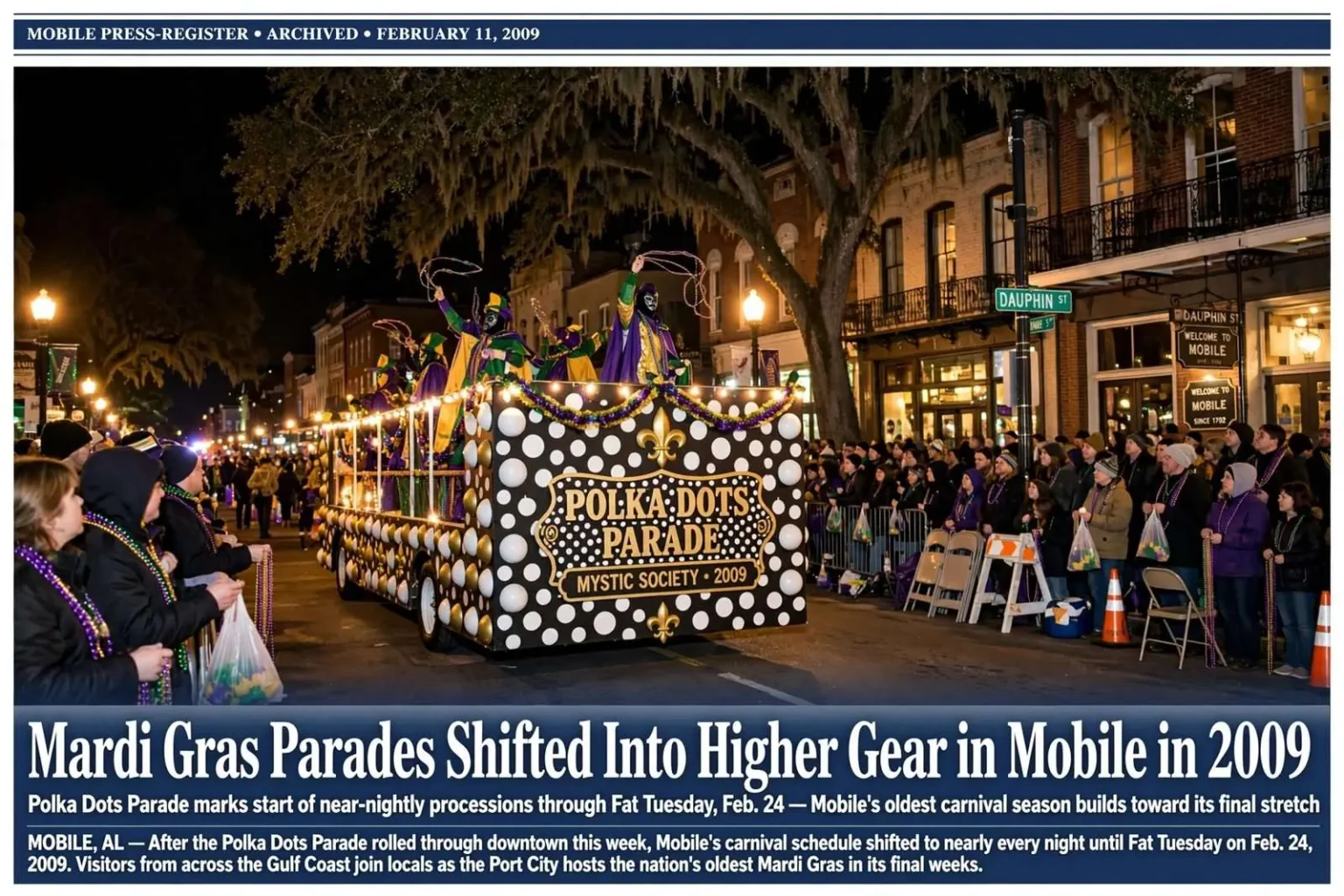
Historical report preserved from an archived 2009 local news story.
Mobile’s Mardi Gras season shifted into a near-nightly parade schedule in February 2009 after the Polka Dots Parade rolled through downtown, according to an archived local news report.
From then until Fat Tuesday — Feb. 24, 2009 — parades were scheduled almost every night in Mobile, filling the streets of the Port City with floats, marching bands and crowds in the season’s final weeks.
The report said visitors were already arriving from out of town to experience Mardi Gras in the Port City, joining local residents in the run of processions that makes Mobile’s carnival season the oldest in the nation.
This article records the 2009 parade-season update and is not a current event schedule.
The Season’s Final Stretch
Every Mardi Gras season has a rhythm, and by mid-February the tempo accelerates. The early weeks of Mobile’s carnival — which formally begins with events in November and builds through January — feature a smattering of parades and society balls spaced days apart. Then comes the stretch that locals wait for: the February run when parades stack up night after night, and the downtown routes fill on weekday evenings as well as weekends.
In 2009, the archived report marked that shift as having arrived with the Polka Dots Parade. Once that procession rolled through downtown, the report noted, the calendar became near-nightly, holding that pace until Fat Tuesday on Feb. 24. For residents, the stretch means a changed city — roads closed on parade nights, families camped along the routes with coolers and folding chairs, and the sound of bands and sirens carrying through the evenings.
The near-nightly schedule is the product of logistics as much as tradition. Mobile’s parade societies — mystic organizations that spend the year planning their processions — each reserve a date and a route, and the season’s final weeks pack them in because that is when crowds are largest and the countdown to Fat Tuesday builds. A city that hosts parades almost every night for weeks requires coordination among the societies, police, fire services and city crews that few other American cities ever attempt.
Mobile’s Mardi Gras, the Nation’s Oldest
Mobile’s claim to the oldest Mardi Gras celebration in the United States rests on its colonial history: the French founders of the city marked carnival in 1703, more than a century and a half before New Orleans existed. The organized tradition took root in the 19th century — the Cowbellion de Rakin Society was parading by the 1830s — and the modern era of mystic societies, secret orders with their own themes, throws and balls, grew from that stock.
Today’s season is the work of dozens of societies, whose processions and invitation-only balls fill a calendar that stretches from autumn social events to the February crescendo. Each parade is built around a theme revealed at the society’s ball, with masked riders distributing throws — beads, cups, MoonPies and other trinkets — to the crowds below. The floats themselves are works of craft, designed and constructed over months for a single night’s run down the route.
The 2009 season, like every season, drew its identity from that structure. When the archived report described the Polka Dots Parade as the event that tipped the calendar into near-nightly mode, it was describing a moment familiar to any Mobilian: the point where the season stops being occasional and becomes a way of life until Ash Wednesday.
Visitors Come to the Port City
The report’s note that visitors were already arriving from out of town reflects a pattern that repeats every year. Mobile’s Mardi Gras has grown into a regional draw, pulling crowds from across Alabama, the Gulf Coast and beyond — families who time visits to the parade schedule, former residents who return for the season, and travelers who come specifically to see the nation’s original carnival celebration.
Those visitors matter to the city’s economy during the season. Hotels, restaurants and downtown businesses see their busiest stretch of late winter during the parades, and the season’s near-nightly schedule gives travelers flexibility: with processions almost every evening in the final weeks, a visitor can plan a trip on short notice and still catch several parades.
The local welcome extends to the practical details that make carnival approachable for newcomers. Ladders and chairs line the routes for a reason — experienced families stake their spots early — and the unwritten rules of the season, from catching throws to the courtesy owed the marching bands, are passed along quickly to anyone standing nearby. A visitor who arrives knowing only that Mobile celebrates Mardi Gras finds, within one parade night, that the city’s version is built to be shared.
For the visitors, the experience differs from the postcard version of carnival. Mobile’s parades run through a compact downtown framed by historic buildings, with society balls — most closed to the public — continuing the celebration into the night. The crowd culture skews local and familial, with generations of the same households occupying the same stretches of route each year, and newcomers welcomed into the catch-and-throws tradition of the season.
February 2009, Night by Night
The 2009 season’s final stretch followed the shape described in the report: after the Polka Dots Parade, parades nearly every night until Fat Tuesday on Feb. 24. The finale of any Mobile season stacks its most anticipated processions into that last week — society after society taking the downtown route, each with its own theme, floats and throws, until the final day closes the celebration before Lent begins on Ash Wednesday. The last week carries a quality that regulars describe as its own kind of endurance test: workdays punctuated by parade nights, limited sleep, and a city that keeps celebrating anyway, because the season comes but once a year and Mobile has always treated it that way.
For residents, the near-nightly run imposes a familiar set of adjustments. Commuters learn the parade-night detours; families plan suppers around roll times; and the downtown blocks fill hours before the first float moves. Weather plays its perennial supporting role — February on the Gulf Coast can deliver mild evenings or cold rain, and the crowds dress for either.
The archived report’s snapshot of that week is a small piece of the season’s documentary record. Local coverage of individual parades — which society rolled, what the theme was, how the crowds ran — accumulates year over year into the history of a celebration that has repeated, with variations, for three centuries.
What It Takes to Stage a Near-Nightly Carnival
A parade calendar that runs almost nightly for weeks is one of the most logistically demanding things a mid-sized American city does. Each procession requires route setup, street closures and traffic control, police and fire presence, sanitation before and after, and the Float marshaling that assembles dozens of masked riders, drivers and marching units in the right order at the right hour.
The societies shoulder their share as well. A mystic society’s parade night represents a year of preparation — float design and construction, costume and throw purchasing, ball planning and the secret-keeping that defines the organizations. Riders spend the evening distributing throws by the armful, and a single society’s parade can put tens of thousands of beads into the hands of the crowd in a few hours.
City government, meanwhile, treats the season as a major civic operation. Mobile’s police and public works departments scale up for the parade calendar every year, and the relative smoothness of the near-nightly stretch is the product of planning that begins long before the first February procession rolls. The 2009 season ran on that same machinery.
Reading a 2009 Season Report Today
This article preserves what the archived 2009 local news report established: the Polka Dots Parade as the event that moved Mobile into its near-nightly schedule; parades almost every evening from that point until Fat Tuesday, Feb. 24, 2009; and out-of-town visitors already in the Port City to take in the season. Those specifics date the report precisely and anchor the 2009 season in the record of Mobile’s carnival history.
Readers should keep the article’s purpose in mind: this is a historical record, not a current schedule. Parade dates, routes and societies change from year to year, and anyone seeking information about a coming Mardi Gras season in Mobile should consult the city’s current parade calendars and the societies’ own announcements rather than this 2009 account.
What the 2009 snapshot preserves is the season’s shape and spirit: a city whose carnival begins in colonial history, builds through the winter, and reaches its near-nightly crescendo every February — when the Polka Dots roll, the calendar fills, the visitors arrive, and the Port City celebrates the oldest Mardi Gras in America, night after night, until Fat Tuesday ends the season and Lent begins.