Mobile Mayor to Revive Annexation Push as City Council Finishes Redistricting Fight
Mayor Sandy Stimpson's office plans to unveil a new annexation proposal for West Mobile next month, arriving just as the City Council works to finalize a contentious redistricting plan before an August deadline.
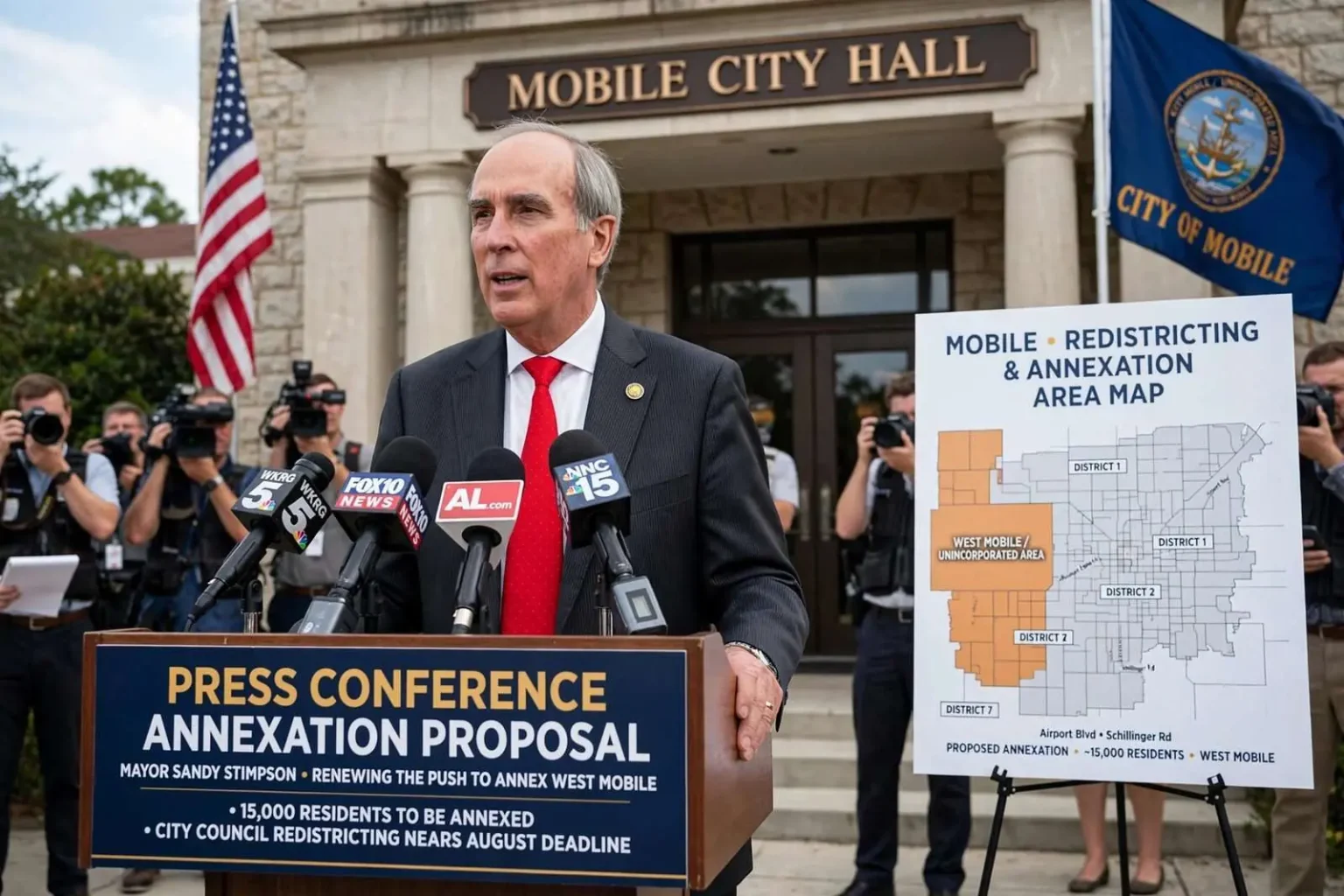
Mobile Mayor Sandy Stimpson’s office has told city officials it will introduce a new annexation proposal next month, reviving an effort to bring thousands of West Mobile residents into the city limits after a previous attempt stalled in the City Council.
The announcement lands at a delicate moment for city government. The Mobile City Council is simultaneously working to finish a court-required redistricting plan for its seven districts, a process that must be completed by August under state law. Any new annexation vote would add an estimated 15,000 residents to the city, a shift large enough to force yet another redistricting effort soon after the current one is finalized.
West Mobile, the unincorporated suburban corridor stretching along Airport Boulevard, Schillinger Road and the city’s western boundary, has long been the most fertile ground for annexation campaigns. Residents there receive police and fire response from the county and pay city taxes only when their property lies inside the limits, so the question of joining Mobile turns on service levels, taxation and identity rather than on any single issue.
How redistricting works
City redistricting happens every 10 years following the U.S. Census, when municipalities are required to redraw council district boundaries so that each district contains roughly the same number of residents. In Mobile, population has steadily shifted from the eastern part of the city toward the west, meaning the eastern districts must expand geographically to pick up more residents while some western districts must shrink.
The pattern is familiar across the Gulf Coast. Downtown and the older peninsular neighborhoods east of the Mobile River have lost population over recent decades, while subdivisions west of I-65 have added it. Every census cycle, that drift forces mapmakers to stretch the eastern districts across more territory and compress the western ones, redrawn line by line down to the census block.
The court-required element adds another layer. Redistricting plans in jurisdictions with a history covered by the federal courts are reviewed to ensure they protect the ability of minority voters to elect candidates of their choice, which is why Mobile’s plan went through a court process rather than a simple council vote.
The district-by-district arithmetic
Because a majority of Mobile’s population is Black, the current redistricting proposal would create three districts with large Black majorities, one with a large White majority, one with a small Black majority, one with a small White majority, and one district where Black voters outnumber White voters without holding an outright majority.
Much of the debate has centered on District 7, which is slated to become a Black-majority district under the new lines. Early drafts of the plan drew objections because Black residents did not hold a majority among voting-age citizens specifically, even though they made up a majority of the district’s total population.
The plan was subsequently revised to raise the voting-age Black population to 51 percent, along with a larger majority among Black residents of all ages. Some community activists have continued to push for that figure to be raised further, to 53 percent, arguing the higher threshold is needed to offset historically lower voter turnout among Black residents.
Citywide turnout in Mobile’s most recent municipal election was just 24 percent, a figure that has fueled debate among council members and community leaders over how much weight to give racial composition when turnout is low across the board regardless of district demographics.
Do districts decide outcomes?
City leaders have pointed to recent election results as evidence that candidates, rather than district racial makeup alone, often determine outcomes.
Stimpson, who is White, won more than 60 percent of the vote citywide in a city where Black residents are the majority. Council members Gina Gregory and Joel Daves each won by wide margins in districts that are roughly evenly split between Black and White voters.
Mobile’s history offers additional examples: Sam Jones was elected mayor when the city was majority White, and later lost re-election bids to Stimpson after the city had become majority Black.
Why annexation supporters say time matters
Supporters of annexation argue the city cannot afford further delay. Mobile lost out on an estimated $100 million in federal COVID-19 relief funding tied to population figures after its last annexation push was blocked, according to city estimates, and officials project that successfully annexing new residents would generate millions of additional dollars in tax revenue in the short term, with the potential for significantly more growth over time.
The arithmetic of federal relief made population the currency of the pandemic era. Cities that added residents before the census-based funding formulas were set captured larger shares of the money, while cities whose boundaries stayed fixed — or shrank — watched the per-capita allocations go elsewhere. For Mobile, the blocked annexation was not merely a lost chance at growth; it was, in the city’s own estimate, a nine-figure miss.
What annexation would mean on the ground
For the unincorporated neighborhoods involved, annexation is not an abstraction. Joining the city changes which police department answers a call, which fire station is nearest, how streets are maintained, and which municipal taxes appear on a bill. It also changes who can serve the area with sewer and water extensions and how quickly paving requests reach a governing body.
Annexation in Alabama proceeds by a handful of established routes — referendum, petition of a percentage of property owners, or legislative act — and each has a different political signature. A referendum lets every affected voter speak; a petition route moves faster but concentrates the decision in fewer hands; legislative annexations depend on the local delegation. Whichever path the renewed proposal takes, the council’s posture — not just the mayor’s — will determine whether it clears the finish line this time.
The city’s earlier annexation effort stalled in the council precisely because those mechanics became political: members weighed which neighborhoods would come in, what the additions would do to district populations, and how services would be paid for. The new proposal arrives with that history visible to everyone involved.
The opponents’ case, and the rebuttal
Opponents of a new annexation vote have pointed to Mobile’s overall population decline as a reason to hold off, arguing the city should stabilize its existing population before adding new residents through annexation.
Proponents counter that the net effect of annexation would still be positive: while an estimated 2,800 residents have expressed interest in leaving the city through other boundary adjustments, roughly 15,000 potential new residents in unincorporated areas have shown interest in joining it, an overall gain of more than 12,000 people.
Most of the new residents would be White, but the city would remain majority Black under the change.
The fiscal stakes in detail
The federal relief miss illustrates how population converts directly into money. Per-capita funding formulas distribute dollars by head count within municipal boundaries, so a city that stays put while its neighbors grow effectively transfers its share of national funding to them. City officials’ $100 million estimate for the blocked annexation is a measure of exactly that arithmetic — not new taxes raised, but federal dollars that a larger head count would have captured.
The projected revenue gains from annexation itself work differently. New residents bring property taxes, sales taxes on their spending, and utility fees, while also bringing service costs. Proponents argue the annexation areas skew residential-affluent — West Mobile’s subdivisions — so the ratio of revenue to required new services favors the city; skeptics note that fire stations, paving and patrols do not extend themselves for free.
What both sides share is the premise that Mobile’s trajectory matters. A city that grows its population keeps its congressional and state representation, its eligibility for federal programs, and its argument for regional investment. A city that shrinks watches each of those recalculate downward.
A councilman’s argument about consistency
City Councilman William Carroll, whose District 2 has seen population losses in recent years, has previously noted that the same logic used against annexation is not applied within the council’s own district boundaries; districts that lose residents are not shrunk or eliminated but are instead redrawn to bring in new territory during redistricting.
Carroll’s point cuts at the philosophical core of the opposition: if declining numbers are not disqualifying for a council district — which the city routinely renews by extending its boundaries around it — then declining numbers should not be disqualifying for the city itself.
What comes next
With the council’s redistricting deadline set for August, city officials have said it would be difficult, and likely unwise, to attempt to schedule an annexation referendum before the new district lines are finalized.
That means any renewed annexation push is likely to unfold over the coming months as a separate process, even as council members continue to work through the redistricting plan. The mayor’s office, having watched one proposal stall, is betting that a second attempt — introduced with the redistricting fight freshly settled — will find a council more willing to act.
For West Mobile’s unincorporated neighborhoods, the practical stakes are concrete: city police and fire service, city sanitation, city streets, and city taxes. For the city itself, the stakes are revenue, federal funding formulas, and a chance to reverse a long population slide. Both sides agree on one thing: the next few months will decide whether the question is settled or stalls again.