Mobile Mayor Weighs New Options for Civic Center Site as Residents, Council Push Back
Mobile Mayor Sandy Stimpson's administration is reviewing new options for the Civic Center property that would renovate the aging arena rather than demolish it, after pushback over earlier redevelopment plans that omitted an event space.
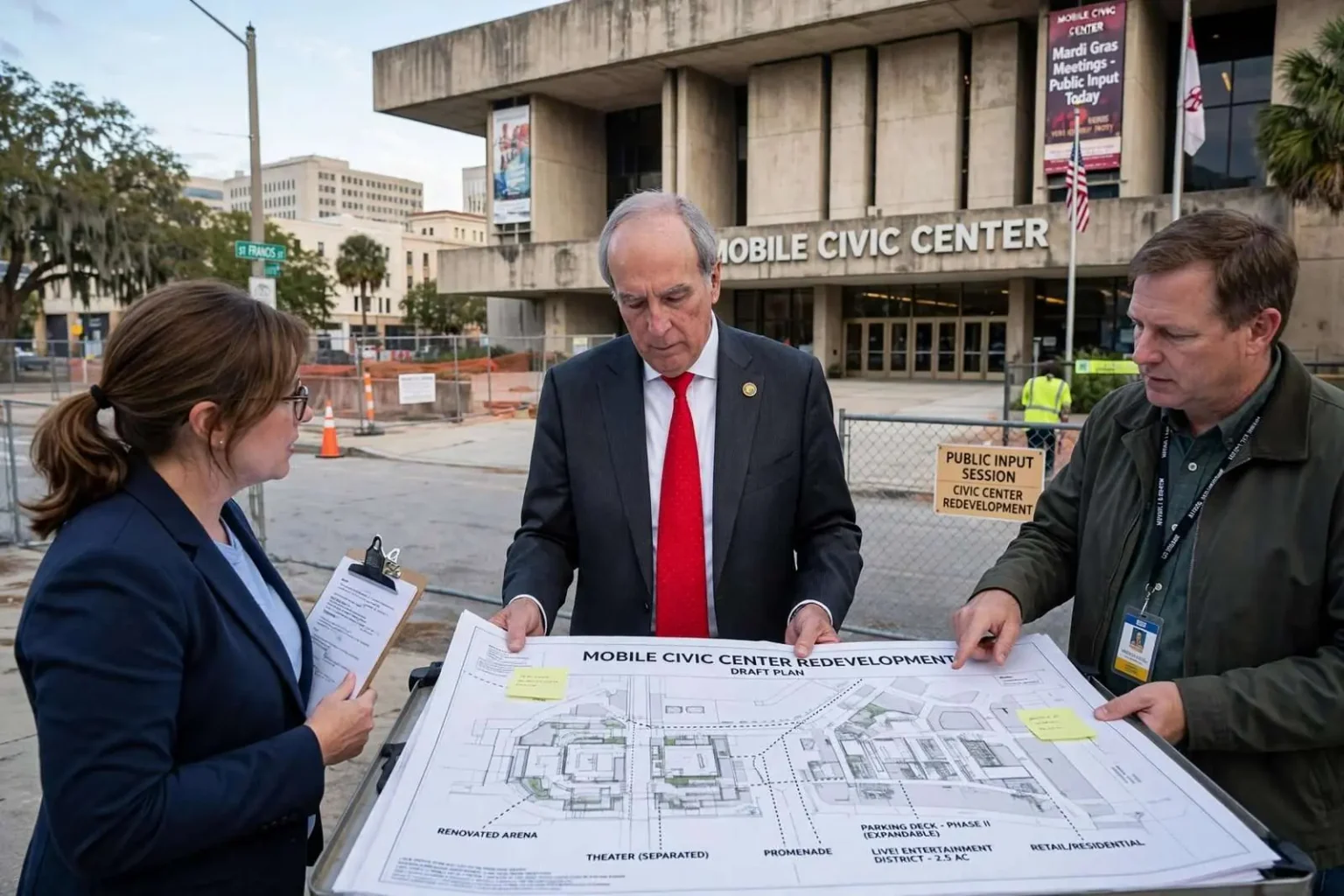
Mobile Mayor Sandy Stimpson’s administration is exploring a revised set of options for redeveloping the property that houses the aging Mobile Civic Center, as city officials respond to criticism over earlier proposals that left out an arena or event space. The new concepts, developed internally by the city, would allow for renovation of the decades-old facility rather than its demolition — a fundamental shift in a debate that has been defined, for months, by the question of what happens to the arena at the center of it.
City representatives presented the updated plans to members of the Mobile City Council during a closed-door executive session, then met later the same day with leaders from the Church Street East neighborhood, the Mobile Area Mardi Gras Association and downtown restaurant owners to walk through the concepts and gather feedback. The pairing of a confidential council briefing with an immediate neighborhood outreach session reflected the administration’s effort to answer the two critiques that had dogged the project: too little public detail, and too little room in the plan for the institutions that depend on the Civic Center.
Beyond renovating the arena, the plans carve out a smaller footprint that could still be offered to Cordish Companies for its open-air Live! entertainment district concept, while preserving space for retail and residential development that a private partner could build out separately. A parking deck is also part of the framework, one designed with room to expand if the city eventually needs to accommodate passenger traffic from a larger cruise ship or a second ship docking downtown.
Stimpson pointed to the existing deck at the Mobile, Alabama Cruise Terminal as a cautionary example, saying the city built it too small the first time. “The existing parking deck should’ve been another floor higher,” Stimpson said. “Let’s not do something that’s going to hamstring us in the future because parking decks can pretty much pay for themselves. So what we’re more interested in is not hamstringing ourselves in the future because if any of this stuff works down here you would use the parking for that.”
The mayor’s parking arithmetic captures the broader philosophy behind the revision: build for the demand the downtown might realistically generate, not just the demand a first-phase project requires. A deck sized only for the entertainment district would be full on event nights and empty otherwise; one sized for cruise passengers, Mardi Gras crowds and district visitors together could serve them all — and generate the revenue that makes public infrastructure pay its own way.
What the New Framework Changes
The new framework would also separate the civic center’s theater from the arena and add a promenade intended to physically connect the property to other parts of downtown Mobile, according to Stimpson. The promenade concept responds to a long-standing complaint about the Civic Center block — that its fortress-like layout turns its back on the surrounding streets, deadening the edges of downtown rather than feeding them. Connecting the site to the streets around it — and to the businesses that line them — is the same logic that has driven downtown revitalization across the country: districts live on foot traffic, and foot traffic follows routes people actually want to walk.
City officials have not settled on a total price tag for the project, and Stimpson said any work would likely happen in phases. The sequencing of those phases depends heavily on whether Cordish Companies remains interested in a scaled-down version of the Live! concept it originally pitched to the council. If that partnership does not come together, Stimpson said the city would start by renovating the arena on its own — a fallback that puts the city, rather than a developer, in the position of first mover on the site.
Cordish has not yet told the city how much public investment it would expect for the larger version of its Live! concept, though members of the mayor’s administration reportedly anticipate the figure will be substantial. City spokesperson George Talbot said Mobile expects to contribute the 22-acre Civic Center parcel itself as the bulk of its investment in any partnership with Cordish, with negotiations between the two sides still ongoing. As of the briefings this week, Cordish had not yet been informed of the city’s newest internal plan.
That sequencing — the city developing options internally before showing its lead development partner — marks a notable shift in posture. Earlier rounds of the debate had put the developer’s concept at the center of the public conversation, with the city responding to renderings it did not fully control. The revised approach inverts that: the administration now holds its own plan, with the Cordish partnership positioned as one component within it rather than the organizing vision for the entire site.
The proposal also leaves room for additional development if the Alabama Department of Transportation moves forward with reconfiguring how drivers access the George C. Wallace Tunnel. Should that project free up additional land near the site, Stimpson said it could be used for hotels or other buildings meant to capitalize on downtown tourism and help offset the cost of renovating the Civic Center. The connection between a state highway project and a municipal redevelopment may seem indirect, but in a downtown constrained by water on three sides and interstate rights-of-way on the fourth, every acre of newly available land changes what is financially possible.
The theater separation carries its own significance. The Civic Center’s theater has hosted Broadway tours, symphony performances and graduations that do not require an arena’s scale, and keeping it operating — independent of whatever happens to the arena and the surrounding blocks — preserves the booking calendar and the audiences that downtown restaurants depend on midweek. Mardi Gras organizations, which filled the mayor’s afternoon briefing, have their own stake in what survives the redevelopment: the venue’s halls host Carnival-season events whose traditions predate every current proposal for the block.
The latest proposal marks just the newest twist in a redevelopment debate that has stretched on for more than four years. Most recently, the city had narrowed its list of potential developers down to a single finalist after a group led by Louisiana-based Stirling Properties withdrew from consideration. That group had been the only one among the finalists to include a stand-alone event center in its proposal — a detail that became more significant as criticism mounted over the remaining plan’s absence of one.
The mayor’s office has faced sustained criticism from residents and council members since it first emerged that the Cordish-led plans, at least in their initial phases, did not include either an arena or a dedicated event center for the site. For a city whose Carnival balls, concerts, graduations and boat shows depend on the existing complex, the prospect of losing that capacity without a replacement was the point around which opposition organized — from neighborhood associations to the council members whose districts supply most of the venue’s audiences.
The internal reworking answers that criticism in structure, if not yet in detail. By holding open the option of renovation, the city has preserved the possibility that the arena and its event calendar survive the redevelopment intact. By separating the theater, carving out a smaller Cordish footprint and leaving retail and residential parcels for other partners, the plan converts a single-developer megaproject into something closer to a phased district plan — one the city can advance piece by piece, with or without any individual partner.
The risks remain real. Renovation of a decades-old arena is not cheap, and deferring decisions on the surrounding parcels can stretch timelines that downtown businesses have already watched slide for years. The Cordish negotiation, meanwhile, continues with no public figure for the public investment the larger concept would require, and the council — briefed in executive session rather than sold a finished plan — will have to decide how much flexibility to grant an administration whose earlier approach it has already criticized.
What the revision does establish is a floor. Whatever happens with Cordish, the parking deck is planned with expansion in mind, the promenade concept is on the table, and the arena renovation is the city’s stated fallback rather than a last resort. Four years into the debate, Mobile’s Civic Center question has moved from “should the site be redeveloped” to “in what order, at what cost, and with whom” — a narrower set of questions, and ones that a city council and a watching public are now better positioned to answer.
For the neighborhood leaders, Mardi Gras organizations and restaurant owners who walked through the concepts the same day the council did, the plan’s fate now rests on details yet to come: the price tag, the phasing, and the final answer to the question that started the backlash — what happens to the arena. The administration’s newest proposal does not answer that question completely. But it finally, explicitly, leaves it open.