Mobile Ministry Pivots From Mexico Mission Trips to Getting Seniors Vaccinated
Hands and Feet Ministries shifted from Mexico mission trips to booking vaccine appointments for Mobile seniors, saving hundreds of doses from being.
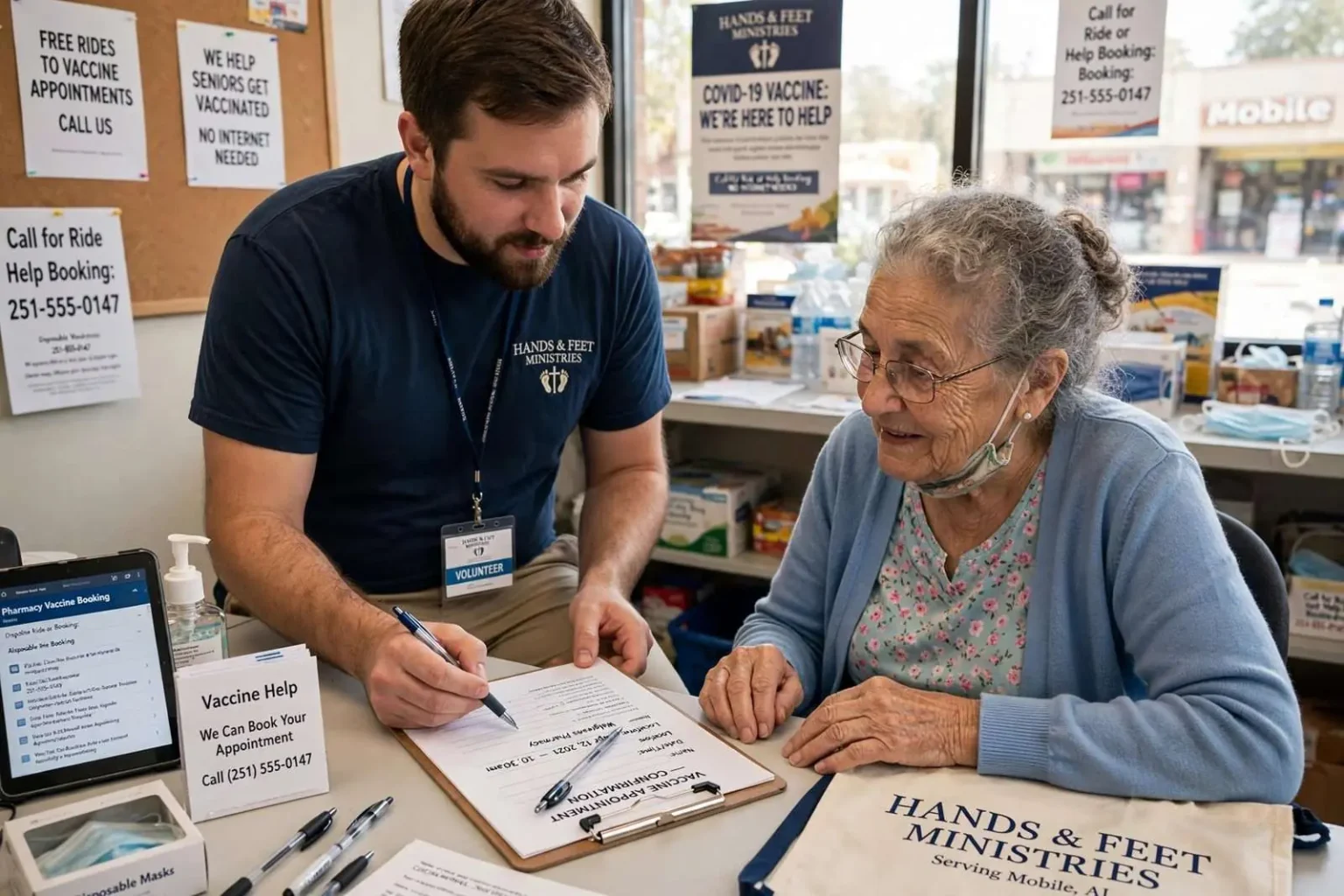
When the pandemic shut down its overseas work, a Mobile ministry did not wait for conditions to return to normal. It found a new job to do at home: getting older residents through the COVID-19 vaccine process.
Before the virus, Hands and Feet Ministries traveled to parts of Mexico to help under-resourced communities launch small businesses. With that work stalled, the organization turned its attention to needs in its own community. “When we saw that this vaccine rollout was coming, we were able to locate some needs in the distribution of it,” said Zach Brining, executive director of Hands and Feet Ministries.
The pivot reflects a pattern that played out across the country during the rollout. Organizations built for one kind of service discovered that the pandemic had opened others, and the groups that adapted fastest were often small ones — close enough to the people they serve to see problems forming before they reached official attention.
A vaccine line that started it
The idea took shape after Brining brought an older family member to a vaccine event and found elderly people standing in line for hours. He said the setup did not look workable for people that age, and he and his relative ultimately had to leave because neither could stand in line that long.
The scene stuck with him. Vaccine events in the early months of the rollout drew enormous crowds, with demand far outpacing supply, and the first-come, first-served lines that resulted were hard on the very people the vaccine was meant to protect first. Older adults — the group facing the highest risk of severe illness — often had the hardest time with long waits on their feet, in the cold or the heat, with no guarantee of a dose at the end of it.
Not long after, large pharmacy chains began taking appointments for eligible groups. That opened a role the ministry could fill: helping seniors navigate the booking process and then physically get to their appointments.
The booking systems that emerged were, for the most part, online. Seniors without computers, smartphones or fast internet connections found themselves at a disadvantage from the start, and even those with access faced appointment windows that opened and closed in minutes as sites filled. Family members scrambled to book slots for parents and grandparents; those without someone to help often gave up.
Catching doses before they expired
The work expanded into a partnership with pharmacies to solve a second problem. When opened vaccine vials were close to expiring, unused doses risked being discarded. “That kind of went into being a partner with these pharmacies to set up lists, when the vaccine was about to go bad, to call people that were not yet eligible,” Brining said.
By the ministry’s count, the effort had helped roughly 80 to 90 people secure vaccine appointments and had helped keep hundreds of doses from being thrown out.
The saved doses represented a small but meaningful piece of a nationwide challenge. Multidose vials had to be used within hours of being opened, and pharmacies — juggling no-shows, cancellations and unpredictable demand — regularly faced the choice of discarding remaining doses or finding arms to put them in. Lists of willing recipients, kept warm by organizations like Hands and Feet, turned potential waste into protection.
Calling people who were not yet eligible also required judgment and trust. Eligibility rules in the early rollout were layered by age, occupation and health condition, and they changed as supply grew. An organization that kept a list of seniors willing to come on short notice could match leftover doses with people who had spent weeks trying to book a slot anywhere.
Broader than seniors
As eligibility widened, so did the group the ministry serves. Beyond senior citizens, volunteers began assisting residents with limited computer access and others who ran into obstacles with online-only appointment systems.
The shift left the organization doing work its leaders never imagined when the pandemic began — and work that looked, in some ways, like an extension of what it had always done overseas. Helping a community launch something it needs, whether a small business or a path through a public health crisis, is a short description of both halves of the ministry’s recent history.
The population the ministry found itself helping was broader than the headlines suggested. Alongside seniors were adults with disabilities that made typing or navigating websites difficult, workers on schedules that never aligned with appointment releases, and residents who simply did not trust automated systems with something as important as a health appointment. Each needed a person on the other end of the line.
Faith organizations in the pandemic response
Hands and Feet Ministries is part of a long tradition in Mobile, where congregations and faith-based nonprofits have historically filled gaps that government programs and market services miss. During the pandemic, churches across the area distributed food, ran testing sites and organized volunteers, and the vaccine rollout became another chapter in that role.
Trust was a central part of the work. Vaccine hesitancy ran through every demographic group, and questions about safety and side effects were often voiced first to people the asker already knew. Volunteers from community organizations found themselves answering questions that a website never could, and the personal relationships that ministries bring made those conversations possible.
The logistics mattered just as much. Getting to an appointment could mean a drive across town, a wait in line and paperwork that assumed comfortable familiarity with forms and insurance cards. Volunteers who offered rides, sat with people in line and helped fill out forms removed the small barriers that kept many older residents from following through.
What the rollout revealed
The ministry’s experience highlights lessons that public health officials have drawn from the rollout nationwide. The systems that worked on paper — online scheduling, large-scale events, first-come eligibility — worked best for people with time, technology and transportation, and worst for those without. Communities that paired official distribution with local organizations reached further than those that relied on one or the other.
The digital divide was among the most consistent findings. Households without reliable internet access lagged in every service that moved online during the pandemic, from schooling to unemployment claims to vaccine appointments, and seniors were overrepresented in that group. Organizations that kept phone lines open and offered in-person help became the bridge.
For Hands and Feet Ministries, the work also changed the organization itself. A staff and volunteer corps assembled for international trips learned the geography of local vaccine distribution, built relationships with pharmacy staff and developed a list-keeping operation that would have been unrecognizable a year earlier. Those relationships and skills remain part of the organization’s toolkit as it looks toward resuming and reshaping its other programs.
The ministry’s count — roughly 80 to 90 people helped into appointments and hundreds of doses saved from the trash — measures the effort in the most concrete terms available. Behind each number is an older resident who did not have to stand in line for hours, and a dose that ended up doing what it was made to do.
The ministry’s original mission remains part of its identity. The Mexico trips that paused with the pandemic were built around a different model than short-term service projects: rather than dropping in to complete a single task, the organization worked alongside under-resourced communities to help residents start and sustain small businesses of their own. That longer-horizon approach, leaders have said, is what they hope to return to when travel conditions allow.
In the meantime, the local work gave the organization a way to keep its volunteers engaged. Service organizations live on the habits of their volunteers, and a year without a project to join tends to drain them. A mission that required only a phone, a list and a willing driver could be carried out one household at a time, at whatever pace volunteers could manage.
The work also brought the ministry into contact with parts of Mobile it might not otherwise have reached. The seniors on the other end of those calls lived in every corner of the city, in neighborhoods and circumstances as varied as the city itself, and each call was a reminder of how uneven access to health care can be even within a single county.
Public health planners have taken note of models like these. The rollout showed that “last mile” problems — reaching people who are eligible, willing and overlooked by the systems built for everyone else — are best solved by organizations that already have their trust. Cities that funded and coordinated with community groups got doses into arms faster than cities that did not.
As the acute phase of the pandemic receded, the ministry’s vaccine work wound down along with the crisis that created it. The eligibility lists shortened, the calls slowed and pharmacies shifted from scarcity to surplus. What remains is the lesson the organization learned in its unexpected season: that a mission does not stop at the city limits, and that the same instinct that sends volunteers across a border can put them on the phone with a neighbor who needs a ride to an appointment.
For the seniors who were helped, the outcome was measured in ordinary terms — an appointment kept, a card updated, a family’s worry eased. For the ministry, it was proof that its calling travels well, even when travel itself is off the table.