Mobile Mother Credits Dumas Wesley Program for Fresh Start, New Home
Mobile native Crystal Roberts credits the Dumas Wesley Sybil H. Smith Family Village transitional housing program with turning her life around and helping her buy a new home.
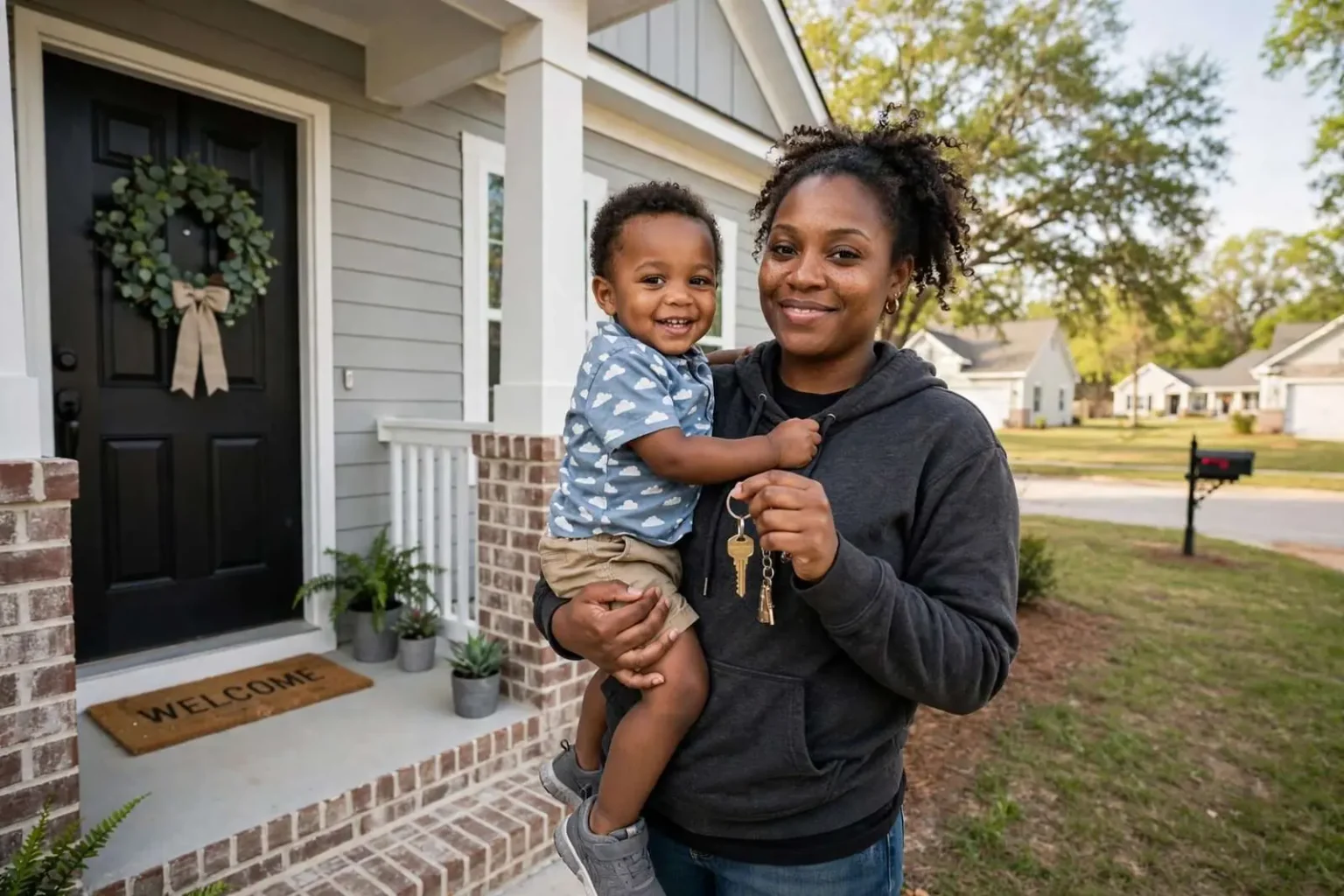
MOBILE, Ala. — The Dumas Wesley Community Center is creating space for women and their children in the Mobile area, helping give them a fresh start on life. For more than a century the center has worked in the neighborhoods north of downtown, and its transitional housing program has become one of the quiet engines of second chances in the city — a place where a woman with nothing but a duffel bag and a decision can rebuild, step by measured step, into something like stability. The story of one recent graduate shows what that work looks like from the inside.
Crystal Roberts, a single mom and Mobile native, has seen her share of ups and downs. She said the last few years have been quite a journey. “Getting divorced was kind of when my homeless journey started. I kind of bounced around from friend to friend, couch to couch. I finally met my current son’s father and we kind of ran off,” Roberts said. The pattern she describes — the slow slide from a settled life into sleeping wherever someone will have you — is one social workers in Mobile see constantly, and it rarely announces itself as homelessness until it has already become one.
While homeless, Roberts said, she never knew what the next day would bring. “There were some very difficult times,” Roberts said. “And then my entire life changed when I found out I was pregnant. Immediately got clean and sober. Then right around then, everything seemed great. Until my third trimester, when my whole world crashed, and I realized the rose colored glasses came off. And I realized he wasn’t the person that he claimed to be.” What had looked like a fresh start collapsed in the final weeks of her pregnancy, leaving her with a child on the way and nowhere of her own to bring him home to.
Finding the Sybil H. Smith Family Village
After leaving that relationship, Roberts moved to Mobile and learned about the Dumas Wesley Sybil H. Smith Family Village, a two-year transitional women’s housing program that helps put women on the path to a better life by equipping them with real-world skills. She began her journey with the program in the spring of 2023. The Family Village model is deliberately structured — not an emergency shelter that moves families through in weeks, but a two-year program built around the understanding that getting out of homelessness permanently takes time, savings, steady employment and habits that only form under sustained support.
“Left with what I could carry,” Roberts said. “I had no clue where I was going to go. I mean, this is where he’s from. So everything around this area, like, he knows. So it was like, how am I going to survive without him looming over my shoulder.” For women leaving controlling or unsafe relationships, the practical geography of a new start matters as much as the emotional one — knowing which streets belong to the past, and finding a place that offers both shelter and breathing room.
Roberts said she was hesitant at first but eventually took full advantage of what Dumas Wesley had to offer, including the structure of regular inspections. “I’ve never been a clean person,” Roberts said. “Like keeping a house clean has never been my forte. But being here where you have inspections and you have, hey, we got to keep it clean. Hey, but there’s reasons for it.” The structure she once bristled at became, in her telling, part of the transformation — the small disciplines of a maintained home building toward the larger disciplines of a maintained life.
The two-year window is designed to coincide with the real timelines of rebuilding. In two years a resident can hold a job long enough to build a rental history, pay down debt, save a deposit, and — for mothers like Roberts — watch an infant become a toddler in a home that stays put. Program staff work with each woman on budgeting, employment, parenting and the paperwork of independence, with the explicit goal that graduation means a household that can sustain itself without the center’s help.
The path into the Family Village usually begins the way Roberts’ did — with a referral, a phone call and a waiting list. Social service agencies across Mobile County coordinate with the center to identify women who are ready for a structured program: not in immediate crisis, but genuinely motivated to spend two years building toward independence. The intake process assesses each applicant’s situation, from employment history to childcare needs, and sets individual goals from the first week. Residents live in their own units with their children, which means the program works on family life as a whole rather than separating a mother from the very people she is rebuilding for.
Regular inspections, budget reviews and progress meetings give the program its spine. To an outsider the rules can look strict, and Roberts admits she balked at first. But the structure mirrors what independent life will demand — landlords, lenders and employers all run their own inspections of a sort — and graduates consistently describe the discipline as the part of the program that aged best. By the time a resident faces a real lease or a real mortgage, the habits are already in place.
The center’s longer history in Mobile gives the housing program its foundation. Community centers like Dumas Wesley grew out of the settlement house movement of the early twentieth century, placing social services directly in the neighborhoods that needed them, and the center’s continuity in the same part of the city has made it a trusted institution across generations of Mobile families. Mothers who came to the center as children now send their own children there, and that deep local trust is part of what allows a women’s housing program to succeed where a parachute operation from outside the neighborhood might struggle.
A new milestone
Roberts said the program changed her life’s direction. After completing it, she reached another milestone with the help of Dumas Wesley. “April of 26 I unlocked a brand new house,” Roberts said. “Blows my mind still to this day that me and my kid are living in a newly built, brand new house.” The moment of turning a key in a door that belongs to you — for a mother who once did not know where the next night’s bed would be — is the outcome the entire program is built to produce, and it arrived for Roberts on the schedule the program promises: a fresh start measured not in weeks but in years.
She credits her own hard work but, most importantly, Dumas Wesley for her success. “My entire life changed for the better,” Roberts said. “I can’t even. I could write a novel on the amount of things that has changed and helped. I’ve got my confidence back. I’m a single mom working two jobs and just bought a house.” The résumé she describes — two jobs, a mortgage or lease in her own name, a healthy child — is the arithmetic of a life rebuilt, and she is the first to say it was earned rather than given.
Her story also illustrates what the center means for the wider city. Mobile has a persistent shortage of transitional housing beds relative to the number of families moving through homelessness, and programs like the Sybil H. Smith Family Village occupy a critical middle ground between emergency shelter and permanent housing. Without that middle ground, families cycle from couches to shelters and back again; with it, they get the runway needed to make the changes that stick. Roberts’ two-year arc — from a third-trimester crisis to the keys of a brand-new house — is exactly the trajectory the model is designed to make possible.
The Dumas Wesley Community Center’s work extends beyond housing into the life of its Crichton-area neighborhood, where the center has operated for generations, offering senior activities, children’s programs and social services alongside the residential program. That breadth is deliberate: a mother like Roberts does not rebuild in isolation, but inside a community that has places for her children to learn and play while she works and saves.
For the women now beginning their own journeys at the Family Village — arriving, as Roberts did, with what they can carry and no idea what comes next — her milestone stands as the program’s answer to the question every new resident quietly asks: does this actually work? “My entire life changed for the better,” Roberts said. The center’s staff would add that it changed because she did the work, one inspection, one paycheck, one savings deposit at a time, until the day in April when she unlocked a brand new house of her own.