
Mobile Mourners Turn Fallen Officer’s Patrol Car Into a Makeshift Memorial
Flowers, cards and prayers gathered on Officer Sean Tuder's Mobile patrol car as the community mourned the fallen officer before his funeral.
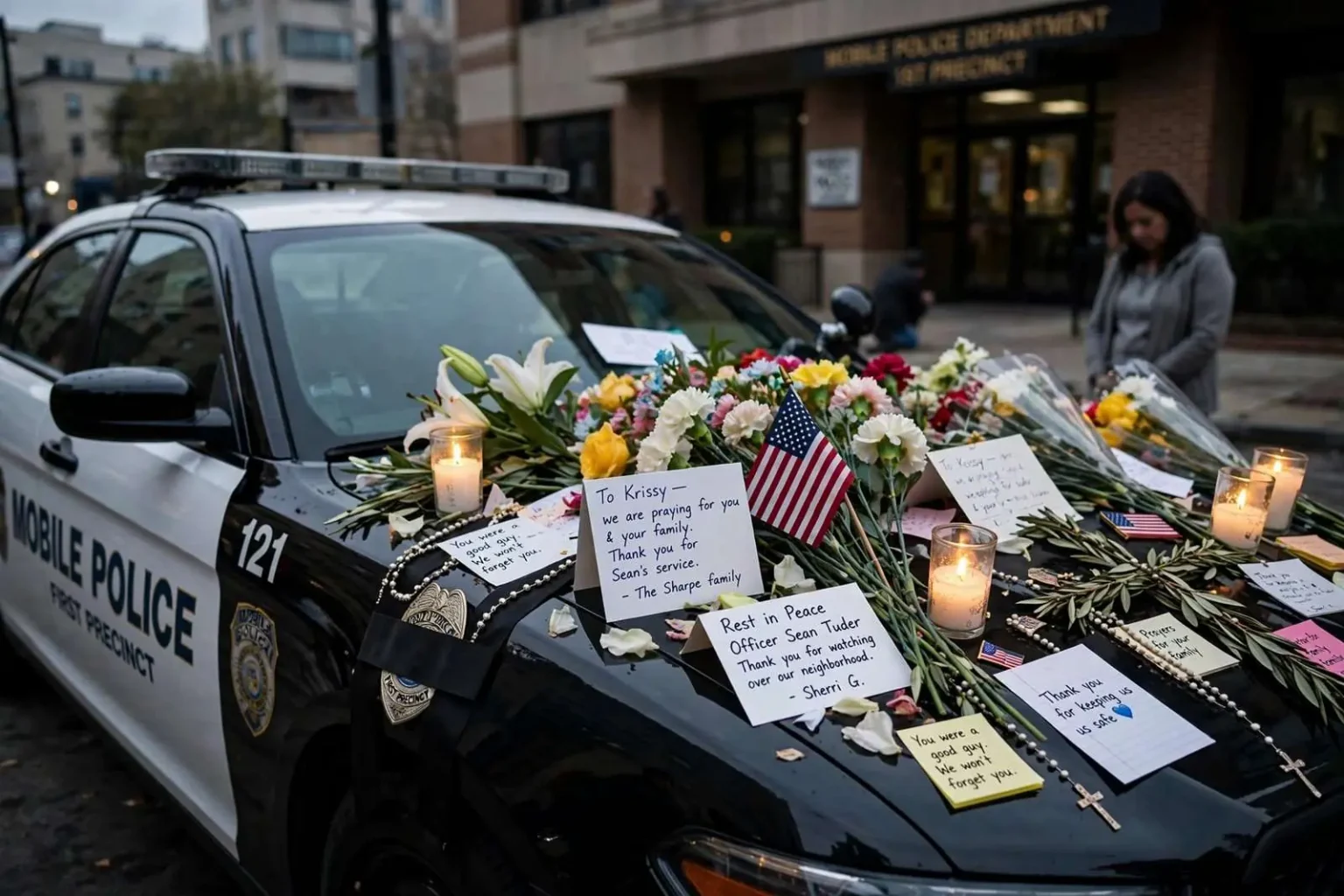
In the days before Officer Sean Tuder’s funeral, mourners in Mobile found a quiet way to say goodbye: they gathered at his patrol car and left pieces of their grief on its hood. Some left flowers. Others placed a card addressed to Tuder’s wife, Krissy. A few simply knelt beside the vehicle in prayer.
The patrol car, parked in the city, became the focal point for a community that wanted to reach the family but had no other way to do it. In the tradition that follows line-of-duty deaths across American law enforcement, the vehicle itself — the cruiser an officer rode in every shift — becomes a memorial site, a place where flowers, cards, candles and flags accumulate until the funeral procession carries the grief away.
The tributes reflected how deeply the officer’s death had reached into the neighborhoods he served. Visitors came at all hours, some alone, some in families, pausing at the car on their way through their day. For a department and a city still absorbing the news, the memorial offered something to do with sorrow that otherwise had no outlet.
The neighbors who knew him
Lana Sharpe said her heart ached for Tuder’s wife and family. “He’s out trying to keep us safe,” she said, “and I just hate it happened.” Her words captured the feeling shared by so many who stopped at the patrol car — the sense that the loss was not an abstraction on the news but a personal wound to a neighborhood that recognized the officer and the risk he carried for them.
Sherri Graham remembered Tuder from a night she dialed 911 while he was working in the city’s first precinct — he was the officer who answered her call. “He was a good guy,” Graham said. “Very quiet, but he listened to the community and I’m proud to be in the precinct where he was a member of our law enforcement team.”
Graham’s recollection points to the role community policing plays in the neighborhoods Mobile’s first precinct covers. Officers who answer calls in the same territory shift after shift become familiar faces — the ones residents greet by name at the grocery store, the ones children recognize on the street. That familiarity is why an officer’s death hits differently inside the precinct he served than it does across the rest of the city, and why the mourners at the patrol car were not only strangers but people whose 911 calls he had answered.
A city and a department in mourning
The patrol-car memorial stood as a small but visible sign of a community processing the loss of one of its own officers, ahead of a funeral service expected to draw fellow officers and residents from across the city. Line-of-duty funerals in Mobile bring out formations of patrol cars, honor guards and officers from neighboring agencies across Mobile County and the Gulf Coast, and residents line the routes to watch the procession pass.
For the Mobile Police Department, the days before a funeral are among the hardest a force endures. Officers balance their own grief with the duty of honoring a fallen colleague — standing honor guard, coordinating logistics, supporting the family — while continuing to answer the calls Tuder would no longer take. Chaplains and peer-support networks become part of the daily routine, and the department’s leadership must steady a workforce that has lost one of its own in the line of duty.
What the memorial means
Memorials like the one at Tuder’s patrol car serve a purpose beyond sentiment. They mark the spot where a community and its police meet in their most human moment, and they send a message to the department that its losses are shared. In neighborhoods where relations between residents and officers can be strained by the daily frictions of urban policing, the sight of civilians kneeling beside a patrol car in prayer is a reminder that the bond is real — tested, but real.
The flowers and cards left on the hood also become part of the record. Departments photograph and often preserve tributes from line-of-duty memorials, and the items left by residents frequently make their way to the family after the funeral. For Tuder’s wife, Krissy, the volume of tributes will stand as evidence of how widely her husband’s service was felt.
Grief of this kind ripples outward through the police family in ways the public rarely sees. Officers who worked alongside Tuder, trained with him, or shared a shift at the first precinct carry the loss into every call they answer afterward. Across the city, the knowledge that one of Mobile’s own will not finish his watch changes the texture of every roll call, every radio transmission, every stop along the routes he used to patrol.
The first precinct and the streets he served
Tuder worked in Mobile’s first precinct, the patrol division that covers a broad stretch of the city north of downtown — neighborhoods where the department’s community-policing approach depends on officers building the kind of trust Graham described. In those districts, an officer’s reputation travels quickly: residents know which officers listen, which ones follow up, and which ones treat a late-night 911 call with the seriousness it deserves. The tributes from people who had interacted with Tuder on exactly those terms say more about his service than any citation could.
Community policing has been a cornerstone of Mobile’s approach in its precincts, pairing patrol officers with the neighborhoods they serve so that problems get solved before they become emergencies. Officers embedded in that system pay a price when it works — they become known, and in moments of danger, being known to the whole neighborhood does not protect them. But the payoff is what the memorial showed: a community that feels the loss as its own.
The funeral ahead
The service expected in the coming days will draw officers from across the region, as Gulf Coast departments routinely send delegations to honor a fallen colleague. The procession, the rows of uniforms, the flag-folded presentation to the widow — these are the rituals that close a line-of-duty loss, and they serve the living as much as they honor the dead: a public accounting that the sacrifice is seen.
After the funeral, the department and the city will carry the loss in more durable ways. Tuder’s name will join the roll of officers who died serving Mobile, a list the department and city remember each year. His precinct colleagues will return to patrol with the memory fresh, and the neighborhoods he served will get to know the officers who follow him — measuring them, fairly or not, against the quiet officer who listened.
For now, the patrol car still stands where mourners can reach it, its hood gathering flowers, cards and the small offerings of a grieving city. When the last of the tributes is carried away and the funeral procession has passed, what remains is the same thing that drew people to the car in the first place: a community’s recognition that keeping it safe is a task performed by people — husbands, sons, neighbors — and that Mobile has lost one of them.
How cities honor their fallen officers
The makeshift memorial at Tuder’s patrol car belongs to a tradition that stretches back generations in American policing. When an officer falls, departments across the country drape a black band over the badge of every remaining officer, and the fallen officer’s own cruiser often becomes a community shrine — parked at the precinct or station, its hood soon covered with mementos. In smaller neighborhoods the cruiser may remain at the spot where the officer’s watch ended, and the surrounding blocks take on the quiet role of caretaker.
Mobile has followed those customs in past line-of-duty losses, and residents know the script: the procession of emergency vehicles with lights on, the overpasses lined with fire trucks holding flags, the rows of squad cars from counties away. These rituals matter because a line-of-duty death is one of the few events that unites a whole city — police, firefighters, city hall and neighborhoods — in a single moment of acknowledgment.
The support shown to surviving families extends well beyond the funeral week as well. Police foundations and benefit funds across the Gulf Coast exist in large part to support the spouses and children of officers killed on duty, and the cards addressed to Krissy Tuder left on the patrol car will be matched by organized support in the months and years that follow.
What residents can do
In the days around the funeral, residents who wish to pay respects have simple options: visit the memorial, line the procession route as it passes, or simply offer the family privacy as they grieve. Departments generally ask the public to keep roadways clear during processions and to follow the guidance of officers directing traffic along the route.
Afterward, the best tribute to an officer like Tuder — the kind Graham remembered, who listened — is the harder one: the everyday cooperation between residents and the police who answer their calls. The precinct Tuder served will continue to take 911 calls at all hours, and the trust he built there is an inheritance his colleagues will be expected to carry forward, one answered call at a time.


