
Mobile Municipal Judge Revokes Bond of Woman Convicted in Protest Vehicle Damage Case
A Mobile municipal judge revoked the bond of a woman facing riot and criminal mischief charges from a 2020 downtown protest after a new arrest.
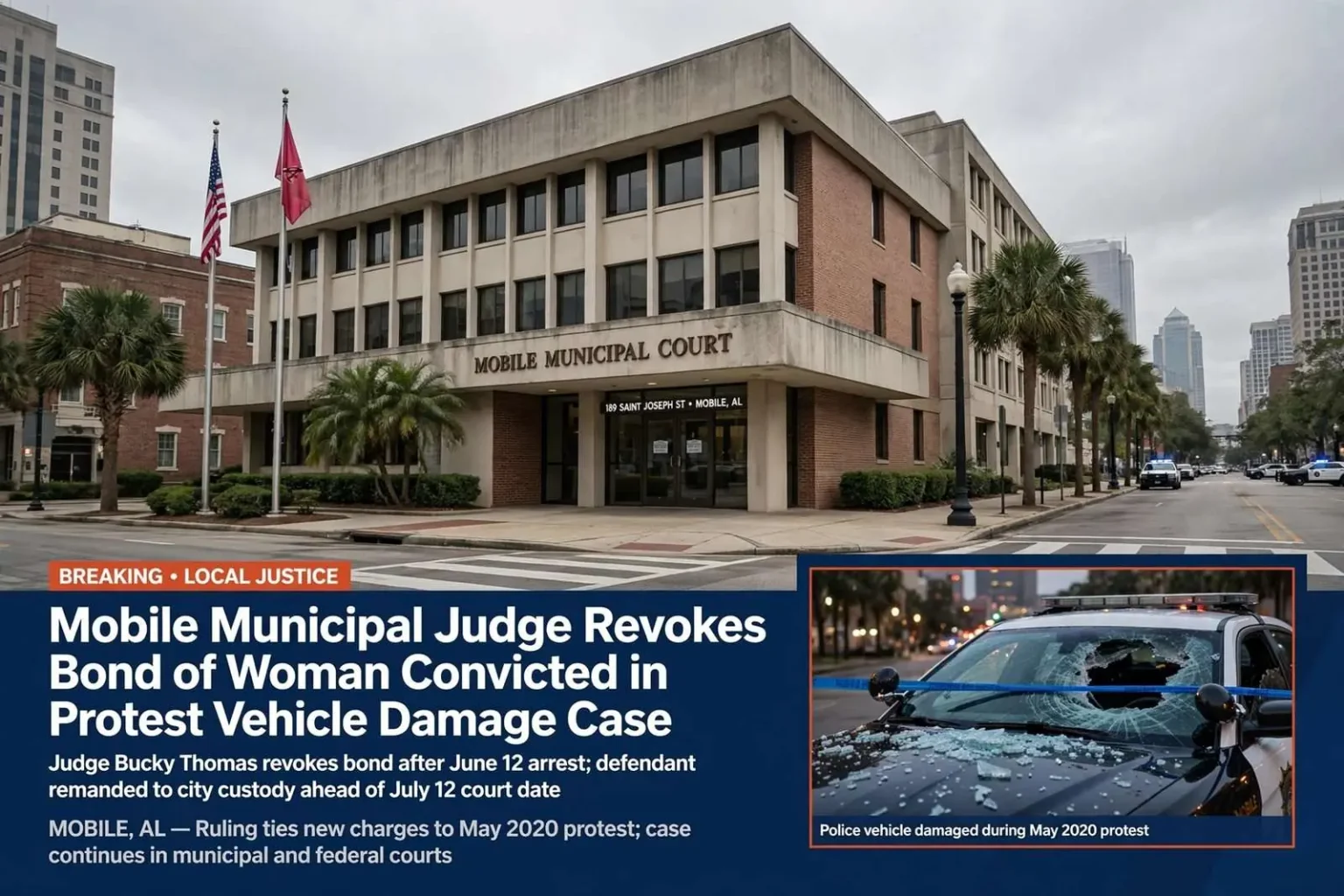
A Mobile municipal judge has ordered a woman back to jail ahead of trial, revoking her bond in a case tied to a May 2020 demonstration in downtown Mobile. The ruling adds a local custody order on top of an already complicated legal picture spanning both the city’s municipal court and a federal case connected to the same night of protest.
How the Bond Revocation Unfolded
Municipal Judge Bucky Thomas granted a request from city prosecutors to revoke the bond of Tia Deyon Pugh, whose original case stems from accusations that she smashed a window on a police vehicle during the protest. She is charged in municipal court with inciting a riot and criminal mischief. Bond revocation requests typically hinge on evidence that a defendant on release has committed a new offense or violated the conditions of release, and Thomas’s ruling followed exactly that pattern.
The revocation followed evidence of a separate arrest. Police took Pugh, 22, into custody on June 12 on charges including public intoxication, disorderly conduct, resisting arrest and possession of brass knuckles after what authorities described as a run-in with another person on Dauphin Street. The new charges put her before the same municipal court that was already managing her original case, and prosecutors moved quickly to ask that her freedom pending trial be withdrawn.
The May 2020 demonstration that underlies the original case arrived during a week of nationwide protest following George Floyd’s death in Minneapolis, when demonstrations in downtown Mobile drew hundreds of participants over several days. The overwhelming majority of those protests concluded without charges, but the incidents that did generate cases — including the alleged damage to a police vehicle — have moved slowly through the court system in the years since, a timeline that is not unusual for cases crossing municipal and federal jurisdictions.
In May, a federal jury convicted Pugh of impeding law enforcement during civil disorder in connection with the same 2020 protest incident. She awaits sentencing in that case, where the conviction carries exposure set by federal sentencing guidelines. After the June arrest, the judge overseeing her federal release conditions modified them but did not order her detained; the municipal court ruling now sends her back to jail pending resolution of the local charges, meaning she will remain in city custody even as her federal sentencing approaches.
The two-track legal situation illustrates how protest-era cases can accumulate across jurisdictions. The municipal charges — inciting a riot and criminal mischief — are handled in Mobile’s municipal court, which adjudicates violations of city ordinances and carries its own docket, judge and prosecutor’s office. The federal charge, impeding law enforcement during civil disorder, is a felony prosecuted by the U.S. Attorney’s office, and its conviction by a federal jury in May came years after the underlying events. The two systems run independently: an acquittal, conviction or plea in one does not automatically resolve the other, which is why Pugh faces sentencing in one court while still awaiting trial in another.
Bond revocation hearings of this kind move quickly because the question before the judge is narrow — whether new evidence justifies changing a defendant’s pretrial status. Thomas’s ruling means Pugh will prepare for both remaining proceedings from a jail cell rather than the community, a material change in her circumstances that defense attorneys typically challenge only when the underlying arrest can be distinguished from the release conditions. Here, the June 12 arrest on four new charges, including weapons possession, left little room for that argument.
Where the Case Goes From Here
What Comes Next
Defense attorney Marcus Foxx said the case would return to court July 12, with both sides hoping to reach a resolution. If prosecutors and the defense cannot agree on a plea by then, the matter will be set for trial. Convictions on the municipal charges carry penalties ranging from probation up to a year in jail — a range that reflects the municipal court’s limited sentencing authority, which is confined to shorter jail terms and fines compared with the felony-level exposure Pugh faces in her federal sentencing.
A negotiated resolution before trial would resolve the local case while leaving the federal sentencing as the controlling event in Pugh’s legal future. Plea discussions in cases like this one weigh the strength of the evidence, the new charges’ effect on the defendant’s credibility and the practical reality that a trial prolongs custody for a defendant already convicted federally. Foxx’s public framing — that both sides are hoping for resolution — signals the ordinary posture of a case heading toward a docket call rather than a contested proceeding.
The city prosecutor’s office did not immediately respond to requests for comment, leaving the state of negotiations unclear outside the courtroom. Municipal prosecutors in Mobile handle thousands of ordinance cases a year, and cases that attract public attention, like this one, follow the same procedural path: docket calls, negotiation windows and, failing agreement, trial settings before the municipal bench.
The Case’s Roots in 2020’s Unrest
The case’s origins trace to a period when Mobile, like cities across the country, was processing the aftermath of late-May 2020 demonstrations. Downtown’s protest marches drew broad participation, and the incidents that produced criminal cases have been sorted between the municipal and federal systems based on the conduct involved and the statutes implicated. The alleged smashing of a police vehicle window fell to the city’s ordinance charges, while the federal civil disorder charge addressed conduct impeding officers during the unrest.
Federal civil disorder prosecutions arising from 2020 protests unfolded nationwide over the following years, with juries weighing evidence gathered from body cameras, surveillance footage and social media. The May conviction in Pugh’s federal case placed her among the defendants nationally who were found guilty of impeding law enforcement during civil disorder, a charge that carries sentencing ranges shaped by guidelines accounting for the conduct and any prior record.
For the municipal court, the revocation order restores Pugh to custody under the local system’s authority, and her July 12 court date now functions as both a case-management milestone and the next checkpoint in a legal saga that has stretched more than two years since the night in downtown Mobile. Whether the July date produces a plea or a trial setting, the ruling from Judge Thomas ensures she will arrive at it in custody.
Legal observers note that cases spanning municipal and federal systems create practical complications for everyone involved: defense counsel coordinating strategy across two courts, prosecutors tracking how developments in one jurisdiction affect the other, and judges balancing release conditions set by different benches. Pugh’s case — with a federal jury conviction, a pending federal sentencing, new municipal charges and now a revoked bond — sits at the complicated end of that spectrum.
Understanding the Charges Involved
The municipal charges themselves carry context worth understanding. Inciting a riot, under Mobile’s municipal code, addresses conduct that urges or provokes disorderly group action, while criminal mischief covers the alleged property damage — in this case the police vehicle window. Both are violations of city ordinance rather than state felony statutes, which is why the matter stayed in municipal court and why the potential sentence tops out at a year in jail. Municipal courts across Alabama handle this tier of offense daily, and their dockets rarely draw public attention; this case’s federal parallel is what has kept it in the spotlight.
The brass knuckles possession charge from the June 12 arrest adds its own dimension. Alabama law treats brass knuckles as a prohibited weapon, and possession charges of that kind are typically misdemeanors handled quickly — but for a defendant on release conditions, any weapons-related charge weighs heavily in bond decisions. Combined with public intoxication, disorderly conduct and resisting arrest from the same Dauphin Street encounter, the new case gave city prosecutors the factual predicate for the revocation request Thomas granted.
The July 12 return date will clarify the local case’s trajectory. If a plea agreement materializes, the municipal case concludes with a sentence within the court’s authority — probation, fines or a jail term — and the focus shifts entirely to the federal sentencing. If it proceeds toward trial, the municipal case will run on its own timeline, with the defendant now in custody and her federal sentencing looming as the more consequential of her proceedings.
For Mobile, the case is a coda to the summer of 2020 that the city, like the rest of the country, has spent years processing. The May 2020 demonstrations produced a handful of prosecutions that have moved at the deliberate pace of the courts, and the participants involved have seen their cases mature alongside changed circumstances — new arrests, federal convictions and, now, revoked bonds. The municipal court’s ruling ensures that when the case returns on July 12, it returns with the defendant present and the local charges still awaiting their day of resolution.


