
Mobile Museum of Art to Host Multimedia Installation Blending Visual Art and Avant-Garde Music
The Mobile Museum of Art presented Projections and Reflections, a multimedia installation inspired by avant-garde composer John Cage.
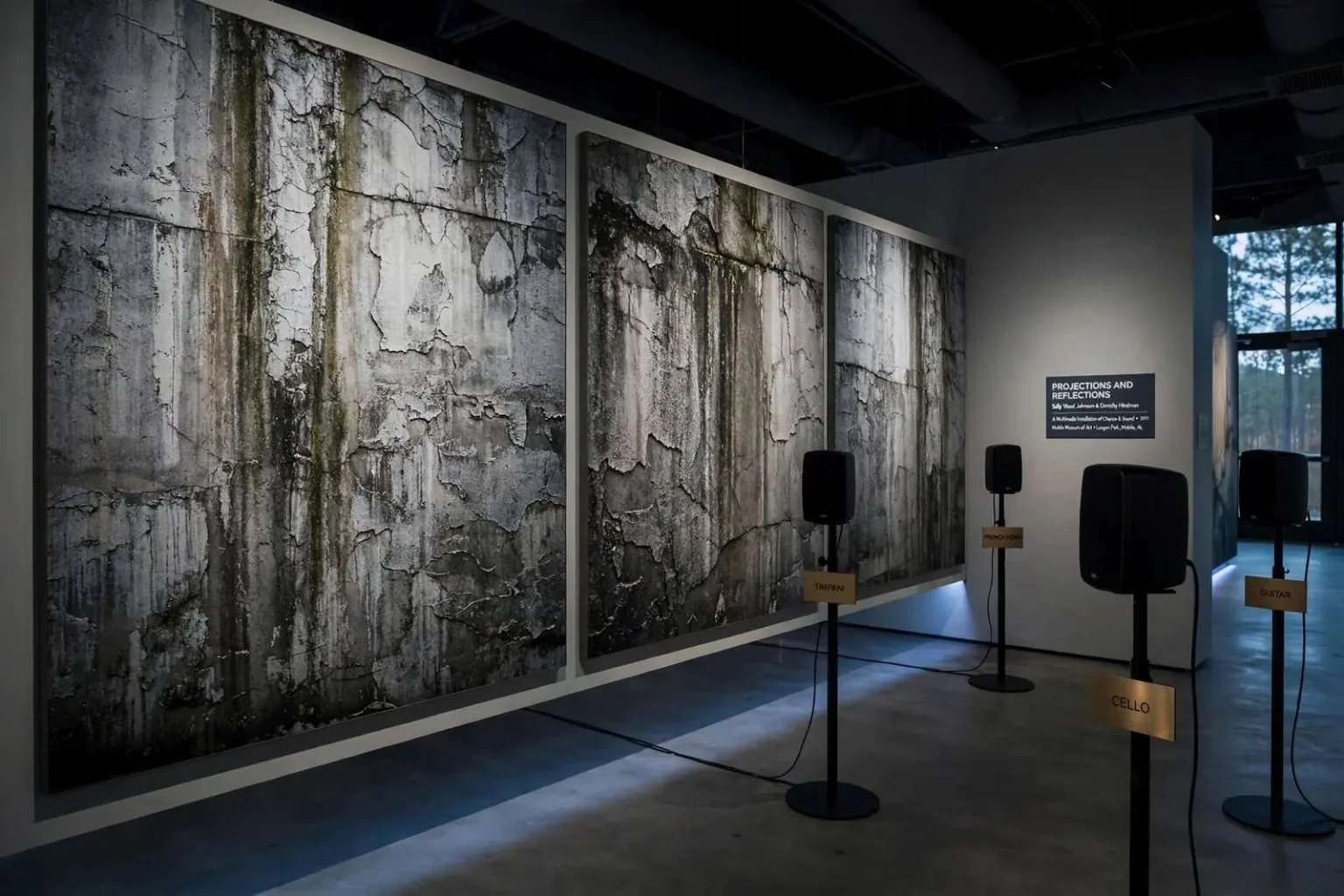
A Birmingham wall and a Boston-trained composer’s score will meet in a Mobile gallery this fall, as the Mobile Museum of Art presents Projections and Reflections, a multimedia installation running from October 14 through November 27, 2011. The exhibition pairs the visual artwork of Sally Wood Johnson with an original musical composition by Dorothy Hindman in a collaborative exploration of chance and indeterminacy in art.
Unlike a conventional exhibition, Projections and Reflections is built to be different on every visit. Its photographs do not change and its score never repeats the same way twice, and the museum has committed a gallery to the idea that the two will interact unpredictably — with each other, and with whoever happens to be standing in the room.
The shadow of John Cage
The installation draws its inspiration from composer John Cage (1912–1992), one of the most influential figures in avant-garde music. Cage’s pioneering theories of aleatory music — compositions shaped by elements of chance rather than predetermined structure — profoundly influenced not only music but also the worlds of visual art, dance, and theater throughout the twentieth century.
Cage spent his career dismantling the idea that a composer must control everything a listener hears. His chance-based methods — dice, coin tosses, divination texts — were not gimmicks but a philosophical position: that intention is only one ingredient in an artwork, and that randomness, noise and even silence belong in the frame. By the time of his death in 1992, those ideas had migrated from concert halls into galleries, dance studios and theater stages, shaping generations of artists who never wrote a note of music. Johnson and Hindman’s project continues that migration on the Gulf Coast.
Johnson and Hindman collaborated loosely on the project, allowing the unpredictable interactions between their respective art forms to shape the viewer’s experience in real time. The approach echoes Cage’s belief that the boundaries between art and everyday life should remain fluid and open to surprise. Neither artist finished her work with the other’s in hand; the two elements were designed to meet — and misbehave — only in the gallery itself.
The wall outside the studio
Johnson’s contribution centers on a series of photographs capturing the weathered textures and patterns of a concrete wall outside her Birmingham studio. These images, rich with the kind of accidental beauty that Cage championed, form the visual foundation of the installation. Nothing in them was composed: the stains, streaks and cracks record decades of weather working on poured concrete, a surface transformed by exactly the sort of unplanned processes Cage spent his career celebrating.
Hindman composed an original score for cello, French horn, timpani, and guitar, with each instrument played through a separate speaker positioned within the gallery space. The musical parts and instrumental tones interact stochastically — their combinations shift unpredictably — creating an indeterminate flow of sound that changes with every visit. No two listeners, and no two visits, hear the same balance among the four voices.
The timing of the exhibition also connects it to a broader season of Cage-related interest at museums nationwide. More than two decades after his death, Cage’s ideas continue to circulate through galleries and performance spaces, and installations that translate his methods into visual experience have become a recurring way for museums to introduce his work to audiences who may never attend an avant-garde concert. Mobile’s presentation joins that tradition, framing the composer’s philosophy through the work of two Southern artists who carry it into the present.
An installation that answers to chance
The result is an immersive environment where the random interplay of visual art, music, and the movements of visitors themselves all contribute to a constantly evolving experience. As Johnson describes it, the concrete wall that inspired her photographs was itself “one huge chance operation,” and the installation extends that philosophy into every dimension of the exhibit.
The mechanics of the show reward attention. Because each instrumental voice speaks from its own speaker, the sound field shifts as visitors move — a step toward the cello thins the guitar, a pause near the timpani changes everything around it. The photographs anchor the room visually, but the ear never settles, and that instability is the exhibition’s subject: a demonstration, in real time, that chance does not end when the artwork is finished but continues operating on everyone inside it.
Two artists, one idea
Johnson’s photographic practice has long attended to the textures of ordinary surfaces — the patinas, erosions and accidents that time writes on built things. The Birmingham wall photographs extend that attention to its logical end: a subject with no author at all. Enlarged and presented within the installation, the images ask how much of what we call beauty is simply pattern that no one planned.
Hindman’s music asks the complementary question from the other direction. A composer’s score is ordinarily the most controlled object in art — every note fixed in place — and her decision to let the four instrumental parts recombine without a fixed hierarchy surrenders exactly the control composers are trained to keep. The two positions meet at Cage’s old insight: that releasing control is not an abdication but a method, one that lets the world supply what intention cannot.
Their loose collaboration — separate studios, separate media, a shared philosophy — also mirrors the working relationships Cage himself favored. Throughout his career he produced some of his most consequential work by bringing a finished element into contact with another artist’s finished element and letting the combination take its chances. Projections and Reflections applies that model to a regional museum, with results that belong to the room in Langan Park and to no one else.
For Mobile audiences, the exhibition offers a rare encounter with sound art in a gallery setting. The Mobile Museum of Art on Museum Drive has long served as one of the Gulf Coast’s premier venues for visual arts programming, regularly hosting exhibitions that range from classical collections to contemporary and experimental work — and for six weeks in the fall of 2011, its galleries will double as an instrument, playing a composition that never finishes.
Docents and gallery staff, meanwhile, prepared for the practical questions a sound installation raises. Where a painting show draws questions about technique and provenance, an installation built on randomness draws questions about authorship: who decided what visitors hear? The honest answer — the score, the speakers, the visitors, and chance together — was itself part of the education the exhibition offered, and museum materials for the run emphasized that indeterminacy was not a defect of the presentation but its central design.
Planning a visit
The installation runs from October 14 through November 27, 2011, a six-week window that spans the museum’s fall season. Visitors should come prepared for a gallery that behaves differently from the painting shows around it: the sound is continuous, the room invites lingering, and the experience rewards repeat visits precisely because no visit settles the piece into a final form. School groups and casual visitors alike will find that the work explains itself less by labels than by time spent inside it.
The museum’s setting adds its own layer to the experience. The Mobile Museum of Art sits among the pines and lakes of Langan Park, the city’s largest, and a trip to the gallery doubles as an outing into a landscape whose own weathering — the same forces that wrote patterns on Johnson’s Birmingham wall — is visible everywhere around the building. The connection between the installation and its park setting is the kind of accident Cage would have appreciated.
Why it matters here
Exhibitions built on chance and sound remain uncommon at regional museums, which tend to program the traveling shows and collection-based exhibitions that draw reliable crowds. Presenting Projections and Reflections puts Mobile in the company of the larger institutions that have explored Cage’s legacy since his death, and it gives local audiences a first-hand answer to a question that is easy to state and hard to feel until standing inside it: what happens when a museum gives up control of its own gallery?
The answer, for six weeks in the fall of 2011, is a room where a Birmingham concrete wall and a stochastic score for cello, French horn, timpani and guitar keep negotiating with everyone who walks in. Johnson’s photographs hold still; everything else — the sound, the crowd, the hour, the visit — changes. That is the exhibition’s argument, made not in text but in the experience itself: chance, given a gallery, never runs out of material.
By the time the installation closes on November 27, the museum will have hosted hundreds of individual experiences of a single work — each one accurate, none of them repeatable. For the two artists and the institution presenting them, that is not a shortcoming of the format but the whole point of it.