Mobile Musician of the Month: Daryl Huffman Reflects on a Career That Started With The Versatiles
Mobile guitarist Daryl Huffman's career spans 1960s garage band The Versatiles, two decades touring with B.J. Thomas, and today's local club scene.
This month, South Alabama News looks back at the career of Mobile guitarist Daryl Huffman, whose musical roots trace back more than four decades to a local band called The Versatiles.
Huffman’s story is Mobile’s musical story in miniature: a teenager on the club circuit of the 1960s, a stint on the road with a national act, and a return to the local stages where it all began. Musicians like Huffman form the connective tissue of a city’s music history — the players who carried sound from one era to the next while audiences came and went around them.
In the mid-1960s, The Versatiles were a fixture on the Mobile club circuit, playing venues including The Happening and the Stork Club. The lineup featured Huffman on lead guitar and keyboards, Jerry Smith on guitar, David Smith on bass and P.J. Johnston on drums.
The Mobile club scene of that era was a thriving ecosystem. Gulf Coast port cities had absorbed rhythm and blues, British Invasion rock and soul music from radio and from traveling acts, and local teenagers responded by forming bands in garages and recreation rooms, then hustling for club dates. Mobile’s venues booked young groups regularly, giving bands like The Versatiles the stage time that sharpened them from hobbyists into working musicians.
A Distinctive Sound
According to music historians who have documented the era, The Versatiles released two singles on the Rickarby label. The first, released around 1967, paired an original song titled “Cyclothymia” — a nod to a mild form of manic depression — with a cover of a Brian Wilson-penned track.
The choice of material said a great deal about the band’s ambitions. An original title track was unusual for a teenage club band, whose income depended on playing the hits audiences recognized; recording original songs on an actual label marked The Versatiles as a group that wanted to be heard beyond the rooms where it performed. The pairing with a Brian Wilson composition tied the band to the most admired songwriting voice in American pop of the moment, the Beach Boys leader whose studio work was redefining what a rock record could be.
The band’s second single featured two songs written by Clarence “Tony” Previto, one with lyrics touching on the anxieties of the Vietnam War era and the other a lighter, more melodic tune.
The second single deepened the band’s original identity, with both sides written within the band’s orbit rather than pulled from the top-40 catalog. The Vietnam-era material placed The Versatiles among the many American bands of the period whose music absorbed the war’s presence — a conflict that hung over young men of their generation, whether or not they wore the uniform. The lighter B-side material reflected the same duality that filled their live sets: topical songs for listeners who wanted them, melodic crowd-pleasers for the dance floors that paid the band’s bills.
Unusually for a rock group of the period, The Versatiles had no single designated lead singer; band members sang their songs in unison across verse and chorus.
The unison vocal approach was a genuine rarity. Most bands of the era were built around a frontman — a single voice that identified the group on record and commanded the stage at night. Unison singing gave The Versatiles a blended, ensemble sound, but it also meant the band’s identity lived in its collective sound rather than in any one member, an arrangement that matched the group’s lineup stability and its emphasis on the material itself.
A Long Career in Music
After his time with The Versatiles, Huffman went on to spend roughly two decades performing with B.J. Thomas, the Grammy-winning singer best known for “Raindrops Keep Fallin’ on My Head,” before stepping away from that gig in the early 2000s.
The move from a Mobile club band to a nationally touring act’s band represented the career path that every teenage musician dreams of and few achieve. B.J. Thomas, a Gulf Coast native whose career included multiple gold records and five Grammy Awards, toured constantly, and a sideman position in that operation meant years of venues, travel and recording sessions far from the Mobile stages where Huffman had learned his craft. “Raindrops Keep Fallin’ on My Head,” the Burt Bacharach and Hal David song that topped American charts in 1970 and won an Academy Award for its film appearance, made Thomas a household name and kept his touring calendar full for decades.
Two decades is an extraordinarily long tenure for a sideman. Touring bands turn over constantly — players leave for family, for other gigs, for careers off the road — so a guitarist who held a seat for roughly twenty years became part of the act’s musical identity, the player audiences heard night after night and the colleague the bandleader trusted with the sound.
Stepping away in the early 2000s closed that chapter but did not end the working life. Huffman returned to what he had started with: Mobile stages.
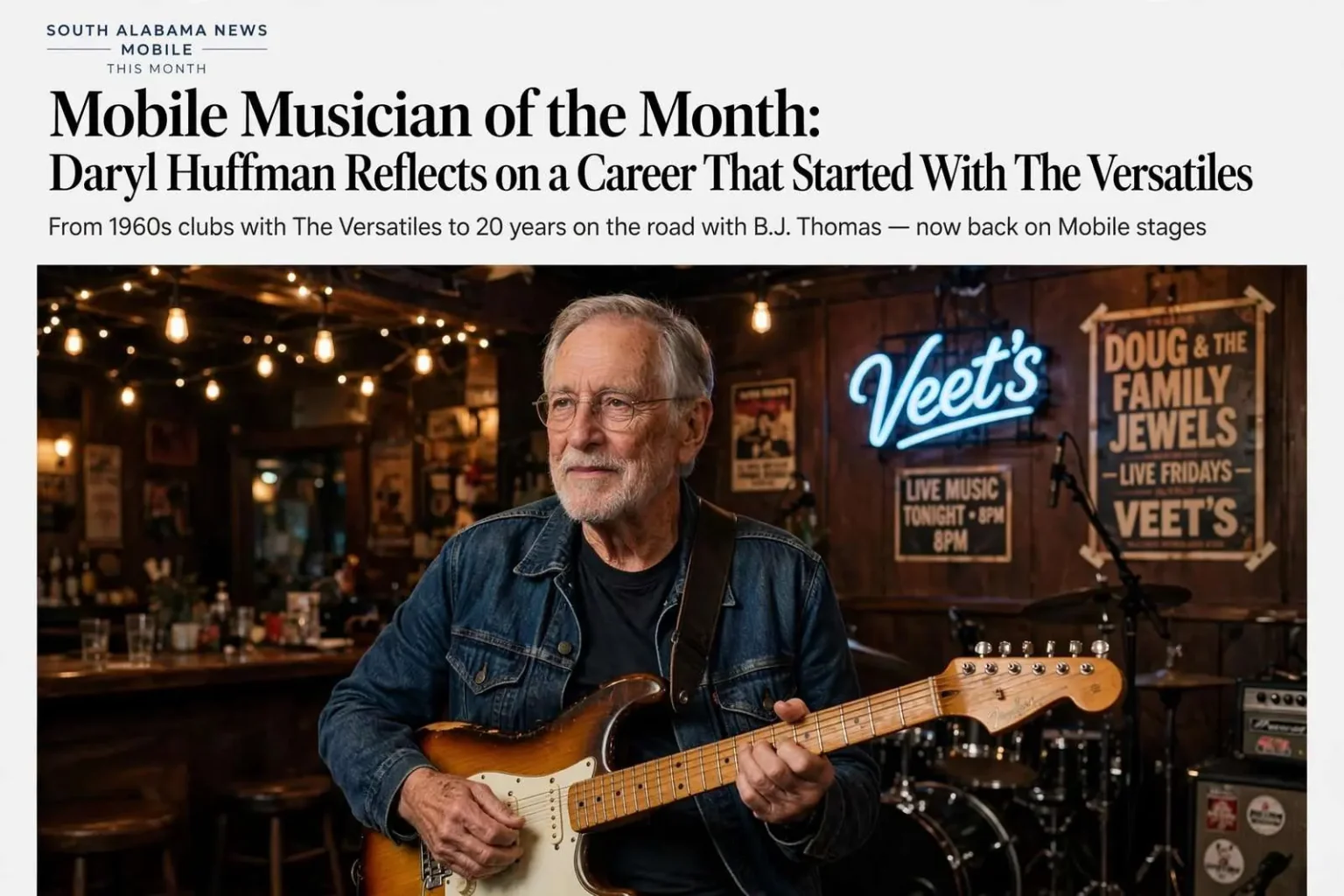
These days, Huffman continues to perform locally, playing alongside Doug Previto in the band Doug and the Family Jewels, known for regular appearances at Veet’s in Mobile.
The connection across the decades runs through the Previto name. Clarence “Tony” Previto wrote the songs on The Versatiles’ second single, and Doug Previto shares the stage with Huffman today — the kind of continuity that threads through Gulf Coast music scenes, where families in music are common and working relationships span generations.
Veet’s, the venue where the band plays regularly, belongs to the category of neighborhood nightclubs that sustain local music between the big events — the rooms where working musicians play weekly, where the audience knows the band by name and where a four-decade career stays alive night by night. Cities that support live music are held up by venues like it, as much as by the concert halls and festival stages that get the headlines.
Huffman’s decades-long run — from a scrappy 1960s garage band to two decades on the road with a national touring act, and now back to Mobile club stages — reflects the kind of deep, often under-the-radar musical history found throughout the city’s club scene.
Mobile’s 1960s Band Scene, Remembered
The Versatiles belonged to a generation of Gulf Coast bands whose story has been preserved largely through the work of music historians and collectors. Regional labels like the Rickarby imprint pressed small runs of singles by local groups, selling a few hundred copies at shows and through neighborhood record shops, and then vanished from the marketplace — leaving behind records that decades later became prized artifacts for collectors of regional garage rock and Southeastern pop.
Those recordings document something the hit parade never captured: what teenagers along the Gulf Coast were actually playing and writing in the 1960s. Original songs about the anxieties of the Vietnam era, sung by a band with no frontman, recorded on a Mobile label — that is local history pressed into vinyl, and it survives because historians took the trouble to document who played on it and where it was sold.
The venues where those bands worked have their own afterlives in memory. Club stages along Mobile’s entertainment corridors came and went with the decades, but for the musicians who played them, the rooms — The Happening, the Stork Club and their contemporaries — were classrooms as much as workplaces, the places where young players learned arrangements, audience sense and the stamina that a life in music requires.
What a Career Like Huffman’s Adds Up To
Careers in music rarely follow straight lines, and Huffman’s path makes the point. A bandleader’s resume is measured in one direction — fame, records, hits. A working musician’s resume reads differently: club dates mastered, national tours sustained, and a return home that keeps the music alive in the rooms where it started.
There is a case to be made that the second kind of career matters as much to a city as the first. Mobile’s music culture — its club scene, its dance floors, its generations of weekend bands — depends on players who stay, who teach by example, and who keep showing up at the neighborhood venues that audiences can reach on a weeknight. A guitarist who spent two decades with a Grammy-winning headliner, playing that experience back into local rooms at a stage of life when most musicians have retired, is doing cultural work that gets noticed only when someone looks back.
That is the purpose of looking back now. The Versatiles’ singles, the unison vocals, the club circuit of the mid-1960s, the two decades on the road with B.J. Thomas, and the current run with Doug and the Family Jewels at Veet’s together form a single continuous story — Mobile music, played by Mobile musicians, from the 1960s to the present night. Daryl Huffman has been on stage for all of it, and the city’s club scene is richer for the decades he has put in.